
Two insulation tests can produce the same PI ratio from very different resistance readings. With the VICTOR VC960B insulation tester, keep the absolute values and their elapsed times beside the ratio. The ratio describes a relationship between observations; it does not preserve every fact needed to judge the insulation.
This is particularly useful when a maintenance report contains one impressive-looking number but omits the readings used to calculate it. Before comparing assets or visits, reconstruct the measurement behind the result.

Store application image: the test boundary and equipment state must be established before connection.
Start with the exact ratio definition
The VC960B lists PI/DAR, timed-test controls, automatic discharge and five insulation test voltages: 50, 100, 250, 500 and 1000 V. Choose the voltage and procedure from the equipment requirements. The presence of several settings is not a reason to increase voltage until a result looks more decisive.
Check the supplied manual for the time points used by each automatic ratio mode. PI commonly compares ten-minute and one-minute resistance; DAR conventions can differ. A value labelled “ratio” is incomplete without the numerator, denominator and their elapsed times.
Keep the test boundary, temperature and relevant equipment conditions too. A changed cable connection or a still-connected control assembly can make apparently similar tests describe different objects. Isolation, sensitive-equipment disconnection and the test/discharge sequence require the appropriate competent procedure.
Compare these two teaching examples
Assume both examples use the same ten-minute/one-minute definition. They are illustrative arithmetic, not VC960B measurements or acceptance recommendations.
| Example | One-minute resistance | Ten-minute resistance | Calculated ratio |
|---|---|---|---|
| A | 20 MΩ | 40 MΩ | 40 ÷ 20 = 2.0 |
| B | 200 MΩ | 400 MΩ | 400 ÷ 200 = 2.0 |
The ratios are identical, but the absolute resistances differ by a factor of ten. Reporting only “PI 2.0” removes that distinction. Neither row can be labelled a pass or fail without the equipment-specific criteria and relevant conditions.
The reverse problem also occurs: two tests can finish at the same resistance while starting from different values. A final number and a ratio therefore answer different questions. Preserve both rather than choosing whichever makes the report look better.
Check units before checking the conclusion
If one recorded value is in MΩ and another in GΩ, convert them to the same unit before calculating. For example, 0.40 GΩ is 400 MΩ. Dividing the bare display numbers 0.40 by 200 would produce a meaningless result if the units were ignored.
The ratio itself is dimensionless because the resistance units cancel. A ratio of 2.0 should not be written as “2 MΩ”. Keep the instrument's displayed unit on each underlying resistance reading and the ratio in its own field.

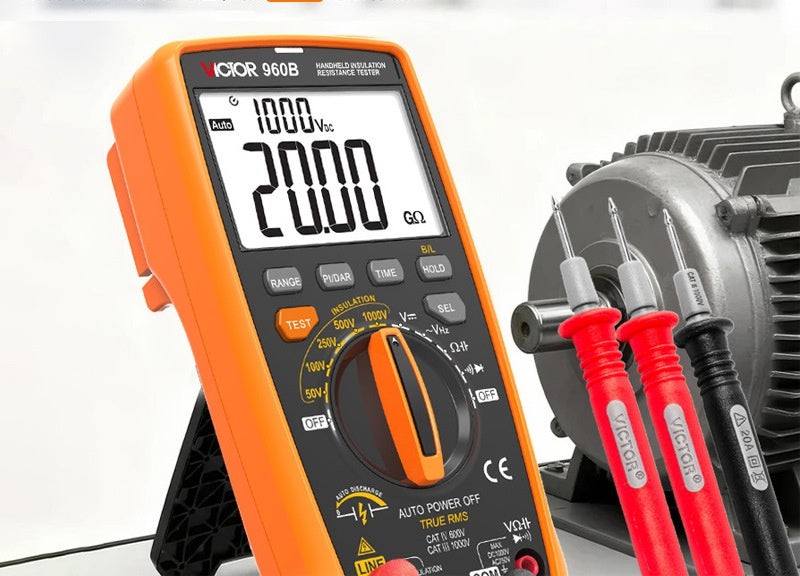
Promotional display illustration; the shown number is not a measured result from this guide.
Do not calculate through an unknown reading
The VC960B listing gives an insulation display maximum of 20.00 GΩ. That endpoint is not a value you may substitute whenever the instrument shows over range. If one required time point is outside the measurable range, the true resistance at that time is not known precisely enough for an ordinary numerical ratio.
Record the actual indication, selected voltage, range and elapsed time. Do not turn “over range” into 20.00 GΩ just to complete a spreadsheet. Likewise, a missed reading cannot be replaced by zero or by a value taken at a different time without changing the meaning of the calculation.
Very high resistance, noise, changing conditions or the insulation system's characteristics can also limit the usefulness of a ratio. More apparent digits do not resolve those issues.
Read the history, not a universal colour code
A rising resistance sequence can be consistent with changing charging and absorption currents during the test. Its interpretation depends on the asset, method and conditions. A stable or falling sequence requires appropriate investigation, but no universal “good/bad” table should replace the equipment's assessment criteria.
For a repeat visit, first match boundary, voltage, timing and relevant temperature conditions. Then compare the absolute readings and ratio together. If a condition changed, retain it as an explanation to investigate rather than silently treating the numbers as a deterioration trend.
Close the physical test as carefully as the calculation
The listed automatic-discharge feature does not replace verification that the circuit is safely discharged. Complete the required discharge, restoration and connection checks before returning the asset to service.
See the VICTOR VC960B product page for the current configuration and the related insulation guide for the underlying concepts. A useful ratio report lets the next reader reconstruct the calculation and understand its limits.
Explore the VICTOR VC960B
See its functions, suitable tasks and key limits before choosing.