
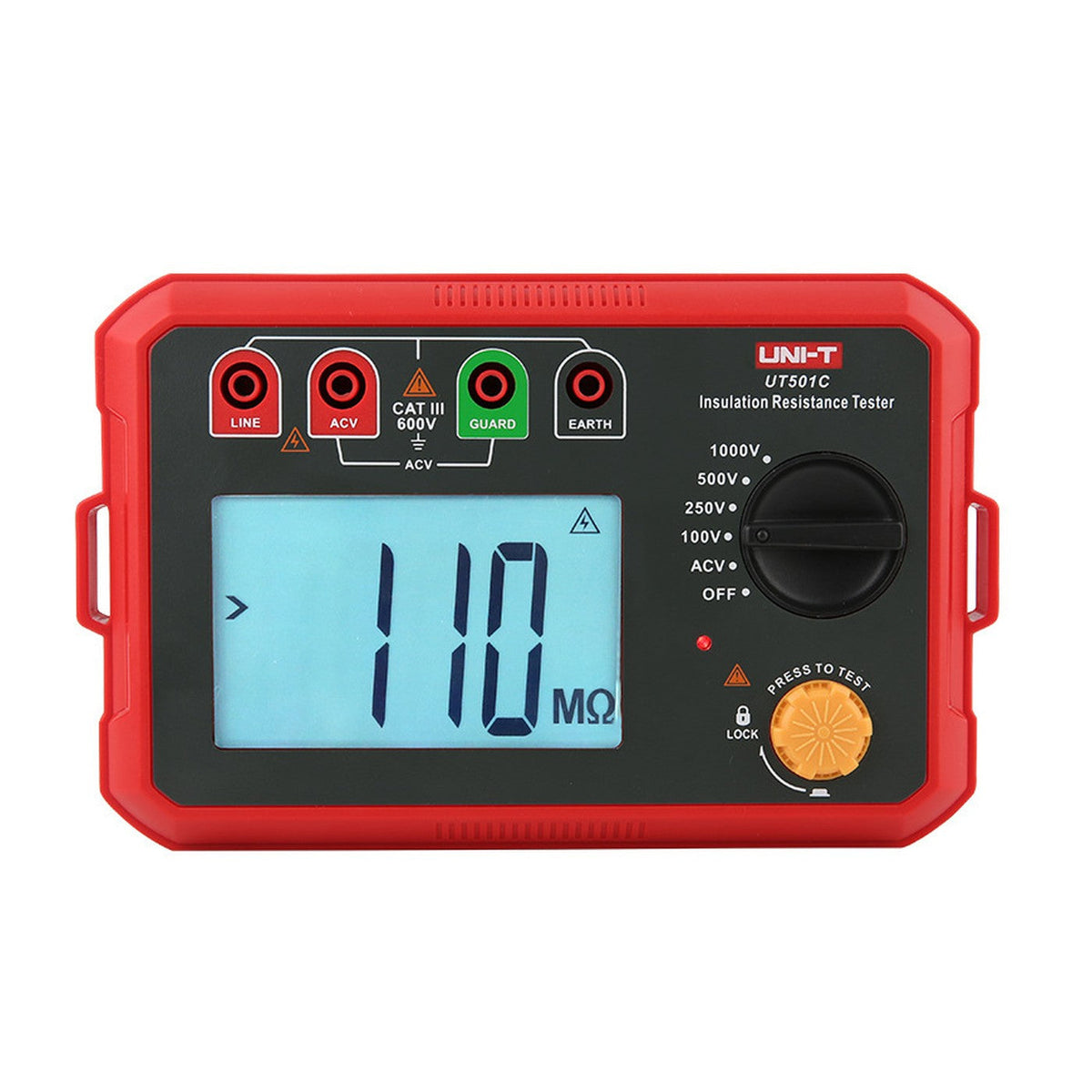
Pressing early is the usual mistake. The UNI-T UT501C is an insulation resistance tester with selectable 100V / 250V / 500V / 1000V outputs, a listed insulation span up to 5.00GΩ on the 1000V range, ACV 30V–750V (50/60Hz), and CAT III 600V. Before you compare two readings — or trust one number on a job sheet — isolate and discharge, match the test voltage, connect LINE and EARTH correctly, then PRESS TO TEST.
Higher voltage is not automatically “more thorough.” Match the voltage to the insulation class and the method you are following. If a listing or poster shows UT502C or UT501A/B/E, confirm the face dial (1000 / 500 / 250 / 100 / ACV / OFF) and the UT501C marking before you buy.
Isolate and discharge before you connect
- Confirm the circuit under test is isolated from supply and stored energy has been discharged by a safe method.
- Verify residual voltage with a suitable check — on this instrument, the ACV dial position covers about 30V–750V at 50/60Hz for that residual check.
- Only then connect the test leads. Do not treat PRESS TO TEST as a live-work shortcut.
- Stay within the listed CAT III 600V limits and the warnings in the supplied manual.
A neat HOLD capture does not repair a connection made on an undischarged circuit.
Match the test voltage, then connect LINE and EARTH
- Turn the dial to 100, 250, 500 or 1000 to match the insulation class and the method — not by habit to the top gear.
- Connect LINE and EARTH as the manual diagram shows for the points under test.
- Add GUARD only when the method needs a guard path to reduce surface-leakage influence.
- Keep the same voltage and connection pattern when you compare points on the same job.
Insulation ranges by voltage (UNI-T): 100V → 0.00MΩ–100MΩ; 250V → 0.00MΩ–500MΩ; 500V → 0.00MΩ–2.00GΩ; 1000V → 0.00MΩ–5.00GΩ. Accuracy listed 0.00MΩ–99.9MΩ ±(3%+5) and 100MΩ–5.00GΩ ±(5%+5). Wrong voltage or wrong terminals make those figures meaningless for your comparison.
PRESS TO TEST — then wait for discharge
- Return the dial to the chosen insulation voltage after any ACV residual check.
- Press PRESS TO TEST (self-lock as the manual allows) and wait for a stable auto-range reading.
- Record the value with voltage, terminals used, and point identity.
- Release the test, allow auto discharge to complete, then disconnect.
Short-circuit current is listed about <2mA; rated test current about 1.0–1.1mA. Treat the leads as part of a high-voltage test path until discharge finishes.
Keep ACV and insulation ranges separate — and stay on UT501C
ACV on this dial is a residual-voltage aid, not a full multimeter workflow and not an insulation reading. Do not leave the dial on ACV and expect an MΩ/GΩ result.
This page is UT501C only — not UT502C, not UT501A/B/E. Different suffixes bring different ranges, kits and markings. Confirm the model before you reuse a procedure written for another instrument.
Record enough context to reuse the number
Keep with each reading: test voltage, LINE/EARTH (and GUARD if used), point identity, date, and whether ACV was checked first. A stored Hold value without that context is hard to defend later.
For product context before you buy, see the UNI-T UT501C overview and the buying page (£89.99, free UK delivery). Always follow the supplied manual for connection diagrams, accuracy conditions, category limits and operating warnings.