Short answer: Put a few drops of distilled water at room temperature on the prism, then turn the adjustment screw until the boundary line sits exactly on zero. For full confidence, check the reading against a known sugar standard, ideally at 20 °C.
What does calibrating a refractometer actually do?
A refractometer measures how much light bends as it passes through a liquid. Dissolved sugars and other solids increase that bending, and the scale converts it into a reading, most often in °Brix. Over time the optics can shift slightly from knocks, temperature changes or handling. Calibration resets the scale so that pure water reads zero.
Instrument manuals describe zeroing with water as a routine check before each session. A full verification uses a solution of known concentration that falls inside your working range.
What do you need?
- Distilled or deionised water (tap water contains dissolved minerals)
- A soft lint-less cloth or lens tissue
- A pipette
- The small screwdriver supplied with the instrument (handheld analogue models)
- Optionally, a certified sucrose standard or one you have accurately mixed yourself
- A thermometer, if your model has no automatic temperature compensation (ATC)
Why does temperature matter so much?
Refractive index changes with temperature, so the same juice gives a different reading on a cold morning than in a warm packhouse. Scales are normally referenced to 20 °C. Models with ATC correct for temperature automatically within a stated range, often around 10 to 30 °C. Check your manual for the exact range.
Even with ATC, let the instrument, the water and the sample all reach the same temperature before you start. If your refractometer has no ATC, either calibrate and measure at 20 °C or apply the manufacturer's correction table.
How do you zero a handheld analogue refractometer?
- Clean the prism. Lift the daylight plate and wipe both glass surfaces dry.
- Apply water. Put two or three drops of distilled water on the prism, enough to cover it.
- Close the plate. Lower it gently so the water spreads in a thin even film with no bubbles. Bubbles or dry patches blur the boundary line.
- Wait about 30 seconds. This lets temperatures equalise, which is especially important with ATC models.
- Look through the eyepiece. Point the front at a bright light, then focus the eyepiece until the scale is sharp.
- Adjust. Turn the calibration screw until the line between the light and dark fields sits exactly on 0.
- Dry and confirm. Wipe the prism, repeat steps 2 to 5, and make sure the reading still sits at zero.
How do you zero a digital refractometer?
Digital models replace the screw with a "zero" or "cal" button. Fill the sample well with distilled water, press the button and wait for confirmation on the display. Wipe the well dry before you add a sample.

How do you check the instrument against a standard?
A water zero only proves the bottom of the scale. To trust readings higher up, measure a solution of known concentration:
- Use a certified standard. These come with a stated value and an expiry date.
- Or make your own. Dissolve a weighed amount of sucrose in water so that the sugar makes up a known percentage of the total mass. For example, 10.0 g of sugar plus 90.0 g of water gives a 10 % solution, which reads close to 10 °Brix. Use an accurate balance.
If the reading is outside the tolerance in your manual, clean the prism, re-zero and test again. If it is still out, the instrument needs servicing.

How often should you calibrate?
- Zero with water at the start of each session, and again if the temperature changes noticeably.
- Check against a standard periodically, for example monthly or at the start of each harvest, and after any drop.
- Keep a simple log of the date, temperature and result. Quality schemes often ask to see one.
Why do readings keep drifting?
- Residue left on the prism. Sugars dry into a film. Rinse with distilled water and dry.
- Scratched prism. Never use abrasive cloths or metal pipettes.
- Temperature not equalised. Wait longer, or work in the shade.
- Fuzzy boundary line. Usually caused by bubbles, too little sample, or a cloudy sample. Strain pulpy juices.
- Wrong scale. A sea-water salinity or urine specific-gravity scale will not give Brix values.
How should you look after a refractometer?
Clean the instrument straight after each use, keep it in its case, and don't immerse it in water unless the manual says it is waterproof. Store it away from heaters and direct sun.
FAQ
Can I calibrate with bottled mineral water? No. Minerals raise the reading slightly. Use distilled or deionised water.
My ATC model reads 0.2 °Brix on water. Is that acceptable? Re-zero it. If the offset comes back, check the tolerance in your manual.
Does calibration differ for honey or high-Brix refractometers? Yes. Many high-range scales do not reach zero, so they are calibrated with a supplied oil or block of known value. Follow the instrument's own instructions.
Is a Brix reading the same as sugar content? It is close for pure sucrose solutions. In real juices, acids and other solids contribute to the reading, so treat it as total dissolved solids.
Sources
- Cole-Parmer, handheld refractometer instruction manual (zeroing with distilled water, ATC, 20 °C reference): https://pim-resources.coleparmer.com/instruction-manual/81150-23-to-47-manual.pdf
- ITM, Model BX-20 refractometer manual (calibration procedure): https://www.itm.com/pdfs/cache/www.itm.com/43011/manual/43011-manual.pdf
- CASRAI, "Refractometer calibration and zeroing" (certified standards and verification intervals): https://www.casrai.org/guides/refractometer-calibration-and-zeroing
Related products: Moisture Meters & Refractometers
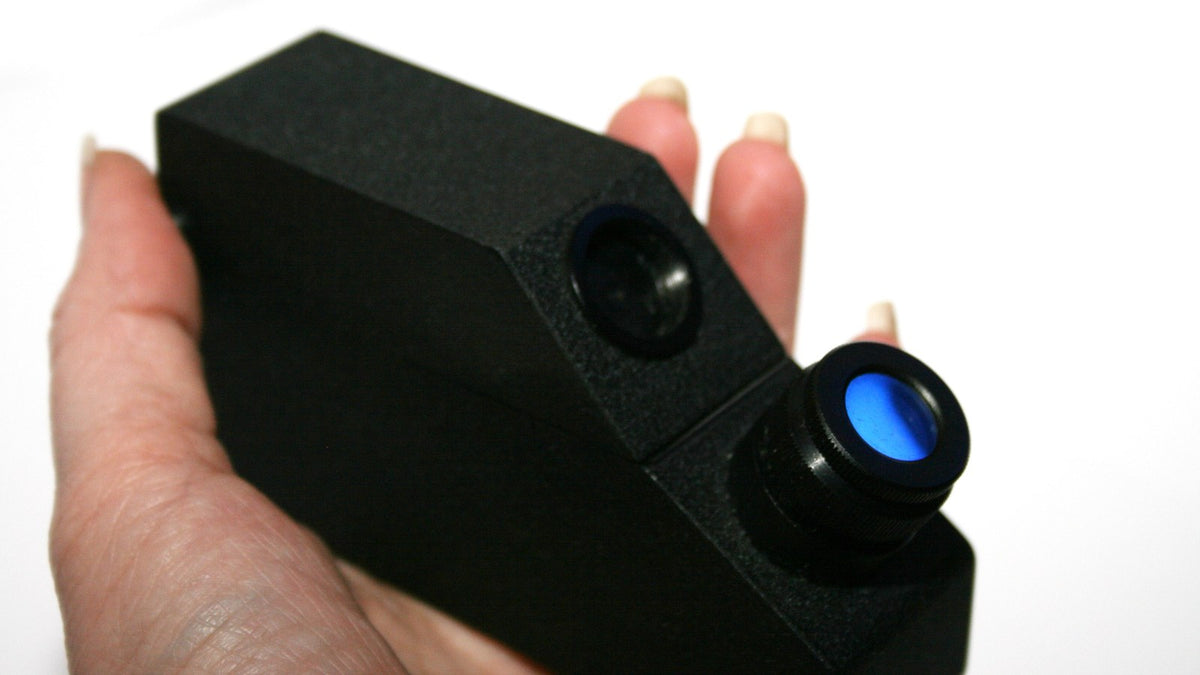
Cover photo: Humanfeather / Michelle, CC BY 3.0 via Wikimedia Commons
Photo in article: Fernando G. (FGM), CC BY-SA 3.0 via Wikimedia Commons