
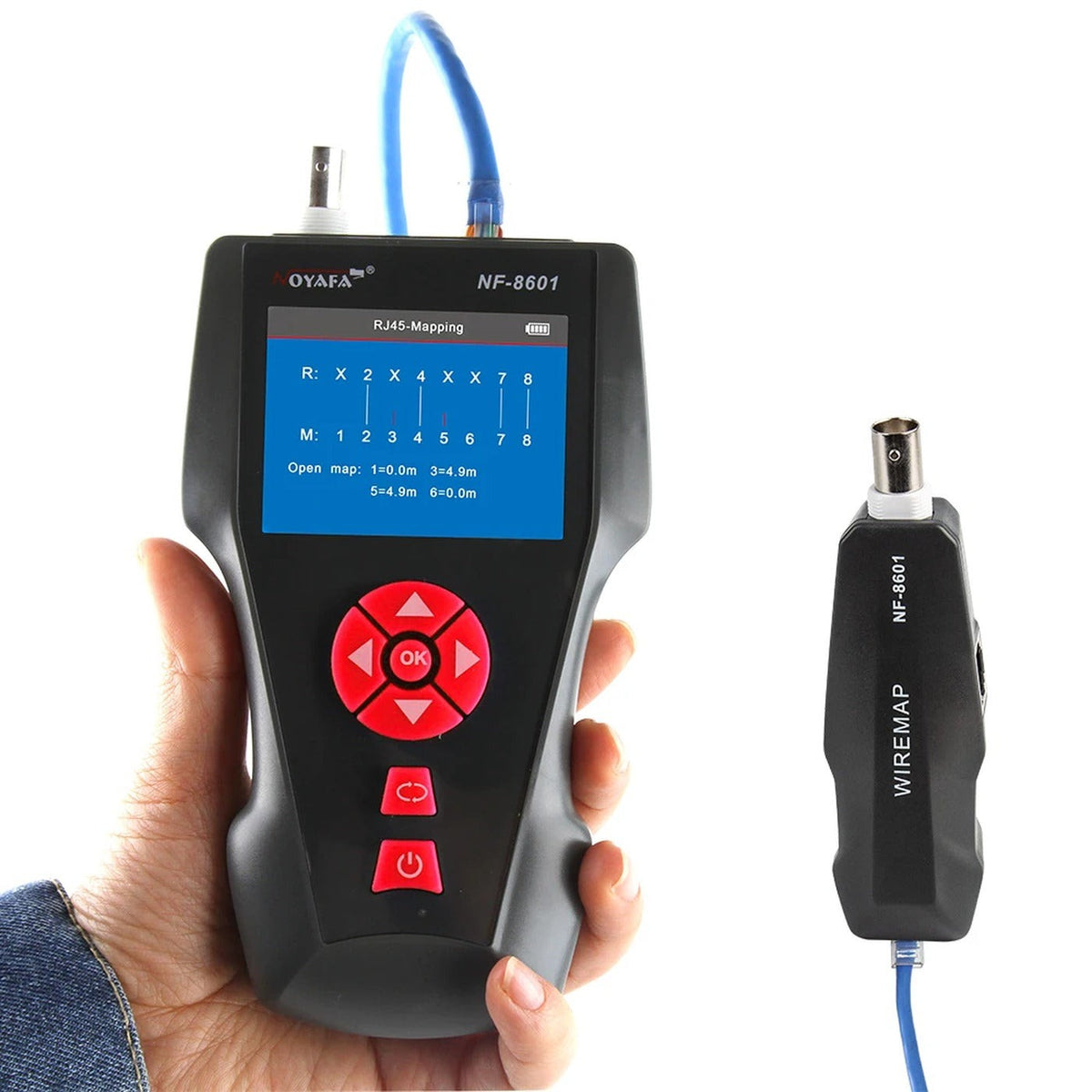
A cable tester's length reading is an estimate of cable length under a selected measurement setup. It is not automatically the distance between two rooms. With the NOYAFA NF-8601, calibrating against a known piece of the same cable type helps make that estimate more useful, while a clear route record explains the difference between electrical length and the installation you can see.
The NF-8601 lists a 5–2000 m length range with on-device calibration, alongside wiremap, tracing, PING, PoE and port-flash functions. Use those functions separately to identify the run before interpreting its length.

Product demonstration of a cable check; retain the calibration and connection arrangement with a length result.
Start with a reference that resembles the installed cable
Cable construction affects the relationship between an electrical measurement and physical length. A reference should therefore be a known, accurately measured piece of the same relevant cable type, ideally from the same stock. An arbitrary patch lead is not necessarily a good calibration reference for a different solid-core installation cable.
Follow the NF-8601 manual's calibration sequence and requirements for reference length and connection state. Record which cable was used, how its physical length was established and which setting was saved. Do not assume a calibration made for one cable family automatically applies to another.
If you cannot establish a suitable reference, retain that limitation with the estimate. A displayed decimal does not remove uncertainty about the setup.
Keep route distance, installed cable and spare loops separate
Consider a planning example: a route drawing shows 22 m between the outlet and cabinet, while service loops and vertical drops add cable beyond that drawn distance. A length reading above 22 m may therefore be reasonable. It does not immediately indicate a tester fault.
Conversely, a reading shorter than the expected run may justify checking the cable identity, connection, calibration and possible fault location. Interpret it with the corresponding wiremap result and the manual's length/fault indications. Do not assume that every displayed length is necessarily the far end of an intact cable.

Use a suitable known cable reference and label the actual run before saving a record.
Build a repeatable length record
| Field | Example of the information needed |
|---|---|
| Cable ID | Outlet and patch-panel labels |
| Cable construction | Relevant category/type and stock reference |
| Calibration reference | Known sample and saved setting |
| Test arrangement | Connector type and far-end condition |
| Result | Displayed length and any pair/fault indications |
| Physical context | Route, drops and accessible spare loops |
The NF-8601 supports RJ45, RJ11 and BNC-related work, but connector support does not make every mode identical across those interfaces. Use the method appropriate to the cable and the instrument documentation. Do not connect high-voltage lines or assume that a supported live-network mode permits every other test on the same powered connection.
Use saved records as evidence, not anonymous numbers
The reviewed model lists up to 160 saved records with TXT export to a computer. Rehearse saving and exporting a small test before relying on the workflow for a whole building. Confirm what the file contains and whether the cable labels you need appear automatically or must be added to your job sheet.
Keep original exports alongside the human-readable route schedule. If a result is repeated after a termination change, label the before and after records. Replacing the first value without retaining the reason can make a later investigation confusing.
Do not convert length into a performance promise
A plausible length and correct wiremap are useful, but neither proves a particular Ethernet throughput or cable-category compliance. High-frequency performance, endpoints and the installation method remain separate questions. Use the appropriate certification equipment when that is the required deliverable.
The 2000 m listed measurement range is also not a promise of Ethernet service over a 2000 m copper channel. It describes the tester's function, not the network design limit.
Finally, confirm the exact NF-8601 version. NF-8601S, W and A are distinct products; a feature shown for one of those variants should not be copied into the base model's workflow.
Review the NOYAFA NF-8601 product page for the current kit. Our accuracy and calibration guide provides background on why a reference and a documented method improve the meaning of a displayed value.
Explore the NOYAFA NF-8601
See its functions, suitable tasks and key limits before choosing.