
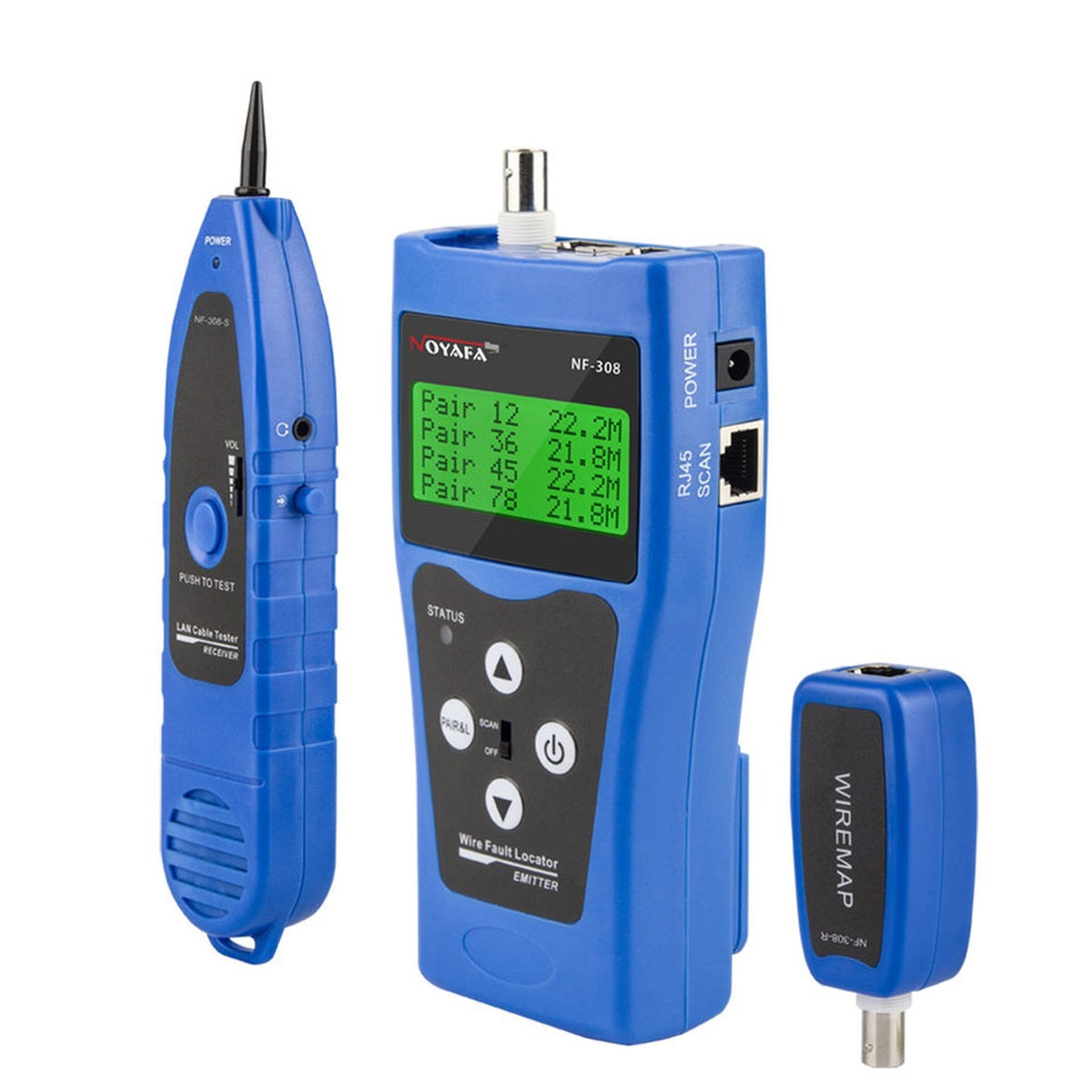
The fastest way to lose time in a multi-room cable tidy-up is to label a run before its identity has been confirmed. The NOYAFA NF-308 supports remote identifiers numbered 1–8, along with tracing, wiring checks and length measurement. Use the identifiers to build a room-to-panel map, then record the wiring result as a separate property of each run.
A label tells you where the cable goes. It does not tell you that the cable works correctly.

Remote-ID support does not guarantee that eight remotes are included in the current kit.
Inventory the kit before planning eight rooms
Support for IDs 1–8 does not mean that every current NF-308 package includes eight remotes. Check the supplied accessories and the manual's supported remote types. If the kit contains fewer, work in small labelled groups rather than assuming missing identifiers are present.
Also distinguish kit markings from model names. The listing notes NF-308-S and NF-308-R accessory labels; those do not turn the main unit into the separate NF-308S product line. Keep the main tester, receiver and remotes identified in the equipment record.
Give temporary labels a controlled meaning
Prepare a room schedule before connecting anything. A useful label describes the physical location, such as “Study, north wall, left socket”, rather than only an arbitrary number. The remote ID is then a temporary bridge between that location and the panel port.
| Room location | Remote used | Panel port found | Wiring result | Final label |
|---|---|---|---|---|
| Study, north wall, left | Record actual ID | To confirm | To record | Apply after verification |
| Bedroom, desk outlet | Record actual ID | To confirm | To record | Apply after verification |
| Hall, access-point outlet | Record actual ID | To confirm | To record | Apply after verification |
This blank schedule prevents an ID number from becoming a permanent room name by accident. Do not move a remote to the next location until its current result has been recorded or explicitly marked unresolved.

Example mapping sheet only. Confirm each port and its wiring status before applying a permanent label.
Map first, then investigate the wiring
Disconnect the run from equipment as required for the selected mode. Confirm the remote identity at the panel, then use the supported wiring check to investigate opens, shorts, reverses or crosses. Record the actual display, not just a tick marked “tested”.
If identity is uncertain, use the tone receiver under the permitted connection conditions to narrow the search. A tone heard on a cable bundle is not enough to assign the final label: confirm the candidate end. Where the installation is busy, a second pass from the room back to the panel is a useful check against a transcription error.
The NF-308 also lists twisted-pair length measurement of approximately 1–350 m with user calibration. A length estimate can expose a surprising route or support planning, but it is not a measured floor-plan distance and does not certify network performance.
Treat each connector family on its own terms
The product supports RJ45, RJ11, BNC and USB-related tracing or continuity tasks. Check the exact mode, cable arrangement and adapters required. Connector support is not a claim that every function works identically on every cable.
For someone searching for a USB cable tester, the distinction is particularly important. Continuity can identify certain connection faults, while signal integrity concerns high-speed electrical behaviour. A continuity pass does not establish USB data rate, USB-C power negotiation or a cable's safe power rating. The NF-308 is not presented here as a USB protocol or signal-integrity analyser.
Similarly, the reviewed NF-308 functions do not establish PoE analysis or PING. Use suitable separate tools when the question moves from cable mapping to live-network service.
Finish with a map that survives the next visit
Apply final labels at both ends, keep the room schedule and retain unresolved results. Separate “identified” from “wiring checked” and “service verified”. Those three states stop a future technician from assuming that every labelled socket was fully commissioned.
See the NOYAFA NF-308 product page for the actual package and accessory information. Our measurement basics guide explains the wider difference between an indication and the conclusion it can support.
Explore the NOYAFA NF-308
See its functions, suitable tasks and key limits before choosing.