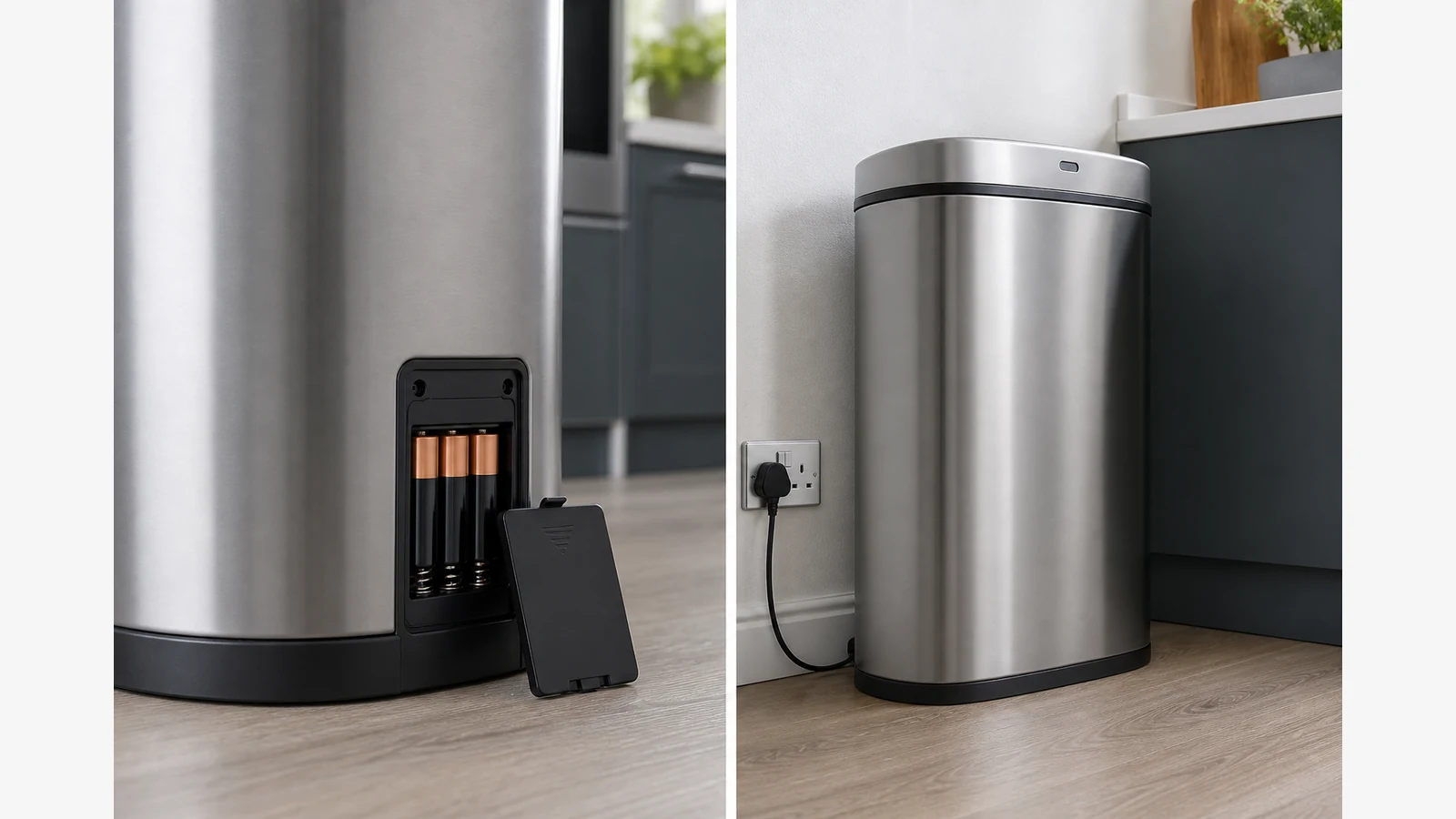
Rechargeable Vs Battery Sensor Kitchen Bin Uk
Pick a battery sensor bin when you need cable-free placement; pick a rechargeable or charge-capable model when the kitchen sees frequent opens and you would rather top up a pack than run AA swaps. The right answer is about sockets, openings-per-day and whether a night-light variant matters — not a blanket “newer is better” rule.
What UK buyers keep seeing in round-ups
The Telegraph’s 2026 kitchen bin tests highlight models that can run on batteries or mains as a practical advantage over battery-only sensors. Retail copy such as Glamhaus sensor bin power options similarly stresses placement freedom plus adapter or mains pathways. Broader 2026 comparisons, including Rankotech’s UK kitchen bin buying guide, call out AA replacement cycles and battery dependence as recurring trade-offs.
Decision path
- Estimate opens per day: high-traffic island kitchens lean rechargeable; quiet secondary rooms lean battery.
- Locate the nearest socket — if a lead would trip a walkway, battery wins.
- Decide whether a night-light SKU helps midnight clear-ups.
- Plan a holiday switch-off so sensors are not left triggering while you are away.
Practical power checklist
- Battery mode: keep spare alkaline cells labelled for the bin; avoid mystery “almost empty” sets.
- Rechargeable / dual-use mode: route the cable tidily behind the bin; charge before the pack is flat.
- False triggers: move the bin away from busy aisle elbows and pet nose height where possible.
- Night-light variants: useful in dark galley runs; unnecessary if the room already has night lighting.
Who should not assume rechargeable-only
Renters without a nearby socket, utility-room placements far from outlets, and anyone unwilling to remember periodic charging should stay with battery sensor modes — or accept that a dual-use bin will live on cells most of the time.
Pairing size with power
In the current catalogue, compact 9L SKUs are battery-led, while 20L SKUs are rechargeable dual-use (with optional night light). Walk through litres in 9L vs 20L sizing and evening-use patterns in hands-free bins for weaning parents. Choose the matching power mode on the EKO Deluxe product page.