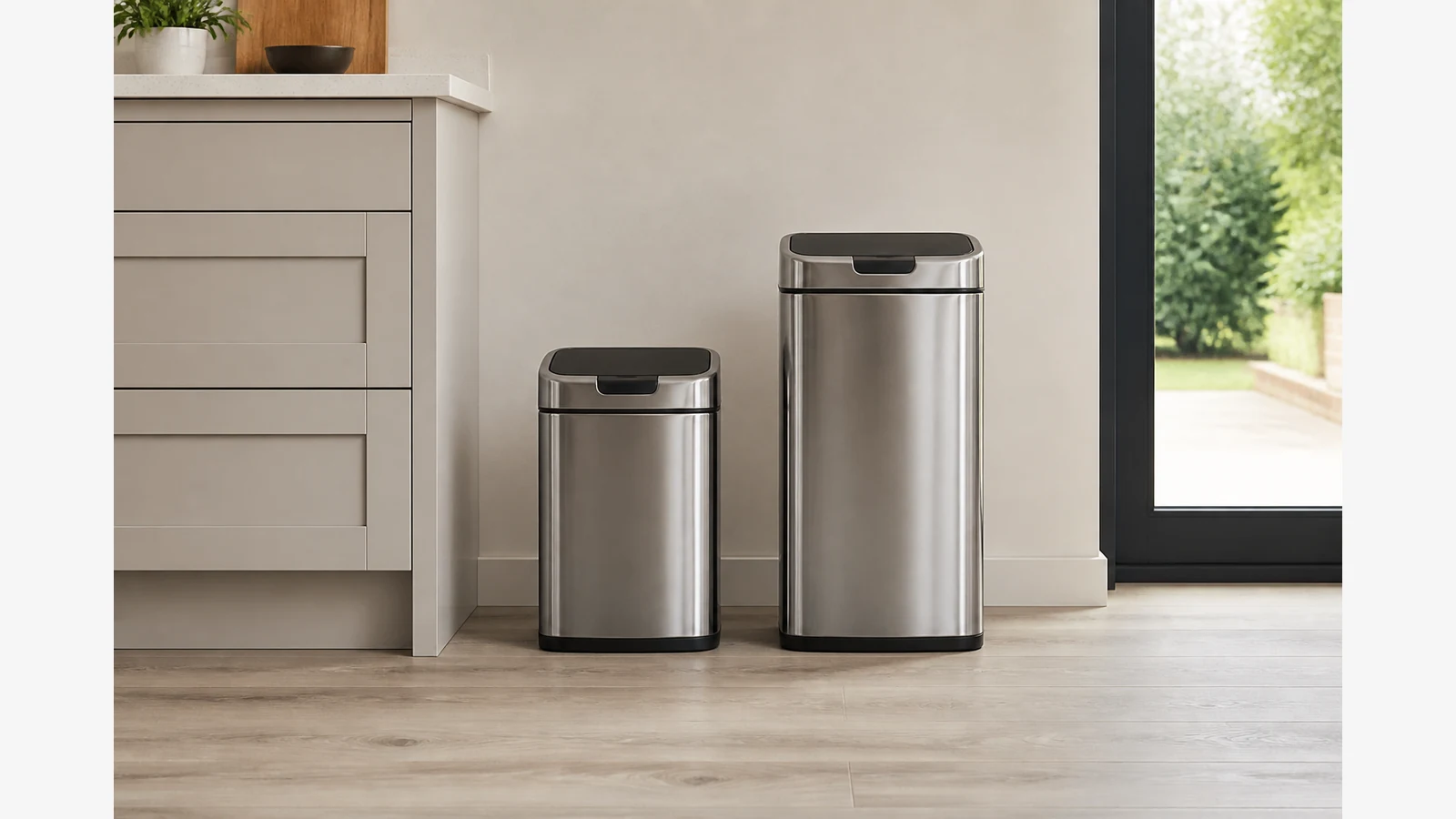
9L Vs 20L Sensor Bin Which Size Uk
Choose a 9L touchless bin for secondary zones or light waste, and a 20L model as the primary residual kitchen bin for most small-to-medium UK households. You do not need to default to a 30L freestanding unit if footprint, bag cadence and power access matter more than maximum litres.
Why capacity is not only “bigger is better” in GB homes
Many flats and galley kitchens run out of floor width before they run out of bag volume. UK retail listings commonly offer mid-capacity sensor formats — for example Maskura’s kitchen sensor bin range and EKO Home’s 20L-class sensor formats — because freestanding 20L options sit neatly beside worktops without dominating a narrow run. The Telegraph 2026 kitchen bin buying guide likewise treats capacity and power options as core decision factors alongside style.
Decision path: empties, sorting and sockets
- Count how often you already tie a residual bag — daily emptiers can live with 9L; twice-weekly emptiers usually prefer 20L in the main kitchen.
- Confirm food scraps and dry recycling leave the residual stream elsewhere (caddy, kerbside boxes), so litres are not wasted on divertible waste.
- Check whether a charging lead can reach the bin: 20L rechargeable variants need occasional cable access; 9L battery models suit socket-free corners.
- Measure the footprint and lid-open height against the exact alcove — do not assume every worktop clearance fits every lid geometry.
Size and power comparison (current catalogue modes)
| Option | Best for | Power mode | Notes |
|---|---|---|---|
| 9L stainless or white | Bathroom, utility niche, light secondary waste | Battery sensor with one-touch lid lock | Compact pack size; cable-free placement |
| 20L stainless or white | Primary kitchen residual waste for couples/small households | Rechargeable dual-use sensor with one-touch lid lock | Fewer battery swaps; needs charge access |
| 20L with night light | Dark kitchens or midnight clear-ups | Rechargeable dual-use + sensor night light | Same 20L class with low-light visibility |
Who should skip 9L as the only kitchen bin
Larger families, frequent hosts, or households stretching to weekly black-bin day with lots of residual packaging will usually empty a 9L too often. Use 9L as a satellite bin, not as the sole kitchen residual vessel.
Related choices
Weigh battery versus rechargeable behaviour in rechargeable vs battery sensor bins, and see how a residual 20L sits beside a food caddy in England’s 2026 caddy vs main bin setup. Match colour and mode on the EKO Deluxe product page.