
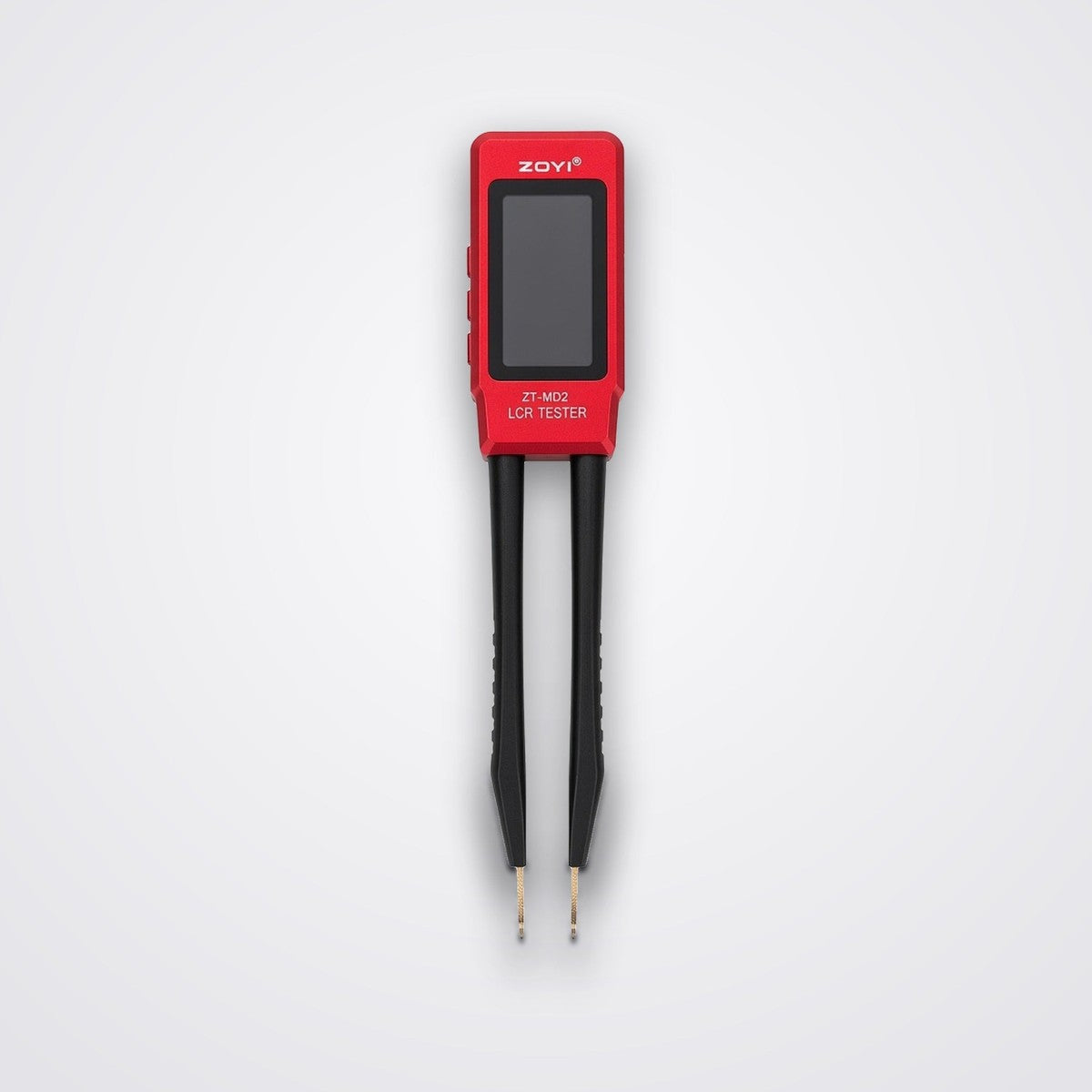
Two LCR readings can differ because the component changed, because the test conditions changed, or because the meter reports a different equivalent-circuit model. The ZOYI ZT-MD1 and ZT-MD2 tweezer meters address different levels of that task.
The MD1 lists automatic identification of resistance, capacitance and inductance. The MD2 adds sweep frequency, a 0.1–0.6 V test level and parameters including Rs, Rp, Cs, Cp, Ls, Lp, D, Q, X and Z. Those additional choices are useful only when their meaning stays in the record.

Cs and Cp are not just alternative labels
The s and p suffixes refer to series and parallel equivalent models. Real components can have losses and parasitic behaviour, so their measured impedance may be represented in different ways. A capacitance value without its model and frequency can be incomplete.
That does not mean one representation is universally correct and the other wrong. Choose the model and conditions required by the component specification or the question being investigated. Do not select whichever setting makes a measured value look closest to the printed marking.
Keep the test level and frequency visible
Some components change their apparent value with frequency or applied level. If comparing two parts, keep those settings the same. If deliberately sweeping frequency, preserve the relationship between each value and its frequency instead of reducing the sweep to one unexplained number.
The MD2 listing confirms sweep capability but does not provide every frequency endpoint or accuracy condition. Check those details before selecting it for a specific acceptance requirement. The MD1's automatic identification should not be assumed to include the MD2's detailed controls.

Control the connection on a small component
Use the tweezers only on appropriately unpowered, discharged components under the instructions. Parallel circuit paths can influence an in-circuit reading. Where appropriate, remove or isolate the component before interpreting the result as its individual value.
Keep the contact points stable and follow the instrument's specified compensation or calibration routine. Small SMD parts are sensitive to contact arrangement, so reconnecting and repeating a surprising result can be more informative than trusting a single hurried touch.
A capacitance number is not a complete health check
Electronics communities often discuss ESR when a capacitor still shows a plausible capacitance. The wider lesson is that one parameter does not describe every failure mode. Loss, leakage, voltage dependence and application conditions may require additional tests.
Do not treat every resistance parameter as automatically interchangeable with a dedicated ESR result. Use the correct model, frequency and interpretation. A meter that identifies a component has not thereby proved it will behave correctly under its full operating voltage or load.
Choose the variant around the decision
The MD1 can be considered for its documented automatic R/C/L identification role. The MD2 is relevant when the task needs the listed equivalent models and controlled test conditions. Its CNC aluminium housing is a construction detail, not a substitute for an accuracy specification.
A useful component record includes part identity, isolation state, frequency, level, model and result. That lets another person understand whether a difference belongs to the component or to the measurement setup.

Select the ZT-MD2 when the component comparison calls for its documented sweep, test-level or equivalent-circuit options. Compare the listed settings with the component data sheet before choosing the kit.
See the Check ZT-MD2 and UK buying options for the current version and kit, or read the ZOYI ZT-MD1 / ZT-MD2 overview before choosing.