
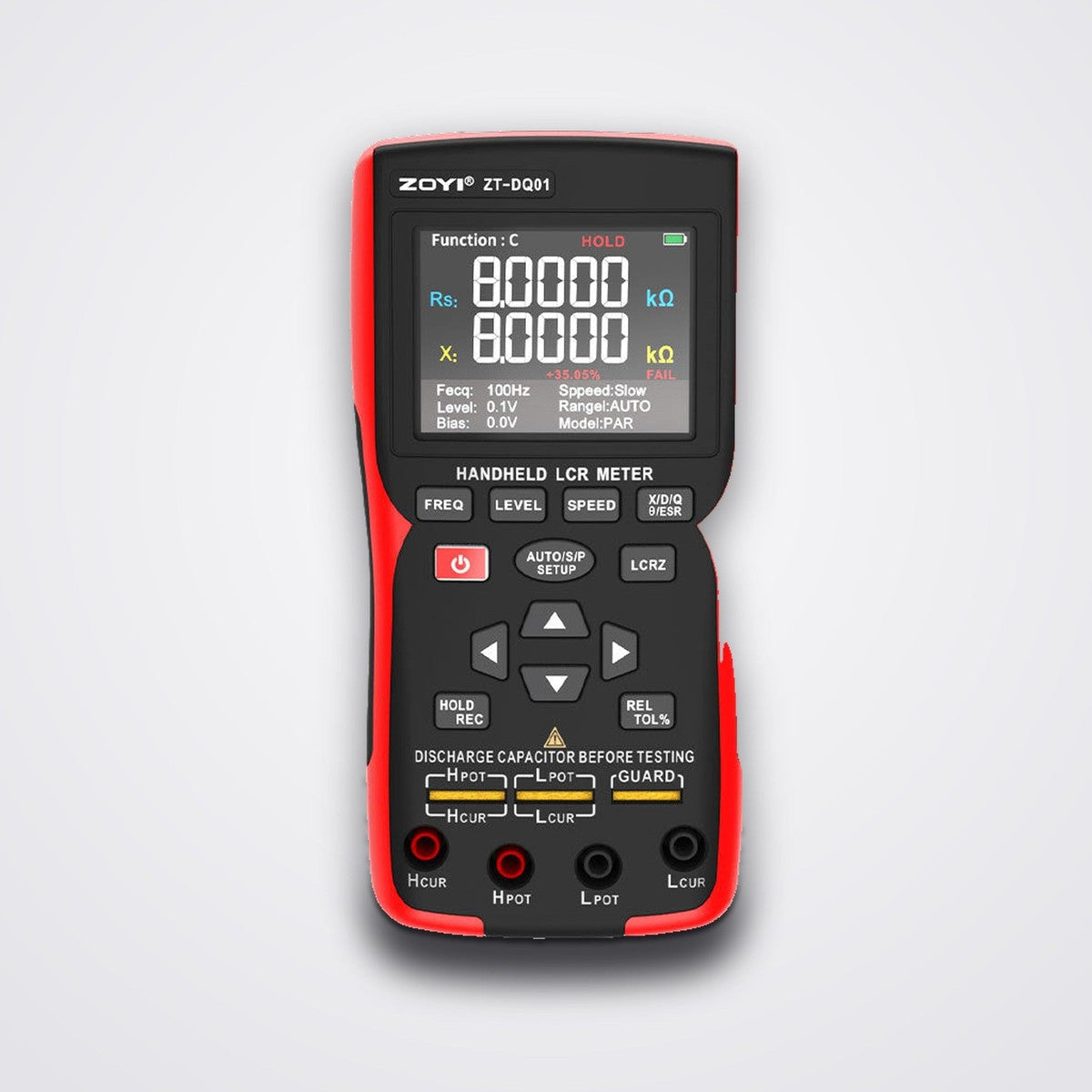
The ZOYI ZT-DQ01 handheld LCR bridge lists capacitance up to 100,000 µF. That large endpoint can be attractive when checking higher-value capacitors, but it does not specify how quickly every component settles or how much confidence to place in a changing display.
Before treating the first number as the result, establish the actual measurement method, component condition and supported operating limits. A repeatable observation is more useful than a screenshot taken at an arbitrary moment.

A maximum range is only one buying question
The listing also gives resistance from 20 mΩ to 20 kΩ and an accuracy expression of ±(5%+10). It does not supply every range's frequency, test level, resolution or settling conditions. Obtain the exact capacitance specification before relying on a close acceptance decision.
Do not interpret 100,000 µF as a promise that every component below that value can be tested instantly or at its working voltage. A maximum range does not establish leakage testing, polarity protection or automatic discharge. Those are separate functions that need explicit documentation.
Prepare the part before starting the clock
Identify the capacitor's marked value, polarity, working voltage and relevant datasheet conditions. Use an appropriately isolated component and follow the equipment's stored-energy procedure. Verify the required discharged condition before connecting the bridge.
A large capacitance can retain significant energy, depending on its voltage. The DQ01's terminals are not a discharge tool. Do not short an unknown capacitor or attach a powered assembly to the meter to find out what happens.
Choose the documented function and correct terminals. Establish stable contact so lead movement is not changing the observation while you wait.

Watch the sequence instead of choosing a convenient value
Follow the manufacturer's stated settling procedure. Depending on the measurement method and component, the display may change while the test develops. An arbitrary ten-second wait should not be presented as a DQ01 specification when the documentation does not establish it.
For a method check, note when the measurement began and what the display did: settled, continued changing, became over-range or produced a fault indication. Retain those states honestly. Do not turn an unstable sequence into a confident answer by selecting the value nearest the component marking.
A simple record can contain:
| Field | Why it matters |
|---|---|
| Component identity and marked value | Keeps the correct part attached to the result |
| Function, unit and documented settings | Identifies the actual measurement |
| Start and recorded-result time | Preserves the observation sequence |
| Settled, changing or fault state | Shows whether the result needs further work |
Repeat under the same preparation conditions
Where the instructions permit, reconnect and repeat using the same preparation, contact and settings. Record the individual observations. If changing contact substantially changes the result, resolve the setup before concluding that the capacitance changed.
For a batch of parts, use the same documented method and keep each component labelled. Repeating the same method can reveal inconsistencies, but it does not remove a systematic accuracy limit or establish calibration.
Decide what requires a separate test
A stable capacitance result still leaves questions about ESR, leakage and performance under operating conditions. The reviewed DQ01 listing does not establish a dedicated ESR measurement. Do not relabel an arbitrary resistance value as ESR or use a capacitance result as a complete health certificate.
A component checker earns its place by answering a defined question reliably. For the DQ01's larger-capacitance role, the useful result is a labelled value with a documented method and an understood settling state. If those conditions remain unresolved, keep the limitation visible and choose a better-specified method for the decision.

See the ZOYI ZT-DQ01 product page for the current version and kit, or read the ZOYI ZT-DQ01 overview before choosing.