
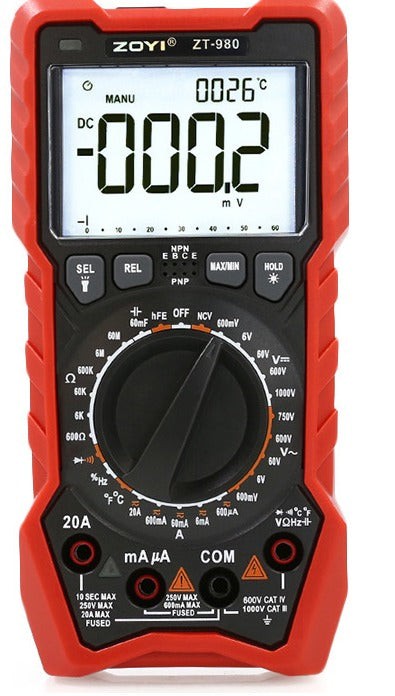
An hFE socket can make a loose transistor look easy to assess: insert it, read a number and decide whether it is good. The ZOYI ZT-980 and ZT-980L list transistor hFE testing, but the number is a measurement under the meter's test conditions. It is not a complete verdict on the component in its intended circuit.
For repair work, the useful aim is to combine correct identification, repeatable connection and a limited interpretation. That is a more dependable approach than replacing every transistor whose gain looks unfamiliar.

Identify the component and its pinout first
Read the part marking and obtain the correct datasheet, including the package orientation and base, collector and emitter connections. Similar-looking packages can have different pinouts. Do not guess the orientation by remembering a different transistor.
Test only a removed, unpowered component in the appropriate socket arrangement described by the meter's instructions. An hFE socket is not a place to connect a live circuit. If the component is not a bipolar transistor or its ratings and pinout are unknown, stop and identify it rather than trying arbitrary combinations until a number appears.
Treat hFE as a conditional result
DC current gain depends on operating conditions, including collector current, voltage and temperature. The meter's test point may differ from the datasheet condition or the circuit's operating point. Two results can therefore differ without either being a complete diagnosis of failure.
An hFE result also does not establish breakdown voltage, leakage at the intended operating voltage, switching behaviour or thermal performance. A damaged device may pass one simple check and fail elsewhere. Use the reading as one piece of evidence alongside the symptom and appropriate component tests.

Make a comparison worth keeping
If comparing removed devices of the same type, keep the instrument, connection orientation and conditions consistent. Record the part marking and socket orientation with the result. Retest a surprising value after checking the connection rather than immediately declaring the part faulty.
For example, a small batch of apparently identical transistors may show a spread of gains. Compare that spread with the relevant datasheet classification and application requirements. It does not automatically follow that the device with the highest reading is the best replacement.
The community phrase component checker is useful here: a checking tool helps narrow a question. It does not reproduce every stress the component encounters in a working circuit.
Where ZT-980 and ZT-980L differ
Both listed variants are True RMS multimeters with auto/manual ranging, NCV, hFE, MAX/MIN, REL and HOLD. The red ZT-980 and blue ZT-980L are separate choices. The L version adds inductance measurement, listed up to about 60 H.
That inductance function does not improve an hFE reading or make it a semiconductor curve tracer. Choose it if you have a separate need to measure inductance and have checked the relevant ranges and conditions. Do not use colour alone as the technical specification when ordering a replacement.
Keep the follow-up tied to the fault
If a transistor is being assessed after a circuit failure, consider what caused the original stress and whether surrounding components need inspection. A new component with an acceptable hFE number can fail again if the underlying fault remains.
For a low-voltage bench session, a good record includes the component identity, connection, displayed hFE and the next question still unresolved. The ZT-980/980L can support that process without turning one convenient number into a promise of complete component health.

See the ZOYI ZT-980 / ZT-980L product page for the current version and kit, or read the ZOYI ZT-980 / ZT-980L overview before choosing.