
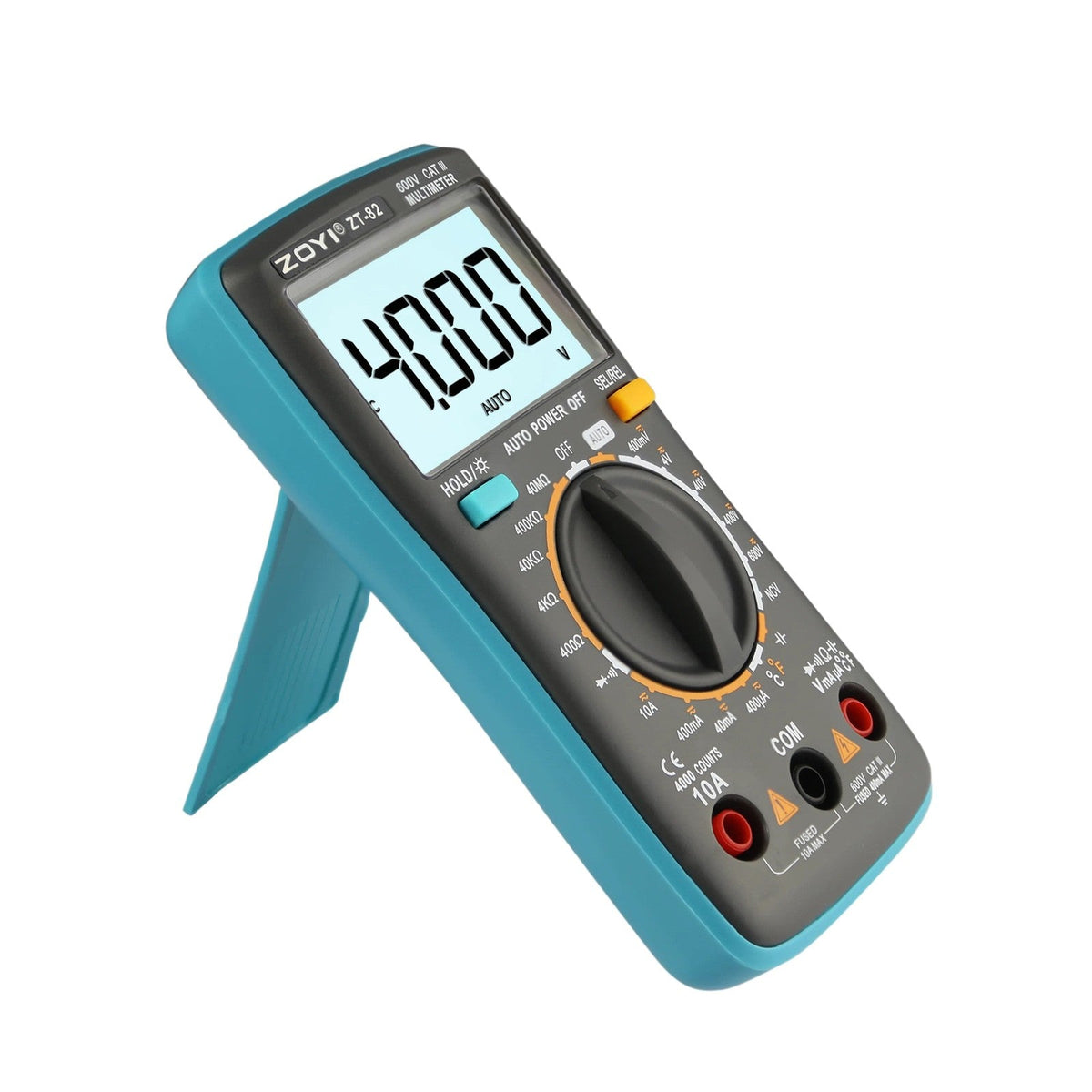
The ZOYI ZT-82 multimeter includes capacitance measurement, but a capacitance value is only one part of a capacitor's condition. A component can show a plausible capacitance and still have unsuitable leakage, equivalent series resistance or behaviour under its working voltage and temperature.
Use a capacitance check to answer the question it can support: what value does the meter report for this appropriately prepared component? Do not turn that single number into a complete health certificate.

Use a stable setup and confirm capacitance mode before testing an appropriately prepared component.
Identify the component before measuring it
Read its marked capacitance, tolerance, voltage rating, polarity and type. A schematic or component reference can help establish whether the part is actually the one suspected. Similar packages do not guarantee interchangeable characteristics.
Work only on an appropriately isolated assembly. Capacitors can retain energy after power is removed, so use the equipment's approved discharge method and verify the required condition before handling or testing. Do not discharge a capacitor by shorting it with a screwdriver. High-energy and mains equipment require the appropriate competence and procedure.
If the component is visibly damaged, leaking or swollen, do not let a plausible meter value override that evidence. Follow the equipment repair requirements and handle damaged parts appropriately.
Remove parallel paths from the question
An in-circuit reading can include other capacitors and components connected to the same nodes. If the circuit permits an approved isolated-component test, disconnect the required lead or remove the part using a suitable repair method. Record whether the result is in circuit or out of circuit.
The ZT-82 lists auto ranging and a 4000-count display. Select and confirm the capacitance function, use the correct sockets and check the supplied manual for supported range, polarity requirements and settling behaviour. A display that is still changing may not yet be a useful result.

Only the capacitance function is established for the ZT-82 here. The nominal tolerance interval excludes instrument uncertainty and other component requirements.
Compare with the actual tolerance
Suppose a capacitor is marked 100 µF with a ±20% tolerance. Its nominal tolerance interval is 80–120 µF before considering the measurement method, instrument uncertainty and the conditions specified for the component. A teaching reading of 96 µF lies within that nominal interval, but it says nothing by itself about leakage at working voltage.
The tolerance is not a universal repair acceptance rule. Some circuits depend on other characteristics, and ageing or temperature can change behaviour. Use the component and equipment requirements, rather than assuming that every value within the printed tolerance proves fitness for service.
Separate capacitance, ESR and leakage
| Property | What it concerns | What a basic capacitance result leaves open |
|---|---|---|
| Capacitance | Charge-storage relationship under the test method | Behaviour at other frequencies or conditions |
| ESR | Effective series loss at a relevant frequency | Heating and ripple-related performance |
| Leakage | Unwanted current through the dielectric under specified conditions | Performance at working voltage and temperature |
The reviewed ZT-82 functions establish capacitance measurement, not a dedicated ESR or high-voltage leakage test. Use suitable separate equipment and procedures when those properties are needed. Do not improvise a leakage test by attaching an unknown capacitor to an unrestricted supply.
Let the symptom guide the follow-up
If a device resets only under load, the fault may require observations that a static capacitance measurement cannot provide. Connections, supply behaviour and the surrounding circuit can matter. Replacing a component because it is easy to measure is not the same as identifying the cause.
Keep the marked value, tolerance, test condition, reading and unresolved questions in the repair note. After an approved replacement, inspect the work and complete the relevant functional checks. A capacitance result should support that repair process rather than substitute for it.
The ZOYI ZT-82 product page describes this model's functions and current supply terms, including any minimum quantity. For how to use a multimeter in the wider repair sequence, read our multimeter selection guide. Direct current measurement is not assumed from the ZT-82's voltage and component-test functions.
Explore the ZOYI ZT-82
See its functions, suitable tasks and key limits before choosing.