
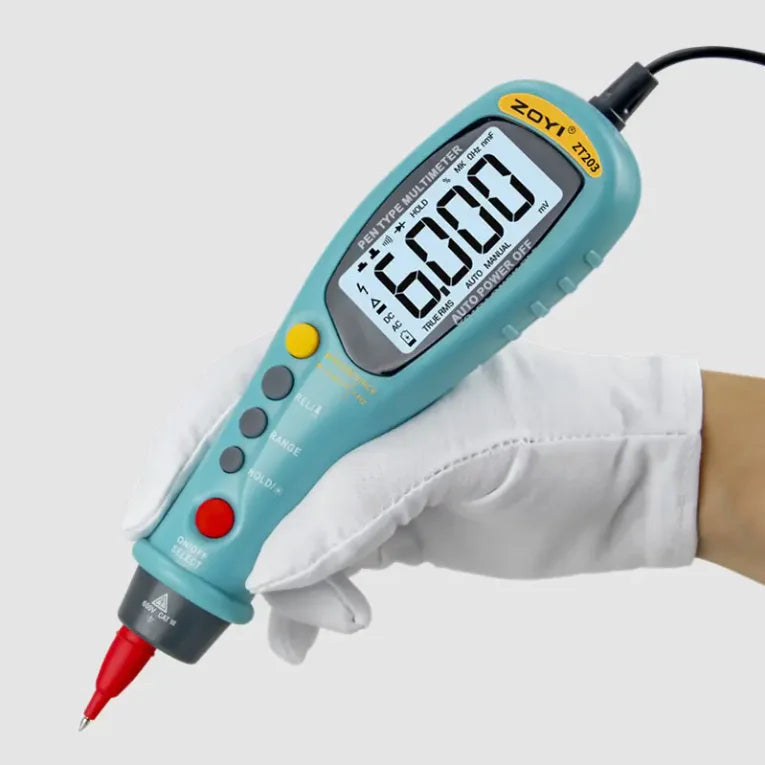
The ZOYI ZT-203 pen multimeter changes how you hold the instrument and reach a test point. Its slim body and integrated probe may suit an accessible connection where a conventional meter and two loose probes feel awkward. Check the complete return-lead arrangement and grip before deciding that “pen type” means one-handed measurement for every job.
This is the ZT-203, with a listed 6000-count display, True RMS and automatic ranging. Its reviewed functions are AC/DC voltage, resistance, continuity, diode and frequency. Current measurement is not established in that function list.

ZOYI ZT-203 supplier product photograph. Displayed values are illustrative.
Start with the two contact points
A contact-voltage measurement needs a defined connection between two points. The integrated tip does not remove the need for a suitable reference connection. On a low-voltage bench setup, first identify both points, check their spacing and consider whether the instrument body leaves the display visible.
A cramped location can make a pen-shaped instrument convenient, but it can also make your hand obscure the target. Do a physical access assessment with the equipment in a safe state. Do not rely on the body shape to provide insulation, a measurement category or permission to work on a live circuit.

Supplier detail views showing the pen format and probe arrangement.
Continuity is a separate measurement
Good continuity is useful for tracing a disconnected connection, but a beep should answer a defined question. Isolate the equipment, make stored energy safe and select the proper function. A continuity indication reports a connection under the meter's test conditions; it does not establish that a contact can carry its normal operating load.
If a joint is intermittent, keep the test connection secure and follow the equipment's inspection procedure. Avoid confusing unstable probe contact with the fault you are trying to find. Record resistance where the procedure requires a numerical value rather than relying only on sound.

Physical access and electrical suitability are separate checks
Frequency does not show waveform shape
The ZT-203 lists a frequency function. A frequency number can be useful when its input conditions match the signal, but it does not show amplitude shape, ringing or brief disturbances. Those questions call for appropriate waveform equipment.
Likewise, True RMS applies within the documented AC conditions. It is not a statement that every signal, frequency or distorted waveform will be measured accurately. Check the actual specification for your signal before choosing a meter on that label alone.
Choose accessories around the grip
Test leads for multimeter work should fit the required input, connection and environment. A useful return lead may matter as much as the integrated tip when both hands cannot comfortably reach the target. Check supplied accessories and probe protection on the current listing.
Choose the ZT-203 when the verified function set and physical layout solve an access problem you actually have. If the job requires current measurement or a waveform display, select those capabilities explicitly instead of expecting them from the pen format.
For the current specification and supplied version, see the ZOYI ZT-203 product page.
Explore the ZOYI ZT-203
See its functions, suitable tasks and key limits before choosing.