
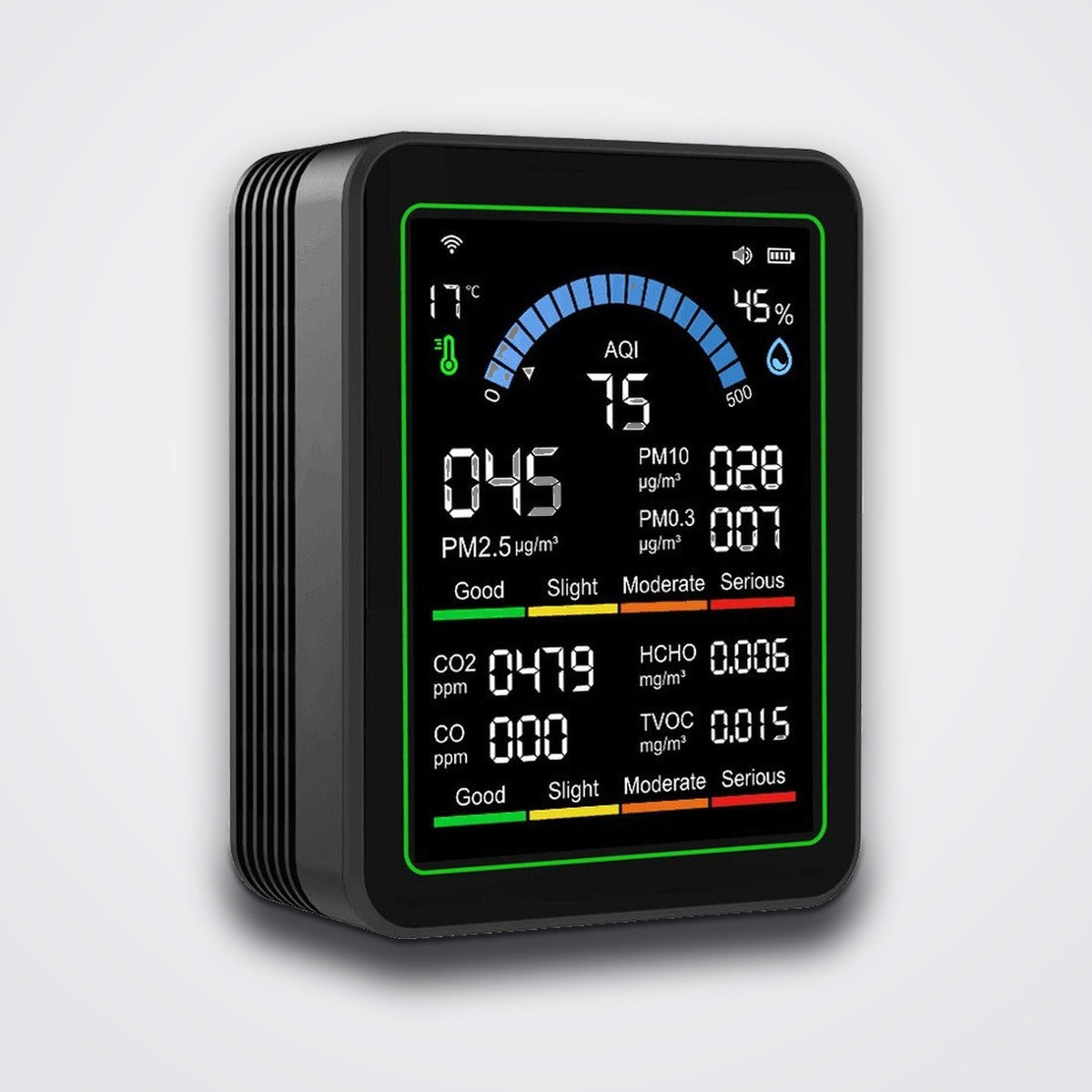
The ZN-MT13 is listed as a WiFi CO2 monitor with PM2.5, HCHO and TVOC readings. Those values answer different questions. A useful room record keeps ventilation events and particle events in the same timeline instead of treating one screen as a single indoor-air score.

ZN-MT13 Air Quality Monitor — supplier product view.

A second supplier view used to confirm the exact model and interface.
Pair the readings with the room event
A Reddit air-quality search result describes using CO₂, PM2.5 and humidity to decide when to open the windows. Another result notes that cooking spikes the CO2 even when a hood fan is running. Use that language as a planning cue: write ‘window opened’, ‘cooking started’ or ‘room filled’ beside the display time. Do not turn a community threshold into medical advice.

Original workflow diagram: the record keeps setup, observation and boundary together.
Choose a stable starting position
Place the monitor where room air can reach it, away from a direct outlet, kettle plume or open window. Let the room settle before calling the first reading a baseline. The store listing supports the monitored categories, but it does not establish sensor response, calibration or clinical thresholds. Keep the location and firmware or mode notes in the record.
Read patterns rather than a single alarm
Compare a quiet period, a meeting or occupied period, and one known source such as cooking. CO₂ may follow occupancy while PM2.5 changes with particles; HCHO and TVOC require their own interpretation. The point is a time-linked pattern that informs ventilation decisions, not a universal safe/unsafe label.
Use the trend as wording, not proof
The captured GB Trends page for ‘CO2 monitor’ is retained with the research bundle; relevant category language is ‘portable CO2 monitor’ and ‘air quality monitor’. Search interest does not validate a sensor reading. Keep the article focused on a repeatable room log and on the exact ZN-MT13 functions in its listing.
Keep a record someone else can use
Keep the room log human-readable: timestamp, occupancy, window or fan state, CO2, PM2.5, HCHO and TVOC. Add a short event note instead of a long narrative. If a value moves after cooking or a window opens, record the event without assigning a health conclusion.
A practical handover
Write down the exact model, the setup, the observation and the limit that still needs checking. For current version and buying information, use the ZN-MT13 Air Quality Monitor product page.
For the related product overview, see the ZN-MT13 Air Quality Monitor Learn More page.