
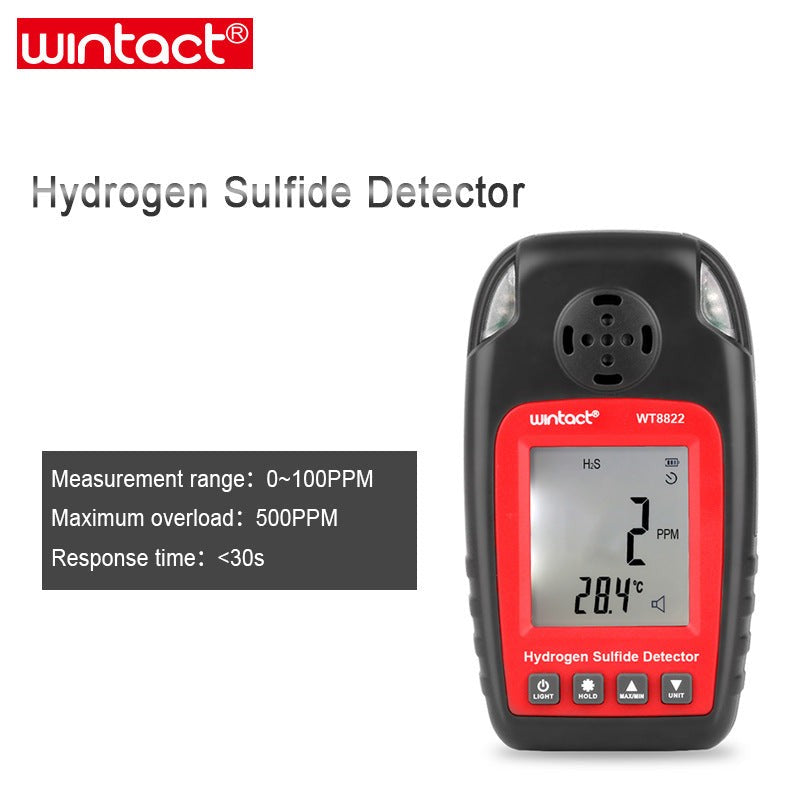
The Wintact WT8822 hydrogen sulphide detector shows H₂S in ppm with a separate temperature readout. Its listed 0–100 ppm H₂S range is only one part of the information a new user needs. A useful shift handover also establishes which instrument it is, whether its required checks are current and whether anything happened that could affect the sensor.
That record is especially valuable when several similar handheld meters share a cupboard. A familiar case does not tell you the gas, range or service condition.

Give the instrument an identity beyond its model name
Retain the serial or asset identifier used by your organisation, the exact model and gas, the current instructions and the relevant service record. The WT8822 is the single-gas H₂S unit, not a WT8811 multi-gas monitor. A label that says only “Wintact gas meter” loses that distinction.
The WT8822 uses three AAA batteries and includes LIGHT, HOLD, MAX/MIN and UNIT controls. Check the state of the actual unit under the supplied procedure. Do not infer readiness simply because the screen lights up.
Make readiness a dated record
Include the required functional check, calibration status and any fault indication. Record the method and outcome rather than writing a vague “checked OK”. Community terms such as bump test and cal gas are useful shorthand, but the formal record needs the applicable procedure and identified gas mixture.
HSE's guidance on gas detection distinguishes a functional check from periodic calibration. Passing one does not erase a failed or overdue requirement elsewhere in the maintenance process.

Preserve unusual events rather than resetting the story
Document an over-range indication, unexpected failure, contamination, damage or exposure that the manufacturer says requires action. Remove the instrument from reliance and follow the specified service process where required. Clearing a screen is not the same as restoring a sensor's performance.
This is where an equipment history is more useful than a collection of isolated readings. If the instrument responded differently after a particular event, the service provider needs that context. Do not invent a recovery time or assume fresh batteries repair a sensor problem.
Do not compare ranges as though they were quality scores
The WT8822's stated H₂S span is 0–100 ppm. Another H₂S detector may advertise a larger span, but that alone does not establish better low-level performance, faster response or greater suitability for the task. Accuracy, resolution, maintenance, certification and the required decision all need consideration.
An upper limit is not an acceptable exposure level. A unit that can display a number is not permission to remain in that atmosphere. Worksite limits and emergency responses must come from the applicable assessment and procedure.
Make the next observation interpretable
When handing over, identify whether the displayed value is current, held or a maximum from the previous observation. Describe the location and operating state to which it belongs. A maximum carried into the next shift can otherwise be mistaken for a new event; a held value can be mistaken for a live one.
Temperature is a useful separate observation, but it does not turn the WT8822 into a multi-gas detector. H₂S monitoring cannot establish oxygen concentration or combustible-gas conditions.
The goal is a compact, trustworthy instrument history: exact identity, current readiness, relevant incidents and clearly labelled observations. It helps trained users recognise when the WT8822 is ready for its defined role and when further verification is required.

See the Wintact WT8822 product page for the current version and kit, or read the Wintact WT8822 overview before choosing.