
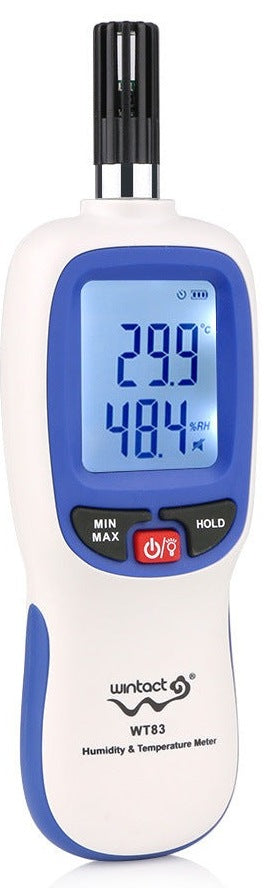
Use the Wintact WT83 dew point display alongside a suitable separate surface-temperature measurement when investigating a cold window. The WT83 senses the surrounding air and calculates dew point; it does not directly measure the temperature of the glass or the water content of the wall. Keeping those quantities separate makes the comparison useful.

The WT83 senses surrounding air; its dew-point display is not a direct measurement of the window surface.
Understand the two temperatures you need
Dew point is the temperature at which the sampled air would reach saturation when cooled under the relevant conditions. A surface at or below that local dew point may support condensation. The surface temperature and the air's dew point therefore answer different parts of the question.
The WT83 displays air temperature and relative humidity and offers calculated dew point and wet bulb. Its listed dew-point range is −20 to 50°C, while the air-temperature range is −20 to 70°C. Do not assume every display mode shares the same range or accuracy.
The standard model in this listing has no Bluetooth. MAX/MIN and HOLD are useful display functions, but do not provide an automatically exported overnight environmental history.
Sample representative air
Choose a position relevant to the window investigation, keeping the sensor clear of your breath, wet curtains, a direct radiator plume or a newly opened window unless that local condition is the subject of the check. Allow the display to settle after moving between rooms.
Record air temperature, RH and dew point together with time and room conditions. Note occupancy, heating, curtains and recent cooking, bathing or clothes drying where relevant. A brief reading in an empty room may not describe the conditions that produced water overnight.
If the question concerns a very local pocket of air behind a curtain, distinguish that observation from a room-centre reading. The two may legitimately differ. Neither should silently replace the other in a comparison.
Obtain a suitable surface measurement
Use a separate instrument and method suited to the glass or frame surface. An infrared reading on reflective glass can be misleading; a suitable contact method may be more appropriate, subject to the surface and instrument instructions. Do not assume a thermal camera sees through the window or that the WT83's sensor cage is a surface probe.
Measure the relevant surface location and the nearby air close enough in time for the operating conditions to remain meaningful. Record the location: centre glass, edge, frame and wall reveal can have different temperatures.
Work through an illustrative comparison
Suppose the room air is 22°C at 60% RH. A standard approximate calculation gives a dew point near 14°C. If a suitable separate measurement finds one glass location at 11°C and another at 17°C, the first is below that illustrative dew point while the second is above it.

Teaching values only. Compare local air and a suitably measured surface close in time; include instrument uncertainty and changing room conditions.
Those numbers are a teaching example, not WT83 measurements or a universal household limit. A result very close to dew point needs particular caution because instrument uncertainty, surface-method error and local changes can alter the conclusion. The listed dew-point accuracy is ±1°C, and the separate surface method has its own uncertainty.
The comparison can explain why water appears at a colder edge before the rest of the window. It does not by itself distinguish every cause of damp or prove that a window, ventilation system or building element is defective.
Keep wet bulb and material moisture separate
Wet-bulb temperature concerns evaporative cooling and air conditions. It is not a second name for dew point, and neither quantity directly measures how much water is inside timber, plaster or masonry.
If the question is a persistent damp patch, combine the air/surface observations with a suitable building investigation. If the question is what happens overnight, use an appropriate time-based measurement plan and, where needed, a logger rather than extrapolating from one daytime spot check.
Follow the pattern into an action
Keep a small series of paired air and surface observations under identifiable conditions. Changes in moisture sources, heating, ventilation or curtain position may affect the pattern; assess changes comparably and avoid prescribing one setting for every home.
The useful outcome is a narrower question: when is the local surface cold relative to the air's dew point, and what conditions coincide with that? That gives a much better starting point for practical advice than calling one RH percentage “safe” or “unsafe” on its own. For an overnight recording plan, see our temperature data-logger guide and check the required sensing channels.
Explore the Wintact WT83
See its functions, suitable tasks and key limits before choosing.