
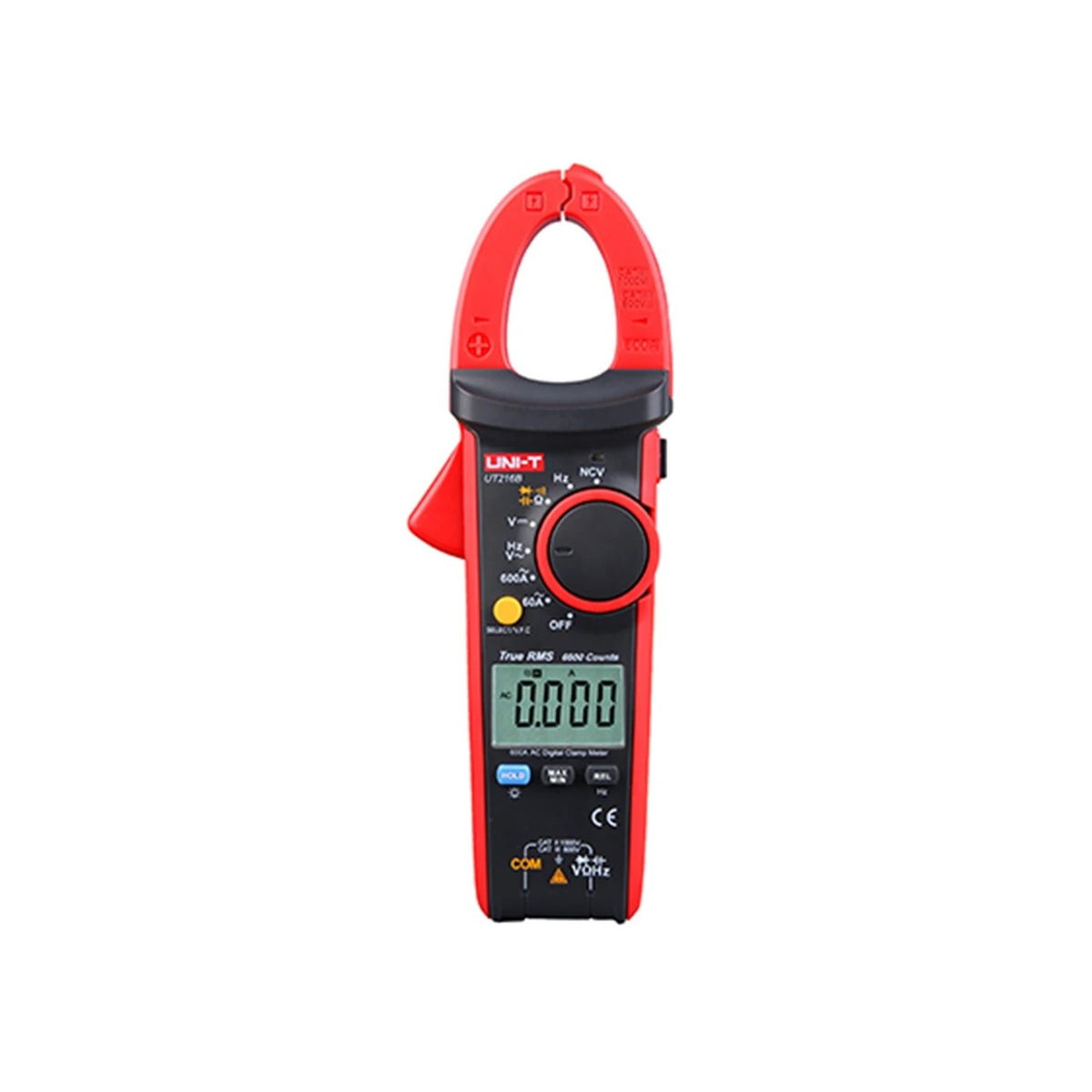
A noisy VFD or inverter voltage reading is easy to misread. The UNI-T UT216B is a True RMS clamp meter with listed 600 A AC, face silk 600A AC Digital Clamp Meter and True RMS 6000 Counts, safety markings CAT III 600 V / CAT II 1000 V, English UI example 0.000 / AC / A, discrete rotary positions 60 A~ / 600 A~, and a yellow face key labelled SELECT / V.F.C. Before you trust a drive-side voltage figure — and before you treat any NCV cue as the answer — set the documented voltage path, engage V.F.C. only as the manual describes, and keep clamp-current work on 60 A~ or 600 A~ with one suitable conductor.
A near-zero reading on a twin-and-earth bundle is usually cancelled go-and-return, not proof that the circuit is idle. A fluctuating voltage near a drive is often noise on the measurement path, not automatically a failed supply — and V.F.C. is an aid, not a substitute for competence or isolation.
Begin with the range that covers the load
If you expect tens of amps, 60 A~ can be appropriate. If you expect hundreds of amps within the listed 600 A AC span, set 600 A~ first. This face has no 6 A~ position (that belongs to UT216A). Do not leave the dial on 60 A~ while you hunt for a large load — discrete ranges need a deliberate choice before the jaw closes.
If you only need a first look for presence of AC electric field, the NCV position can prompt further checks. It does not prove isolation, does not measure amps, does not enable V.F.C., and does not authorise live work. Move to leads, a proving unit and the competent procedure required for that installation when the task demands it.
Even low-looking installations can deliver high fault currents. Protect against accidental shorts and use the competent procedure required for that work and for the face marking CAT III 600 V.
Set 60 / 600 before the jaw closes
- Confirm the expected current sits inside the listed 600 A AC span for this model.
- Turn the dial to 60 A~ or 600 A~ so the range covers the load with headroom. Leave OFF until you are ready; do not browse NCV / ohms around a live conductor you have already clamped unless that is the documented task.
- Open the jaw only when access is safe, then close fully around the single conductor.
- Wait for a stable reading. Use HOLD if you need to move your eyes or body away from the conductor to note the value.
- Use MAX MIN or REL only as the manual describes for the selected function — they are not substitutes for picking the correct AC range or for safe isolation.
True RMS on the face applies to the listed AC paths. It helps when the waveform is not a clean sine; it does not remove the need to pick the range, clamp one conductor, or follow the manual’s accuracy conditions.
Engage SELECT / V.F.C. only on the documented voltage path
Voltage and frequency work use the printed dial positions and the COM / V Ω Hz jacks. When a drive or inverter may inject high-frequency noise into a voltage reading, set the documented voltage function first, then use the yellow SELECT / V.F.C. key only as the manual describes. V.F.C. (Variable Frequency Control) is a measurement aid for those listed voltage paths — it is not a clamp-current mode, not an NCV mode, and not proof that a circuit is safe to touch.
English UI example on this exact face shows 0.000 / AC / A — that is an AC amps-style readout, not a screen-size claim and not a V.F.C. “safe” light.
NCV remains an indication control on the dial. It is not proof of isolation, not a substitute for a proving unit, and not permission to touch conductors. Use the correct safe-isolation equipment and procedure for the installation category you are working in.
Keep HOLD in proportion
HOLD freezes a display value so you can step back — it does not make a live conductor safe. Match leads, PPE and competence to the task. The face / jaw / input markings include CAT III 600 V and CAT II 1000 V; still confirm the manual’s category statements for the function you are using. Seller CAT IV attribute lines that conflict with this face silk are ignored here.
Choose the UT216B when the AC span, range set and V.F.C. match
For buyers searching for a True RMS 600 A AC clamp meter with 6000 counts, English face controls, discrete 60 / 600 A~ ranges, dial NCV and face SELECT / V.F.C., the UT216B is a clear shortlist candidate. Still check access, uncertainty and event type. This page is UT216B only — not UT216A (6 / 60 / 600 A~, £81.50, no this-face V.F.C. silk pairing), not UT216C (do not use A/B/C factory combo posters), not UT213B (400 A / 4000 counts), not UT200B+ and not UT200A+.
For product context before you buy, see the UNI-T UT216B overview and the buying page (£186.40, free UK delivery). Always follow the supplied manual for ranges, accuracy conditions, V.F.C. behaviour, NCV behaviour and measurement-category limits. Jaw opening size and numeric accuracy tolerances are not claimed in this guide — use the manual. Seller jaw millimetre claims that conflict with a full-size 600 A clamp photo are ignored here.