
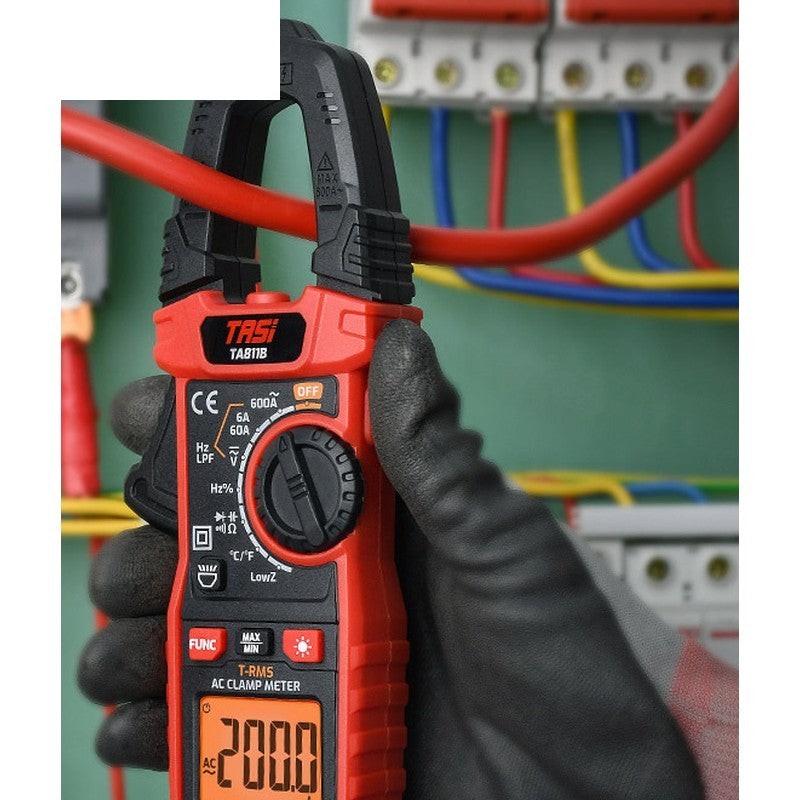
The TASI TA811B AC clamp meter can help compare a motor's running load when the conductor is accessible through a suitable, approved measurement arrangement. Its approximately 32 mm jaw opening and listed 600 A AC range are only the starting points. To make two readings comparable, keep the conductor, operating state and measurement position consistent.
This is a running-current workflow. It should not be treated as an inrush-capture procedure simply because a maximum value can be retained.

Store application image. Live installation measurements require suitable access, equipment and competence.
Check access before checking current
The jaw must close properly around the intended single conductor without being forced into place. Confirm that the conductor and surrounding arrangement fit within the tool's physical and electrical limits. A jaw opening specification does not mean it is safe to push the meter into any crowded enclosure that appears to have enough space.
Do not move live conductors, remove insulation or defeat a guard to make the instrument fit. Where appropriate access is absent, a competent person needs a different approved measurement arrangement. Keep the jaw faces clean and fully closed according to the manual; an incomplete closure can undermine the reading.
Clamping around the whole outgoing-and-return cable can produce cancellation. The measurement must be planned around the circuit, not around whichever cable is easiest to reach.
Make the machine's state part of the reading
For a motor comparison, record speed or control setting, mechanical load, warm-up state and time. A pump moving fluid against a different pressure is not necessarily doing the same work, even if its switch is in the same position.
Use a stable operating period appropriate to the equipment. Note any cycling or control changes during the observation. If the load is varying, report that variation rather than selecting the lowest number as the representative result.
The TA811B lists True RMS and a display of up to 6000 counts. True RMS is useful for AC magnitude within the specified waveform and frequency limits. It does not make an uncontrolled mechanical comparison into a controlled efficiency test.

The approximate 32 mm jaw opening is a fit constraint, not permission to force access in an enclosure.
Use a record that exposes changed conditions
| Item | Before | After |
|---|---|---|
| Machine and conductor | Record identity | Confirm same |
| Speed/load state | Describe | Describe any change |
| Warm-up and timing | Record | Match where appropriate |
| Meter mode/range | Record | Confirm |
| Current observation | Value and variation | Value and variation |
If a reading changes, compare the conditions before assigning a cause. A difference may justify investigating the supply, controls, mechanical load or connections. Current alone cannot distinguish every electrical and mechanical fault.
For a multi-phase machine, each phase measurement must follow the appropriate procedure and comparable conditions. Do not turn sequential handheld readings into a claim of simultaneous power analysis. The TA811B is not presented here as a three-phase power analyser.
Keep MAX/MIN separate from inrush
MAX/MIN can retain extrema according to the instrument's response and update behaviour. A short start event may require a specifically designed capture function with a known timing window. The reviewed TA811B functions do not establish an inrush mode.
If the actual question is whether a motor start causes a protective device to operate, choose a measurement method that can capture the relevant event and have the protection issue assessed appropriately. A normal running-current reading cannot reconstruct what happened during an earlier start.
Match AC and DC requirements explicitly
The TA811B provides AC jaw current. Its separate AC/DC voltage functions do not establish DC-current measurement through the jaw. Someone comparing AC DC clamp meter options for a battery or vehicle task should check that requirement before choosing this model.
The meter also lists resistance, capacitance, frequency, temperature and other functions. Change the connection and equipment state deliberately when moving between them; an unpowered resistance check is a separate task from a live current observation. NCV is not a substitute for safe-isolation verification.
See the TASI TA811B product page for the exact model and kit. The related clamp-meter guide gives the broader context for selecting jaw type, functions and capture behaviour.
Explore the TASI TA811B
See its functions, suitable tasks and key limits before choosing.