
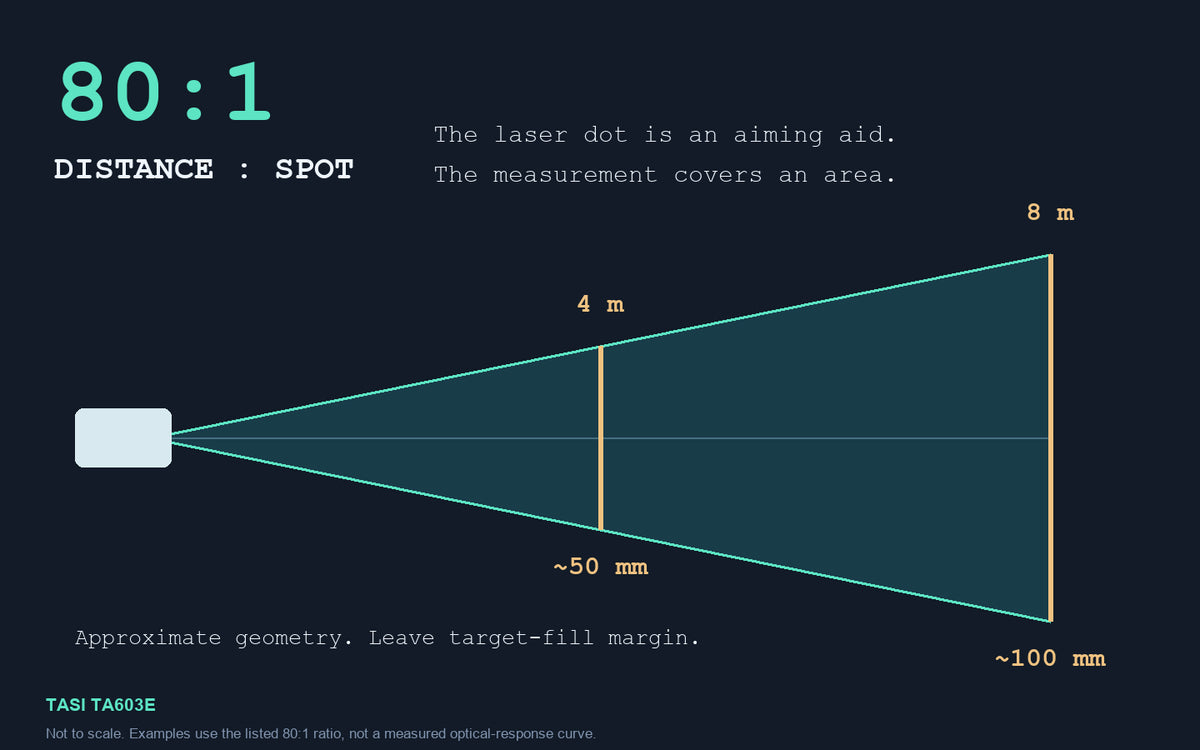
The TASI TA603E distance-to-spot ratio matters whenever the target is small compared with the distance to it. The instrument measures radiation from an area, not just the point highlighted by the aiming laser. If the target does not fill that area sufficiently, the surroundings can influence the temperature reading.
The TA603E lists 80:1 optics, a −32–2200°C measuring range, adjustable emissivity from 0.10 to 1.00 and storage for 255 data groups. The 80:1 figure is a useful planning aid, but it needs to be read alongside the manual's optical description and the surface being measured.
Use the 80:1 distance-to-spot ratio to plan target fill
Distance-to-spot ratio relates the distance to the target and the approximate measurement-spot diameter. Using the headline ratio as a simple geometry estimate:
Approximate spot diameter = distance ÷ 80.
Keep both quantities in the same units. At 4000 mm, the estimate is 4000 ÷ 80 = 50 mm. At 8000 mm, it is 100 mm. These are illustrative calculations from the listed ratio, not measurements of this particular instrument's complete optical response.

D:S examples are approximate geometry, not a guarantee that a target of exactly that diameter gives an accurate reading.
The optical definition, near-field behaviour and energy captured within the quoted spot need checking in the correct manual. Leave a suitable target-fill margin rather than assuming a component exactly 50 mm wide will be measured accurately from 4 m.
A laser dot is an aiming aid
A small visible dot can make a distant component look precisely selected even though the measurement area is much larger. The dot does not shrink that area or remove the influence of the background.
Suppose an accessible 40 mm target is viewed from 4 m. The simple 80:1 estimate gives a 50 mm spot, already larger than the target. The reading may therefore include surrounding surfaces. It should not be reported uncritically as the temperature of that component alone.
Where a closer position is safe and permitted, it may improve target fill. Where access is restricted, a different measurement method or optical specification may be required. Do not defeat a guard or approach a hazardous process just to reduce the measurement distance. Follow the Class 2 laser precautions in the manual.
Emissivity remains a separate source of uncertainty
Filling the target area does not solve every infrared-measurement problem. Surfaces differ in the way they emit and reflect infrared radiation. A shiny surface can reflect a warmer or cooler surrounding object and produce a misleading apparent temperature.
The TA603E's adjustable emissivity helps configure a measurement for the surface, but an adjustable number is not evidence that any guessed setting is correct. Use a defensible value and a suitable verification method for the material and conditions. Do not tune the setting merely until the result matches what you hoped to see.
Record the setting and relevant surface condition. Paint, oxidation or a changed viewing angle can affect a comparison. If a reflective hot object is the task, confirm that the instrument's spectral range and the proposed method are suitable before relying on the result.
Build a repeatable infrared record
Save the target ID, approximate distance, target dimensions, emissivity setting and the operating state of the process. Add the displayed result, unit and data-record identifier if stored. A photograph or sketch helps distinguish a small component from the larger assembly around it.
For a later visit, repeat the geometry and settings as closely as practical. A changed result taken from twice the distance may reflect a larger sampled area rather than a real change in the component.
The 2200°C upper range is a measuring-range specification. It does not guarantee equal accuracy on every material or make the instrument suitable for measuring through every window, enclosure or intervening atmosphere.
Check TA603E rather than a family resemblance
Similar-looking TA603 models have different specifications. This article uses the TA603E's listed 80:1 ratio; it should not inherit a 50:1 figure from another model or a marketplace description.
Our thermal-imaging explanation gives broader context on interpreting infrared information. View the TASI TA603E infrared thermometer for the exact optical, emissivity and temperature specifications before planning a measurement.
Explore the TASI TA603E
See its functions, suitable tasks and key limits before choosing.