
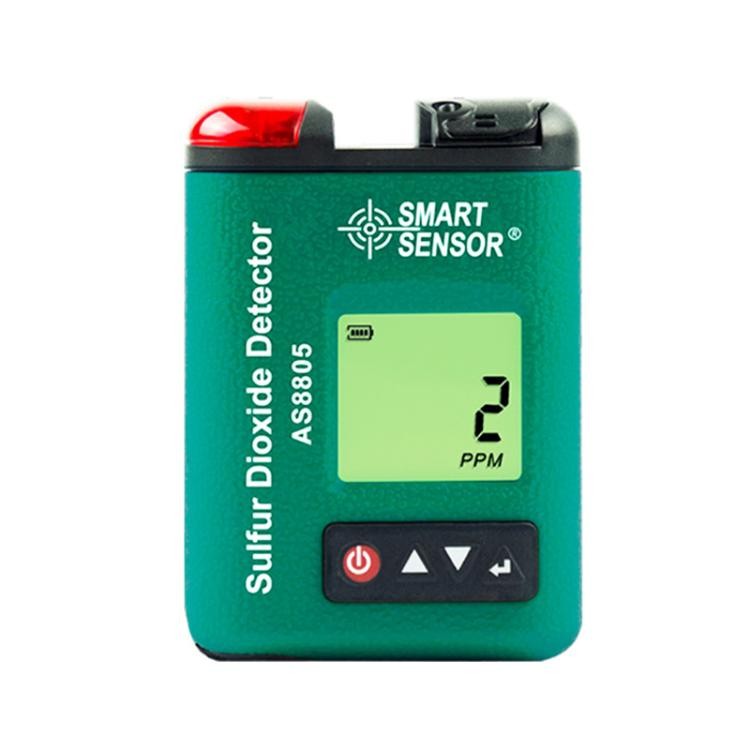
The Smart Sensor AS8805 sulphur dioxide detector is listed with a 0–20 ppm SO₂ range and 1 ppm resolution. That resolution deserves attention before buying: the display cannot communicate arbitrarily small differences simply because it uses a digital number.
A zero reading is therefore an observation from a particular instrument and setup. It is not proof that no sulphur dioxide exists, and it cannot by itself establish that a workplace meets an exposure requirement.

Resolution is the size of the displayed step
Resolution describes the increment available in the readout. Accuracy describes how close a result can be to the reference value under specified conditions. Detection limit, response time and cross-sensitivity are further characteristics. None can be derived reliably from the others.
For the AS8805, the reviewed listing states 1 ppm resolution. If a task needs meaningful discrimination at fractions of a ppm, request a current model-specific specification and calibration information before selecting the instrument. Do not assume extra decimal places are available in a hidden mode.
This is especially relevant when comparing a handheld SO₂ detector with a workplace limit. The limit's averaging period and measurement method matter as well as its number. A short spot observation and a time-weighted exposure assessment are different measurements.
Use an equipment acceptance question
A practical buying question is: “Can this complete measurement system support the decision our procedure requires?” Answer it with the required concentration range, uncertainty, response time and sampling method. Then compare those requirements with the exact unit's documentation.
For example, an application that needs to flag broad changes may have a different equipment specification from one that must resolve a small difference around an action level. This is a hypothetical distinction, not a recommendation to use the AS8805 for either task without the supporting assessment.

Preserve the sampling arrangement
A sensor can only respond to gas that reaches it. Keep its inlet unobstructed as directed, and do not attach an improvised hose or pump because the gas is hard to reach. The listing's portable form does not establish compatibility with remote sampling accessories.
HSE's sampling-system alert describes how unsuitable tubing can produce misleading results. The lesson is to assess the whole system, including its delay and material compatibility, rather than treating the sensor specification as the entire method.
Record what was actually observed
Keep the displayed value and unit, location, time, relevant process state and instrument identification together. Record any fault or over-range state explicitly. If the observation appears inconsistent with the task or previous results, stop and follow the verification procedure; editing an unexpected number out of the record destroys useful information.
“Passed the bump test” should refer to the required functional check, with its proper record. It does not mean the unit has just been calibrated. Equally, a quiet alarm is not a substitute for either check.
Identify SO₂ before comparing neighbouring models
The AS8805 targets sulphur dioxide. The similar AS8803 targets hydrogen sulphide, while AS8806 targets nitrogen dioxide. These chemical names should appear on the equipment brief and match the instrument delivered. A shared case style or neighbouring model number does not make the sensors interchangeable.
The AS8805 is worth considering when its documented SO₂ capability matches a defined job. The useful question is not how reassuring zero looks, but whether the instrument can resolve the decision you need it to support.

See the Smart Sensor AS8805 product page for the current version and kit, or read the Smart Sensor AS8805 overview before choosing.