
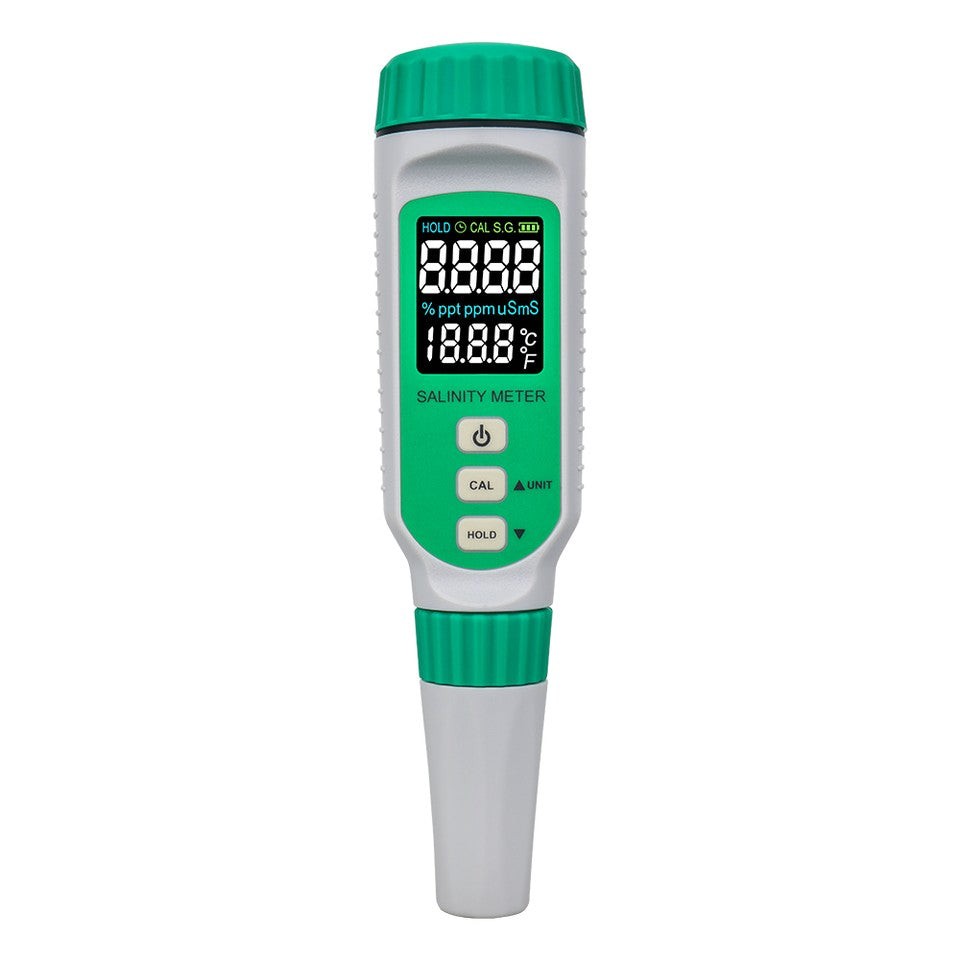
Before adding newly mixed saltwater to an aquarium, verify the salinity measurement as carefully as the mix. The Smart Sensor AR8212+ salinity meter displays parts per thousand, or ppt, alongside solution temperature. A clean sampling method and an appropriate calibration check make those numbers more useful than repeated adjustments made to chase a single display value.
This is especially relevant when two testers disagree. The first question is whether they were checked, used and read under comparable conditions—not which display has more decimal places.

Read salinity in the displayed unit and verify the appropriate reference before adjusting a sample.
Prepare the new water as a separate sample
Follow the salt manufacturer's mixing instructions, using suitable water, a clean container and the required mixing and stabilisation time. Keep the new water separate from the aquarium while checking it. Note the solution temperature and do not assume that a sample taken immediately after adding salt is representative of the whole container.
Use a clean sampling method and avoid carrying residue from a concentrated mix into the tank sample. Rinse and handle the probe as directed between solutions. Remove trapped bubbles and allow the reading to settle according to the instrument instructions.
The AR8212+ lists a 0–50 ppt salinity span and a 0–60°C solution-temperature span. These are instrument limits, not a recommended salinity or temperature for every aquarium.
Check the reference before “chasing numbers”
In reef-keeping discussions, chasing numbers often describes repeated corrections made without establishing whether the measurement is trustworthy. A calibration error can make an apparently abnormal tank result look like an urgent chemistry problem.
Use the correct salinity calibration solution and the procedure specified for the AR8212+. Do not substitute a pH buffer because a promotional graphic or another meter uses similar numbers. Check the reference's condition, temperature requirements and expiry, and avoid contaminating the stock solution.
If a comparison with a local fish shop, or LFS, produces a different result, record both methods, units and conditions. A comparison can reveal a problem, but the shop reading is not automatically a traceable reference merely because it came from another instrument.

Units and workflow illustration only. Use an appropriate validated conversion when the aquarium guidance and instrument use different quantities.
Keep ppt and specific gravity distinct
ppt is a salinity expression. Specific gravity, commonly written SG, is a density ratio under defined conditions. They are related through the solution composition and temperature conventions; they are not the same unit with a moved decimal point.
If the aquarium's guidance is written in SG and the AR8212+ reports ppt, use an appropriate validated conversion for the relevant conditions or a measurement method aligned with that guidance. Do not compare the bare numbers as though both instruments are reporting the same quantity.
The AR8212+ changes display resolution from 0.01 ppt in the lower range to 0.1 ppt in the upper range. Extra displayed digits do not establish corresponding accuracy. Its listed accuracy uses a full-scale basis, which should be understood from the current manual before making a precise uncertainty calculation.
Compare the tank and replacement water systematically
| Check | Tank sample | New-water sample |
|---|---|---|
| Reference verification | Record the same current check | Record the same current check |
| Sampling | Representative location | Fully mixed representative sample |
| Temperature | Record | Record |
| Salinity and unit | Record ppt | Record ppt |
| Repeat observation | Confirm after settling | Confirm after settling |
The target and acceptable change depend on the aquarium and livestock. A nano reef can be sensitive to small preparation mistakes because the water volume is limited, but that does not justify rapid corrections from an unverified reading. Use appropriate aquarium guidance for both the target and the rate of any adjustment.
Resolve discrepancies before the water change
If the reference check fails, correct the measurement problem first. If repeated verified readings disagree between the tank and the prepared water, investigate mixing, evaporation, contamination and units before proceeding. Salinity alone does not establish the water's complete suitability or drinking-water safety.
The Smart Sensor AR8212+ product page provides the current meter, probe and supply information, including any minimum quantity. Our water-testing guide explains the wider choice of measurements needed for a water-quality question.
Explore the Smart Sensor AR8212+
See its functions, suitable tasks and key limits before choosing.