
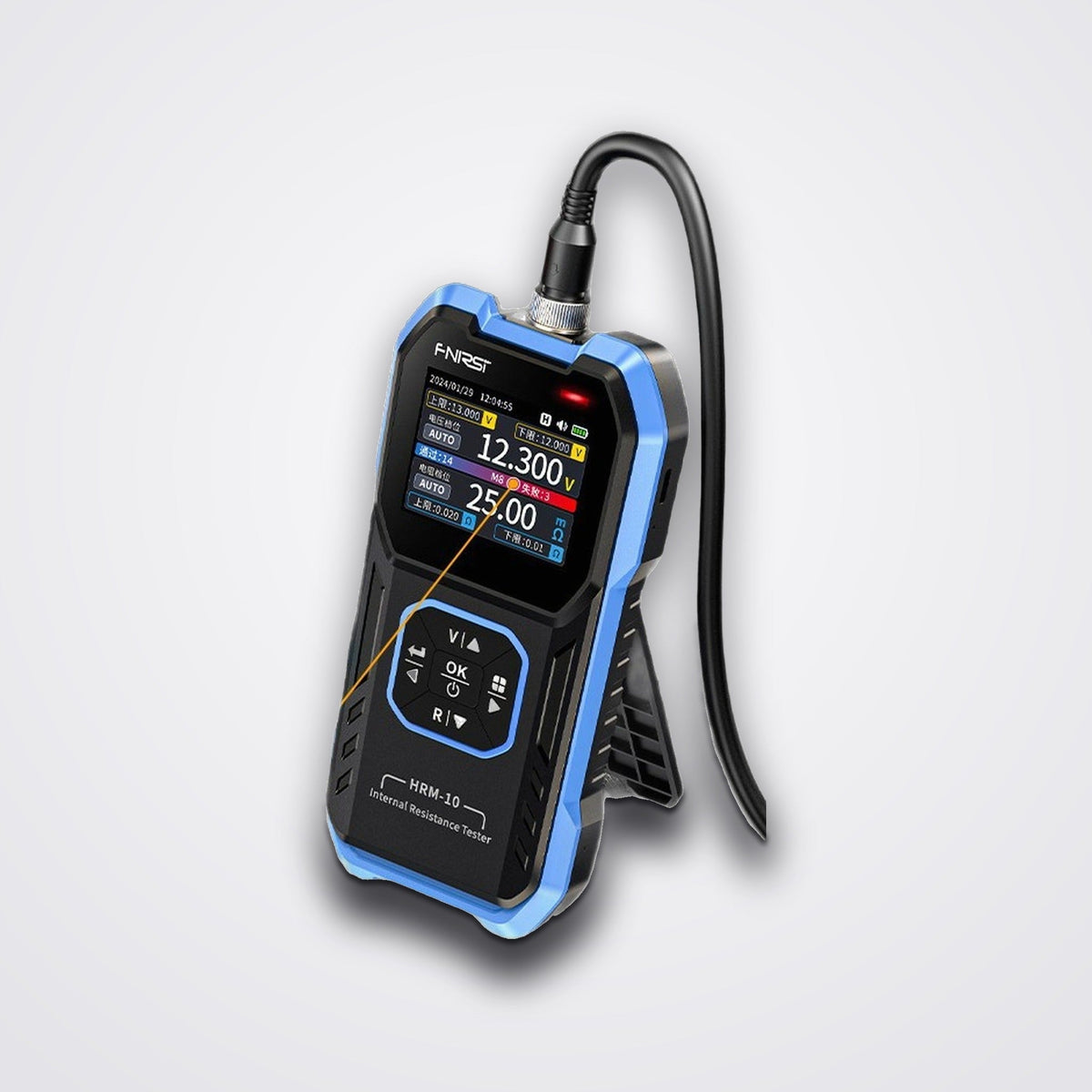
The HRM-10 is a four-wire battery internal-resistance tester that also displays voltage and supports sorting, history and export. A useful comparison keeps resistance beside state of charge, temperature and battery identity. That is how a number becomes a screening record rather than a verdict about a cell.

HRM-10 Battery Resistance Tester — supplier product view.

A second supplier view used to confirm the exact model and interface.
Record the conditions that move the number
A Reddit batteries search result lists ‘internal resistance, measurement method, temperature and state of charge’ as the information that should accompany a second-life battery. Another discussion says IR depends on temperature and state of charge. Use that exact checklist: cell ID, chemistry if known, voltage, temperature, rest time, lead arrangement and resistance.

Manufacturer application artwork; it illustrates a possible setup and is not an EkoDeluxe test.
Use four-wire contact consistently
The store record supports four-wire Kelvin measurement and a 0–100 V voltage range with a 200 Ω resistance range. Clean the contact points and place the sense and current connections consistently. Accessories are sold separately in the merchant record, so do not assume a particular clip set. Take a photo of the connection and keep the tester’s mode in the row.

Original workflow diagram: the record keeps setup, observation and boundary together.
Compare like with like
Screen a small group at a matched state rather than mixing a freshly charged cell with a warm, partly discharged one. Use sorting thresholds only after you have a reference population and a stated reason for the threshold. Export or copy the history so another person can see the original conditions.
Keep screening separate from diagnosis
Internal resistance can flag a difference worth investigating; it does not establish capacity, safety or remaining life on its own. The manufacturer material lists sorting and history, while the product listing supplies the exact model record. Do not convert one resistance value into a guarantee.
Keep a record someone else can use
For each battery row, retain the cell label and rest time. A resistance comparison without state of charge can reverse its apparent ranking. Keep the tester’s exported history with the handwritten notes, and define the screening threshold before looking at the results.
A practical handover
Write down the exact model, the setup, the observation and the limit that still needs checking. For current version and buying information, use the HRM-10 Battery Resistance Tester product page.
For the related product overview, see the HRM-10 Battery Resistance Tester Learn More page.