
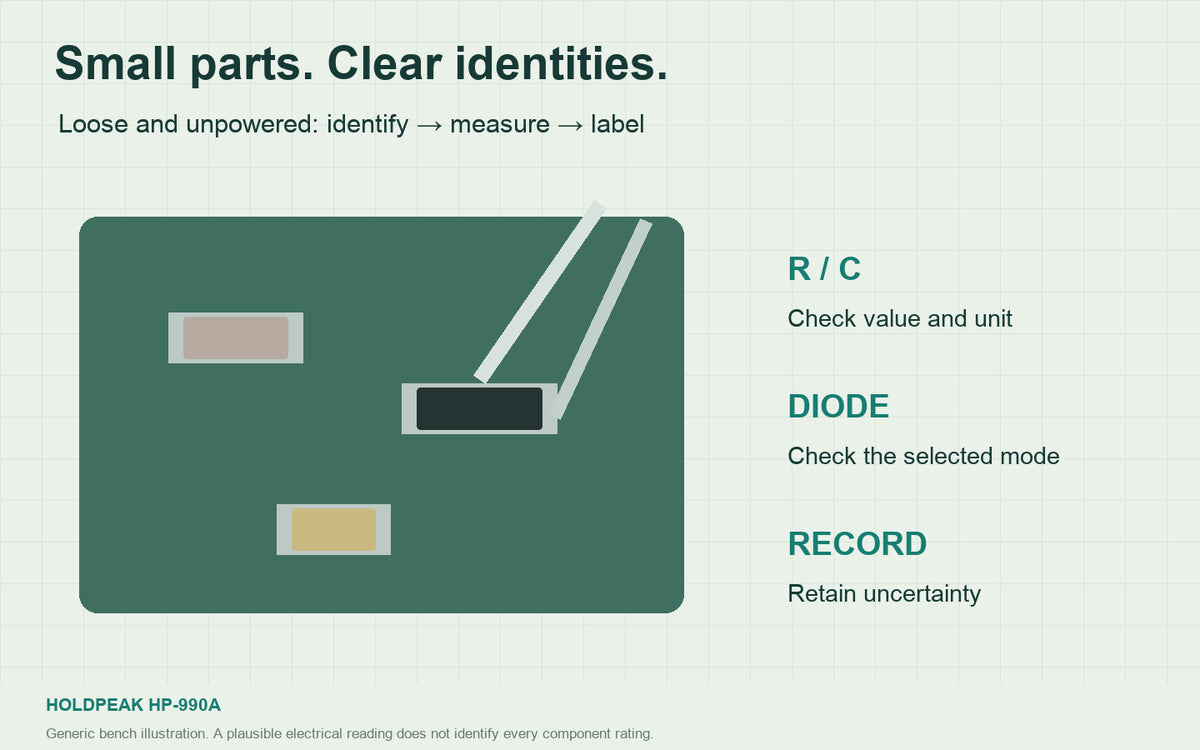
HoldPeak HP-990A SMD component testing is particularly useful when you need to organise loose parts before soldering. Its tweezer format can hold a small component and make electrical contact in one action. The useful outcome is a labelled, plausible part, rather than an unrecorded number on the display.
The HP-990A lists resistance, capacitance, diode and continuity functions, with FUNC, HOLD and SCAN controls. It is not a complete component-identification system: a resistance or capacitance measurement does not reveal every rating, tolerance or operating characteristic of an unknown part.
Prepare a sorting bench that preserves identity
Work with unpowered, discharged loose components. Keep incoming parts, checked parts and uncertain parts in separate labelled trays. If several pieces look alike, assign a temporary ID before measuring rather than trusting their position on the bench.
Retain any packaging or reel information. A supplier label can identify a value, tolerance and voltage rating that a simple electrical reading cannot establish. If packaging and measurement disagree, keep both pieces of evidence and investigate rather than immediately relabelling the whole batch.
Use appropriate electrostatic-discharge handling for sensitive parts and avoid holding the component terminals with your fingers while trying to obtain a dependable contact.

Keep identification, electrical reading and the final component specification as separate steps.
Select the SMD tweezer meter function for the component
Use the manual's mode-selection instructions and confirm the displayed function and unit. An automatic or scanning function is a starting point, not proof that every unfamiliar package has been correctly identified.
| Function | A useful bench question | What remains unresolved |
|---|---|---|
| Resistance | Is the observed value plausible for the labelled resistor? | Power rating and every tolerance or temperature characteristic |
| Capacitance | Is the observed capacitance plausible for the labelled part? | Rated voltage and behaviour under all operating conditions |
| Diode | Is the observed junction response plausible in the selected direction? | Complete device identity and performance |
| Continuity | Is a conducting path indicated under this test? | Whether the part or assembly works correctly in service |
Do not treat these checks as interchangeable. A continuity beep is not a full resistor measurement, and a plausible diode response does not identify every multi-terminal semiconductor.
Make the contact repeatable
Place the tweezer contacts on the intended terminals without bridging adjacent connections. Follow the meter instructions for contact pressure and the selected mode. If the value jumps, first inspect the contact and component position rather than reporting a stable-looking instant chosen from the display.
Repeat an unusual result after repositioning the part. Keep the unit and any displayed range with the number; confusing nF and µF can defeat an otherwise careful sorting process. HOLD can help copy a value, but label it as a retained observation rather than assuming the component remained connected throughout.
The product page does not provide definitive measurement ranges or test frequencies for all functions. Check the correct manual if those determine suitability, especially for very small values or parts whose behaviour depends strongly on test conditions.
Why a populated board is a different task
On a circuit board, other connected components can influence what the meter sees. A resistance across two pads may include parallel paths; a capacitance reading may not isolate one component. A surprising result therefore does not automatically identify the part beneath the tips as faulty.
Start with the schematic and the appropriate service procedure. Where necessary, a competent repairer may need to isolate the component for a meaningful test. Do not apply the loose-part sorting assumptions to an energised or charged assembly.
The listed 36 V maximum input is a limit, not a recommendation to measure powered components. The HP-990A's specified functions also do not include the Battery Power feature associated with other HP-990 variants.
Label the decision as carefully as the measurement
Save the part ID, intended type/value, selected function, observed value and unit, plus any uncertain contact or mismatch. A useful tray label might say “matches marked value under this check” or “requires identification”, rather than simply “good”.
Our multimeter guide gives broader context for choosing electrical test functions. View the HoldPeak HP-990A SMD tweezer meter to confirm the exact model for your component-sorting bench.
Explore the HoldPeak HP-990A
See its functions, suitable tasks and key limits before choosing.