
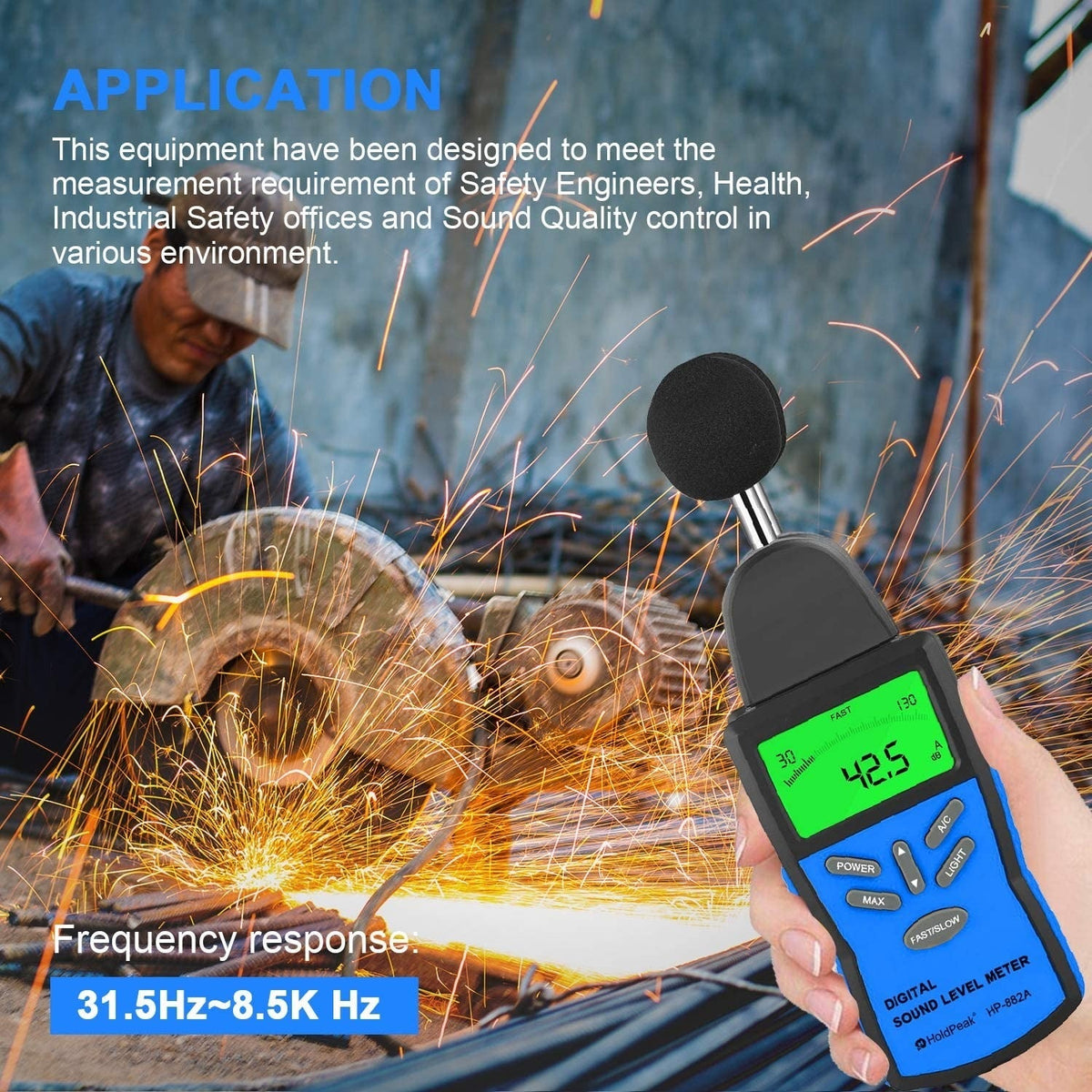
The HoldPeak HP-882A sound level meter offers A/C weighting and FAST/SLOW response. Changing either can change the displayed result without the noise source itself changing. To compare a fan, appliance or workshop arrangement, keep those settings and the measurement position consistent before interpreting a difference in decibels.

Application artwork from the product page. A handheld spot check does not establish noise exposure or hearing protection needs.
Choose a comparison question first
A useful question might be: does the same appliance produce a different spot reading at the same listening position when its operating mode changes? That is narrower than asking whether a workplace is safe or whether a neighbour's noise meets a legal limit.
The HP-882A lists a 30–130 dB range, 31.5 Hz–8 kHz frequency coverage, A/C weighting and FAST/SLOW controls. These functions support different observations; they do not establish an IEC instrument class, accredited calibration or a complete exposure-assessment capability.
Identify the required method before selecting a setting. If a professional assessment or contractual standard specifies the equipment, weighting, response, averaging and calibration procedure, follow that method rather than substituting an informal handheld spot check.
Understand A and C as frequency choices
Frequency weighting changes how different parts of the sound spectrum contribute to the displayed level. A-weighted and C-weighted numbers therefore describe different weighted quantities. A C-weighted value being larger than an A-weighted value is not automatically a meter fault.
For a before/after comparison, record the weighting and use the same one for both observations. If you deliberately examine both, keep two labelled sets. Do not compare yesterday's A-weighted number with today's C-weighted number and attribute the full difference to a quieter machine.
The gap between the two may suggest that spectral content deserves closer investigation, but is not by itself a detailed frequency analysis. The meter's listed coverage does not turn two broadband weighting results into an octave-band report.
Treat FAST and SLOW as time-response choices
A slower display response can make a varying source easier to follow; a faster response can show changes differently. Neither is a universal “more accurate” button. Use the response required by the task, and note it with the reading.
Likewise, a MAX display depends on how the instrument captures and retains its result. Do not label a held maximum as a true acoustic peak, a continuous equivalent level or a personal noise dose unless the instrument and method explicitly support that quantity.
Use the actual manual for starting, resetting and recalling display functions. A maximum carried over from an earlier location can defeat an otherwise careful comparison.
Keep the room and operating conditions visible
Use a fixed position and repeatable microphone orientation. Record distance, nearby reflecting surfaces, doors, windows and the appliance's operating state. Keep handling and clothing from interfering with the microphone, and consider whether airflow or wind affects the observation.
Listen for other sources such as traffic, a refrigerator or another fan. Background sound contributes to the result, especially when the source of interest is only slightly louder. Decibels are logarithmic; subtracting two displayed dB values does not directly isolate the source's sound level.
Repeat a comparison when the background is suitably stable. If it is not, state that limitation rather than constructing a precise ranking from mismatched moments.
Write the result in a comparable form
A compact note might contain position, distance, source mode, A or C weighting, FAST or SLOW response, display function, observed value and background conditions. Keep repeated observations separate rather than replacing them with an unexplained single number.
For hearing-risk decisions, complaints or workplace exposure, obtain an appropriate assessment. A spot reading from this guide cannot establish a safe duration or choose hearing protection. The HP-882A is most useful in this comparison when the question and settings remain attached to the result. For the distinction between display detail and supported accuracy, see calibration and accuracy basics.
Explore the HoldPeak HP-882A
See its functions, suitable tasks and key limits before choosing.