
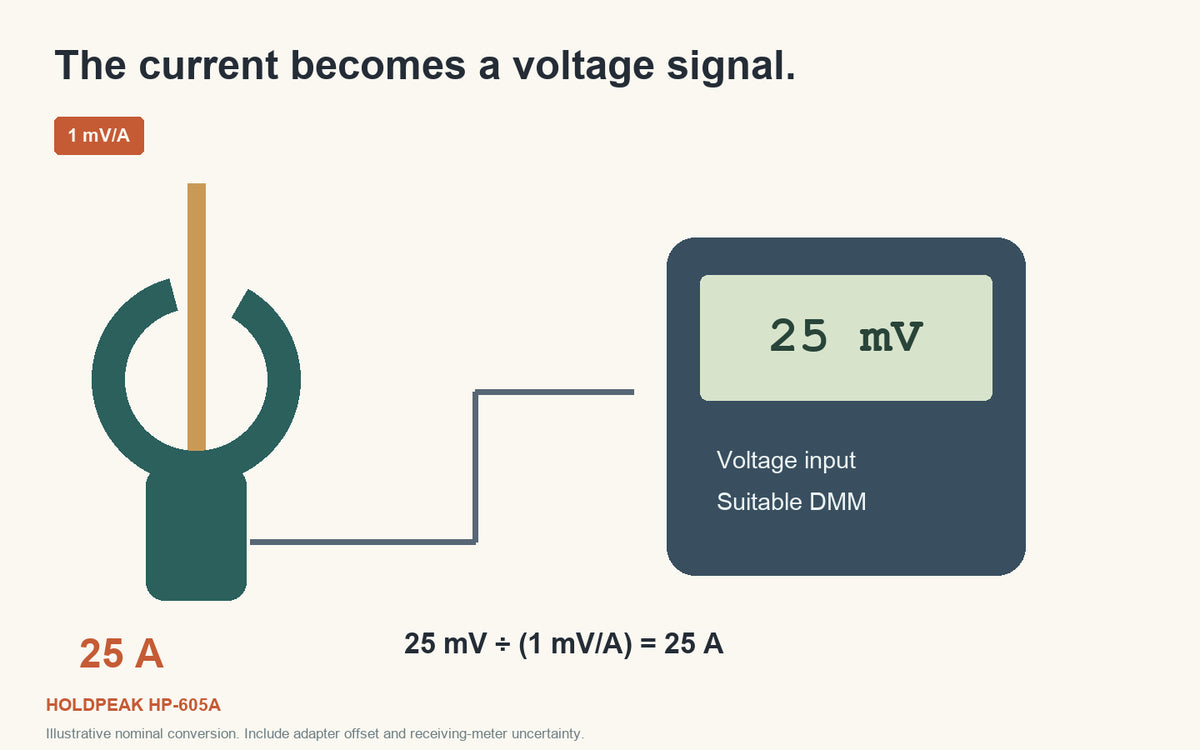
The HoldPeak HP-605A's 1 mV per amp output means a separate multimeter reads a voltage representing current. It is a clamp adapter, not a standalone meter with its own numerical current display. Before buying, check the adapter and receiving multimeter as a complete measurement chain.
The HP-605A is listed for up to 600 A AC/DC, with a 45 mm jaw and a 1 mV/A output through banana plugs. These specifications describe capacity, physical access and conversion. They do not, on their own, establish the accuracy or safety of the whole setup.
Understand the 1 mV/A clamp-adapter conversion
At the nominal conversion factor:
Current in A = output in mV ÷ 1 mV/A.
The numerical values therefore match when the output is expressed in millivolts and the current in amps. A multimeter displaying volts needs a unit conversion first.
| Illustrative output | Same output in volts | Nominal represented current |
|---|---|---|
| 10 mV | 0.010 V | 10 A |
| 25 mV | 0.025 V | 25 A |
| 100 mV | 0.100 V | 100 A |
These are arithmetic examples using the stated conversion factor. They are not measured HP-605A results and do not include offset, calibration uncertainty or the receiving meter's error.

Illustrative conversion only: at 1 mV/A, 25 mV represents 25 A before considering offset and measurement uncertainty.
The receiving meter measures voltage
The adapter output belongs on the multimeter's appropriate voltage inputs and function, as specified in both manuals. It is not a reason to route the adapter output through the meter's high-current measurement socket.
For a DC-current check, the receiving arrangement needs suitable DC millivolt capability. For AC, confirm the required voltage mode, frequency response and waveform suitability. Selecting an AC current label on the clamp does not establish that every receiving meter handles the resulting signal accurately.
Our multimeter versus clamp-meter guide explains the wider distinction between direct current measurement and a clamp-based method.
Check resolution at the current you care about
A 600 A upper rating says little about how well a particular meter-and-adapter combination resolves a small change. At 1 mV/A, a small current produces a correspondingly small output voltage.
Check the receiving meter's available voltage ranges, resolution and accuracy at the relevant output. Add the adapter's specifications and any offset considerations from its manual. Do not assume that displaying extra digits makes the complete result accurate to those digits.
Likewise, the AC/DC label does not establish true-RMS performance for every waveform or an unlimited frequency range. If non-sinusoidal current is central to the task, confirm the capabilities of both parts of the chain.
Plan the clamp placement
The 45 mm jaw gives a physical size limit, but there must also be safe access to the intended conductor and room to close the jaw properly. Follow the manual for conductor positioning and any zero or offset procedure provided for the selected mode.
For an individual current measurement, the intended conductor must be identified correctly. Enclosing outgoing and return conductors together can cancel their contributions and answer a different question from measuring either conductor alone. A whole cable is therefore not automatically the right clamping point.
Do not expose live conductors or alter an installation merely to obtain access. Verify the applicable voltage, category and environmental ratings of the adapter, receiving instrument and leads against the task. A 600 A capacity is not a CAT rating or permission for any mains application.
Record the chain, not just the converted number
Save the adapter model, receiving-meter model and range, AC/DC selection, raw output and calculated current. Include the conductor identity and relevant operating condition. Retaining the raw millivolt value lets a later reviewer check the unit conversion.
For wider purchasing choices, see our UK clamp-meter guide. View the HoldPeak HP-605A clamp adapter if you already have, or plan to obtain, a suitable receiving multimeter.
Explore the HoldPeak HP-605A
See its functions, suitable tasks and key limits before choosing.