
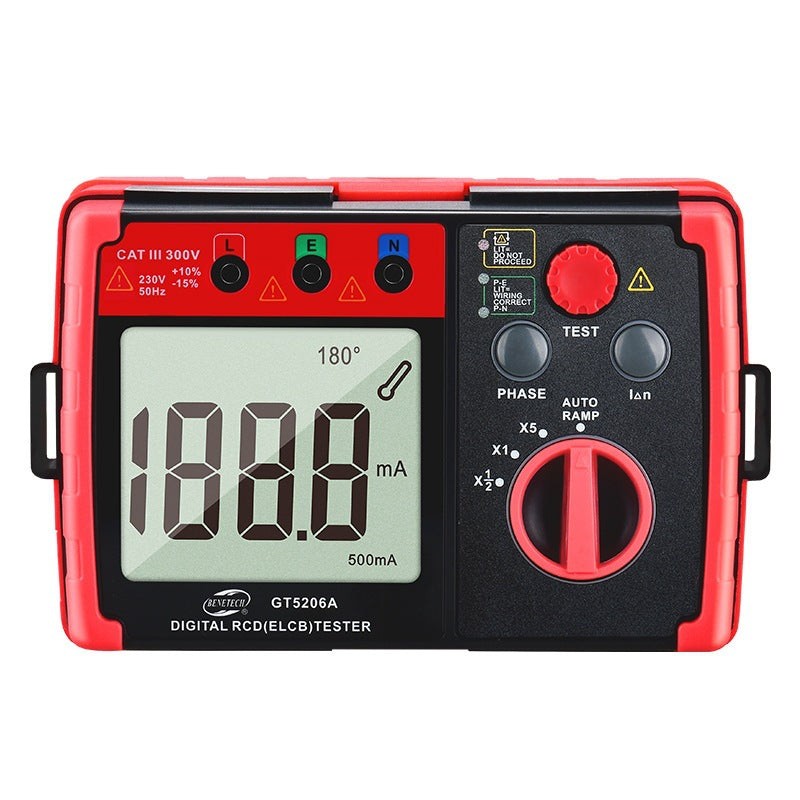
The BENETECH GT5206A RCD tester can measure a protective device's response under a defined test. That is different from discovering why the household RCD tripped unexpectedly last week. Trip time and ramp-test tripping current are useful results, but neither is a complete diagnosis of intermittent nuisance tripping.
For an electrician investigating repeated trips, the first task is to separate the device response from the installation and appliance conditions that may have caused the event.

Keep phase, current setting and mode alongside the trip-time or ramp-current result.
Keep the complaint and the test result separate
An RCD may trip when nobody is present, interrupting heating or a freezer and leaving little evidence. A useful customer record includes the approximate time, weather, appliances operating and whether any equipment had just switched on. The word nuisance describes the disruption; it does not prove that the protective action was unnecessary.
Avoid repeatedly resetting or changing protective devices without investigating the cause. Installation testing and fault-finding require a competent person using the appropriate procedures. A homeowner's event diary can help that person, but it is not a substitute for electrical assessment.
Understand what the GT5206A is configured to test
The reviewed GT5206A is for single-phase 230 V, 50 Hz circuits. Its controls include 0°/180° phase selection and ×½, ×1, ×5 and AUTO RAMP modes. Confirm the RCD type, rated residual operating current, compatible test method and required limits before selecting a mode.
The available current settings and supported RCD waveform classes are not established completely by the reviewed listing. Do not assume compatibility with every AC, A, F or B device simply because the instrument is called an RCD tester. Use the supplied manual and the applicable installation requirements.
The test deliberately introduces a residual-current condition and may interrupt supply. Plan for connected equipment, occupants and safe restoration before starting. Wiring-check indicators help with the instrument's permitted test sequence; they are not a full certificate that the installation is safe.
Trip time and ramp current answer different questions
| Test observation | Unit | Question it helps answer |
|---|---|---|
| Time at a selected test-current multiple | Milliseconds | How quickly did the device operate under this test? |
| Ramp-test operating current | Milliamperes | At what increasing test current did operation occur? |
| Phase selection | 0° or 180° | Under which starting half-cycle was the test made? |
AUTO RAMP is listed as reporting tripping current and trip time together. Keep those two quantities distinct in the report. Do not compare a value in mA with a limit expressed in ms, or compare different test-current multiples as though they were the same experiment.

Mode and unit explanation only; no universal acceptance threshold or supported RCD class is implied.
Record the settings beside every result
Write down the circuit and device identification, selected rated current, test multiple or ramp mode, phase and result. Use the applicable limits for that device and procedure; there is no single trip-time number that can be applied to every test mode and every RCD.
If the display gives an over-range or no-trip indication, record the actual indication and conditions. Do not turn it into a measured time by assigning the display limit as the result. Investigate according to the test procedure.
Why a satisfactory response may not explain random trips
An RCD that responds appropriately during a scheduled check can still operate later when leakage conditions change. Moisture, appliance behaviour and cumulative leakage are among the possibilities a competent investigator may need to assess. The tester does not recreate every combination that existed during the original event.
An insulation resistance tester may contribute to a separate, properly prepared investigation, but the GT5206A is not that instrument. Nor is it a leakage-current clamp. The required follow-up depends on the circuit and equipment; changing devices to suppress unexplained trips is not a measurement plan.
The BENETECH GT5206A product page provides the current model and connection information. For broader instrument-selection context, see the related electrical-testing guide. A useful report states exactly what the RCD test established and what remains unresolved about the original trip.
Explore the BENETECH GT5206A
See its functions, suitable tasks and key limits before choosing.