
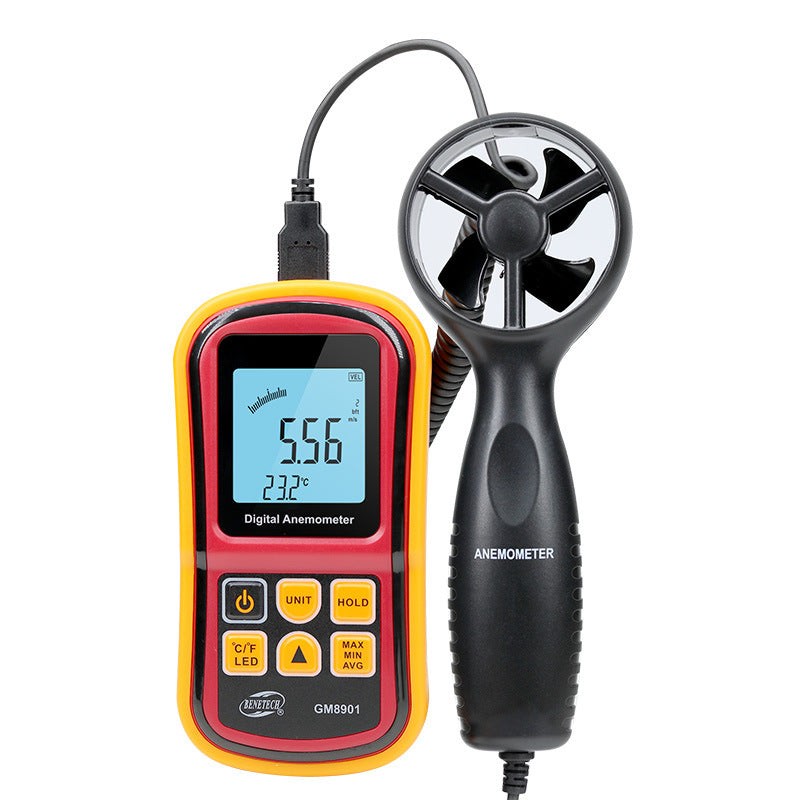
The BENETECH GM8901 digital anemometer displays wind speed, air temperature and wind force level. Wind force is a convenient summary, but it does not replace the underlying speed, unit, observation height or exposure conditions.
For outdoor checks—whether around a vent, a drone launch or a fishing spot—the useful record keeps the measured speed and the context that makes it meaningful.

Keep the raw speed with the classification
The GM8901 listing gives a 0.3–45 m/s range, 0.1 resolution and ±3% accuracy, and also shows a wind-force level. Record the speed and unit even when the force scale is the headline someone wants to discuss.
Force categories are derived from speed bands and can be useful for communication. They do not describe gust duration, turbulence or local obstructions. A classification without the raw value makes it harder to reproduce or challenge the observation.
Avoid mixing outdoor and vent meanings
At a fan outlet or grille, the local velocity can be engineered and constrained. Outdoors, the flow may be variable and affected by buildings, trees, roof height and terrain. The same handheld reading can therefore answer different questions in the two settings.
Record observation height, orientation, position and duration. If the purpose is a drone or kite decision, include the operator's safety requirements; a single reading near ground level may not represent the flight path. If the purpose is an HVAC check, use the appropriate grille or duct sampling method.

Do not label a maximum as a gust without a method
The instrument can show wind force but the reviewed listing does not establish a meteorological gust algorithm or time window. If the display has a MAX function, check how it works. Preserve the sampling period and mode.
The phrase wind meter is common in community posts, where users may casually report a peak. A useful technical record should say whether the number is current, average, maximum or a manually observed moment.
Keep temperature separate
Air temperature is a different measurement from wind speed. It can help describe the condition, but it is not a direct correction to a speed reading unless the chosen method supports that calculation. Record both values and units independently.
The listed 9 V battery and compact body are practical kit details. Check the battery condition and instrument response before travelling to a location where a repeat visit is difficult.
Check uncertainty near a boundary
With ±3% listed accuracy, a reading near a decision threshold may need the relevant uncertainty considered. For example, a displayed 10.0 m/s does not mean the true value is known to the nearest 0.1 m/s simply because the resolution shows that increment.
The same principle applies to the 45 m/s upper span. Do not extend the instrument beyond its listed range to obtain a dramatic reading, and do not treat an over-range display as a valid force category.
Make the result actionable without overclaiming
A good GM8901 record says where, when, how and under what operating state the speed was measured, then adds the force category as a convenience. That format supports a sensible follow-up—repeat the point, change the fan state or stop an outdoor activity—without turning one number into a complete weather or ventilation assessment.

See the BENETECH GM8901 product page for the current version and kit, or read the BENETECH GM8901 overview before choosing.