
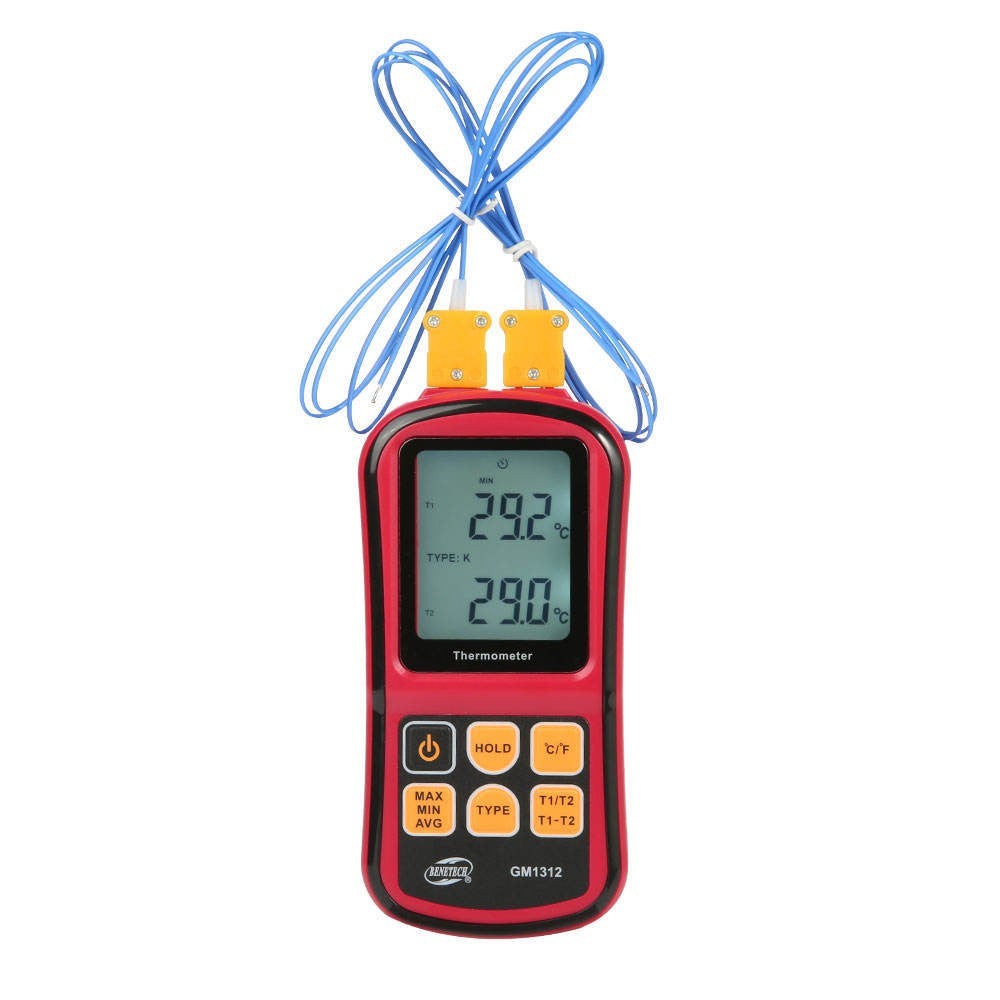
Before interpreting a flow-to-return temperature difference, check whether the two probes agree when they are measuring the same stable condition. The BENETECH GM1312 provides T1, T2 and T1−T2 views. That subtraction is useful, but it includes differences caused by the probes, contact and placement as well as the temperatures you wanted to compare.
A same-point comparison followed by a controlled probe swap can help identify the source of an unexpected difference. It is a troubleshooting check, not a calibration certificate.

Identify each probe and channel before interpreting T1 minus T2.
Match the probe type and physical task
The GM1312 has two flat-pin thermocouple inputs and a TYPE control; the reviewed sample display shows K type. Confirm the actual supported types and select the one that matches the connected probes. Do not infer that every thermocouple type or temperature range is supported from the presence of a TYPE button.
A K type thermocouple probe may be a bead, surface probe or another construction. Its safe range, insulation and contact method can be more restrictive than the meter's capability. Choose a probe designed for the target and working conditions. A loose bead held near a pipe does not necessarily measure the pipe surface reliably.
Compare the probes at one stable location
Place both suitable probes in the same well-controlled condition using the appropriate method. Keep immersion depth or surface contact comparable and allow them to settle. Avoid warming one with your hand while the other is exposed to airflow.
Record T1, T2 and the difference. If the two readings disagree, possible contributions include probe differences, contact, temperature gradients, connectors, type setting and instrument channels. A single comparison cannot identify all of them, but it tells you whether a later small difference may need caution.
For formal thermocouple calibration, use suitable traceable references and the required procedure. A same-point check at one temperature does not establish accuracy across the full working range.
Move to the two points without changing the method
For an accessible heating-system comparison by a suitable person, use compatible surface probes and secure them consistently at the defined flow and return locations. Record system operating state, timing, contact method and nearby insulation. Do not remove protective covers or touch hazardous hot surfaces to obtain a reading.
The phrase flow to return identifies a pair of locations, not a universal target difference. Heating design, load, controls and operating stage determine what is expected. A temperature difference alone does not prove that a system is balanced or diagnose a circulation problem.

Probe comparison concept only. Safe contact, matching probe type, stabilisation and changing system conditions all affect interpretation.
Use a swap to test an apparent difference
Suppose teaching readings show 55°C at the flow location and 45°C at the return, giving 10°C difference. Swap the two probes between those physical locations only when it is safe and permitted, leaving the location definitions unchanged. Let both settle again.
If the apparent difference changes noticeably with probe assignment, investigate probe/contact contributions. If the system itself is changing during the swap, the result is inconclusive; repeat under a more stable condition rather than assigning the change entirely to the probes.
Keep the sign convention clear. T1−T2 changes sign when the channel-to-location assignment is reversed. That mathematical change is not evidence that the heating flow physically reversed.
Keep the measurement record readable
| Field | Record |
|---|---|
| Channel assignment | Which probe and physical location are T1 and T2 |
| Probe type | Selected type and actual probe construction |
| Contact method | Attachment, immersion or other approved arrangement |
| Operating state | Timing, load and relevant controls |
| Values | T1, T2 and signed T1−T2 |
The GM1312 also has HOLD and MAX/MIN/AVG controls. Confirm their behaviour before interpreting a retained value as a particular time average. These controls do not establish unattended logging or automatic heating diagnostics.
See the BENETECH GM1312 product page for the current probe configuration. Our temperature-instrument guide helps distinguish a handheld comparison from a separate long-term recording requirement.
Explore the BENETECH GM1312
See its functions, suitable tasks and key limits before choosing.