
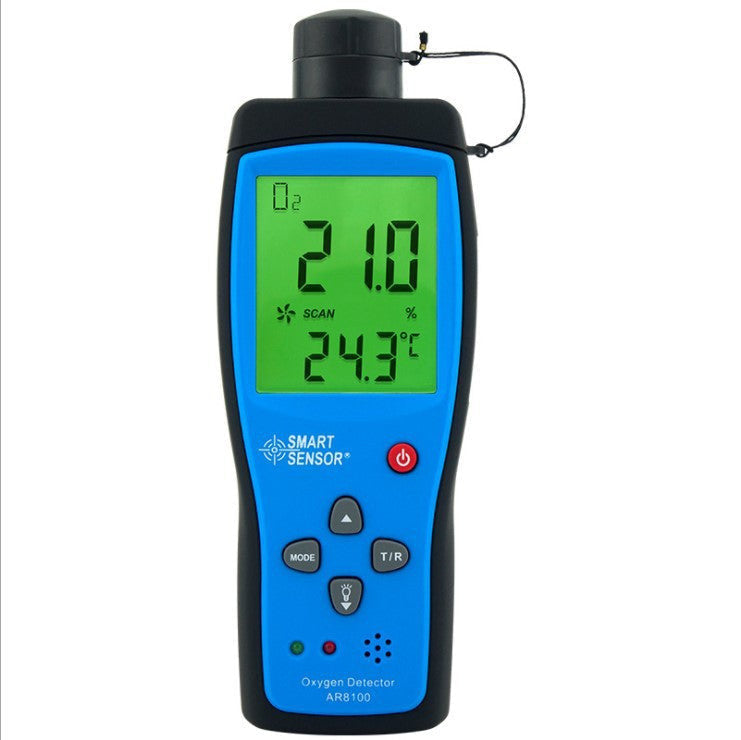
The Smart Sensor AR8100 displays oxygen concentration in percent together with ambient temperature. Before relying on an oxygen reading, establish the checks and operating procedure behind it. A powered display is not proof that the sensor, alarm and sampling arrangement are suitable for the task.
The saved product description identifies an oxygen instrument. It does not establish a complete gas-detection programme, certification or permission to enter a hazardous area.

Smart Sensor AR8100 supplier product image. Screen values and accessory layouts are illustrative; confirm the selected version.
Keep oxygen distinct from other gases
An O2 percentage answers a different question from CO or CO2 in ppm, or combustible gas as a percentage of a lower explosive limit. A plausible oxygen reading does not show that other dangerous gases are absent. Choose the gases and equipment from the actual risk assessment and competent procedure.
Confirm the AR8100's range, accuracy, response, sensor-life and permitted operating conditions from its exact documentation. The short shop feature list does not define all of them. Do not fill essential gaps with specifications from another Smart Sensor model.
Distinguish a response check from calibration
Gas-detection discussions on Gas-detection discussions use “bump test”. In general, that refers to a prescribed functional response check using suitable known test gas. Calibration is a separate process. Follow the manufacturer's exact requirements for the supplied instrument, test gas, regulator, equipment and schedule; do not improvise a test with breath, fumes or an uncontrolled gas source.
Check the required service and calibration records as well as battery and physical condition. Keep the top-mounted sensing area unobstructed according to the instructions. A cap or protective feature should be treated as its documentation specifies, not guessed from its appearance.

A spot O2 percentage is not confined-space entry clearance.
Give the reading a sampling context
Record where and when the observation was taken, the relevant process state, sampling method and instrument identity. The atmosphere at one accessible position may not represent another position or a later time. A single spot observation should not be expanded into an unsupported claim about an entire space.
For confined-space or other safety-critical work, use the approved equipment, training, sampling plan, response arrangements and procedures. Do not treat an AR8100 spot reading as an independent entry clearance. Alarm settings and acceptance criteria must come from the applicable procedure, not a number copied from an unrelated forum.
The useful preparation is a complete chain: suitable instrument, valid checks, correct sampling and a defined action. The displayed O2 value belongs at the end of that chain, with its conditions attached.
For the current specification and supplied version, see the Smart Sensor AR8100 product page.
For the related product overview, see the Smart Sensor AR8100 Learn More page.