
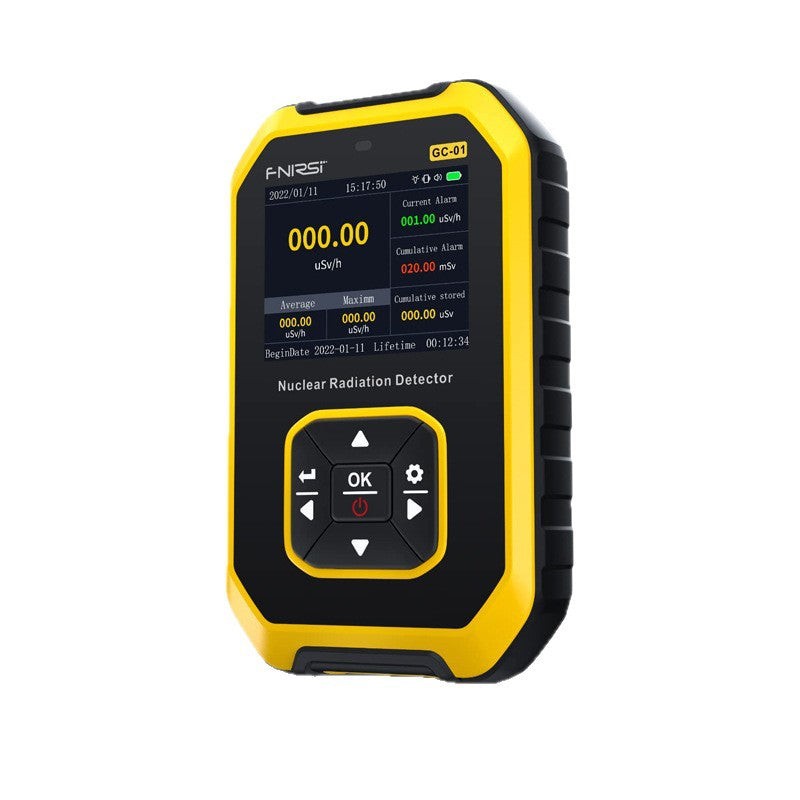
It is normal for a Geiger counter's background count display to move around. The FNIRSI GC-01 offers cps and cpm alongside dose-related units, and a short count does not arrive as a perfectly steady stream. A changing background CPM is not, by itself, evidence that the instrument is broken or that the surroundings have suddenly changed.
The useful first session is a repeatable observation of ordinary background conditions, with no attempt to obtain or handle a radioactive source.

Count rate and dose rate are different quantities
Counts per minute describes detected events per unit time. A dose-rate indication applies the instrument's calibration and response assumptions to the detected radiation. The two are related through the detector and radiation field, but there is no universal CPM-to-dose conversion for every material and energy.
The GC-01 listing identifies gamma, X-ray and beta detection, and explicitly excludes alpha. It describes dose rate and cumulative dose, but also identifies the product as a screening instrument rather than a calibrated legal-metrology instrument. Do not turn the phrase energy compensated into a claim of independent certification.
Why short observations fluctuate
Radioactive counting has statistical variation. As a simplified counting example, if an observation collects 25 counts, the square root of that count is five. That is a relatively large variation compared with the total. At 100 counts, the square root is ten, a smaller fraction of the total.
This example explains why a longer, consistently collected observation can make a background comparison easier to interpret. It is not a specification for the GC-01's averaging algorithm or a complete uncertainty calculation. Instrument response, environment and the measurement method still matter.

Build a baseline without creating a source experiment
Choose a normal location, place the instrument consistently and follow its operating instructions. Record the unit, observation duration and location. Repeat under similar conditions before drawing conclusions from a single brief display.
Keep the same readout mode. A value shown in cps cannot be compared numerically with a previous cpm value without accounting for the time unit. If the screen shows an averaged rate, note that it is not necessarily a count accumulated over the interval you happened to watch.
Do not open the detector, modify its tube or use medical equipment to test it. Unexpectedly elevated readings require an appropriate radiation-safety response, not closer handling of the object in search of a more dramatic number.
What a reading near an object cannot identify
Online discussions of uranium glass often mix appearance, UV fluorescence and Geiger-counter readings. None of those observations alone identifies a material's exact composition, radionuclides or safety. A low response may also reflect geometry, shielding or the instrument's sensitivity to that radiation.
For unknown or potentially hazardous material, use the appropriate specialist route. A consumer screening meter cannot clear it for unrestricted handling or disposal.
Keep the cumulative display tied to time
The GC-01 also records cumulative dose and retains data after shutdown. Before interpreting that value, check what period it represents and how the actual device starts, stops and resets accumulation. A total from a previous session is not the dose from the last few minutes.
The most useful first result is a labelled background observation with a repeatable method. Understanding natural count variation prevents both unnecessary alarm and false reassurance from a handful of changing digits.

See the FNIRSI GC-01 product page for the current version and kit, or read the FNIRSI GC-01 overview before choosing.