
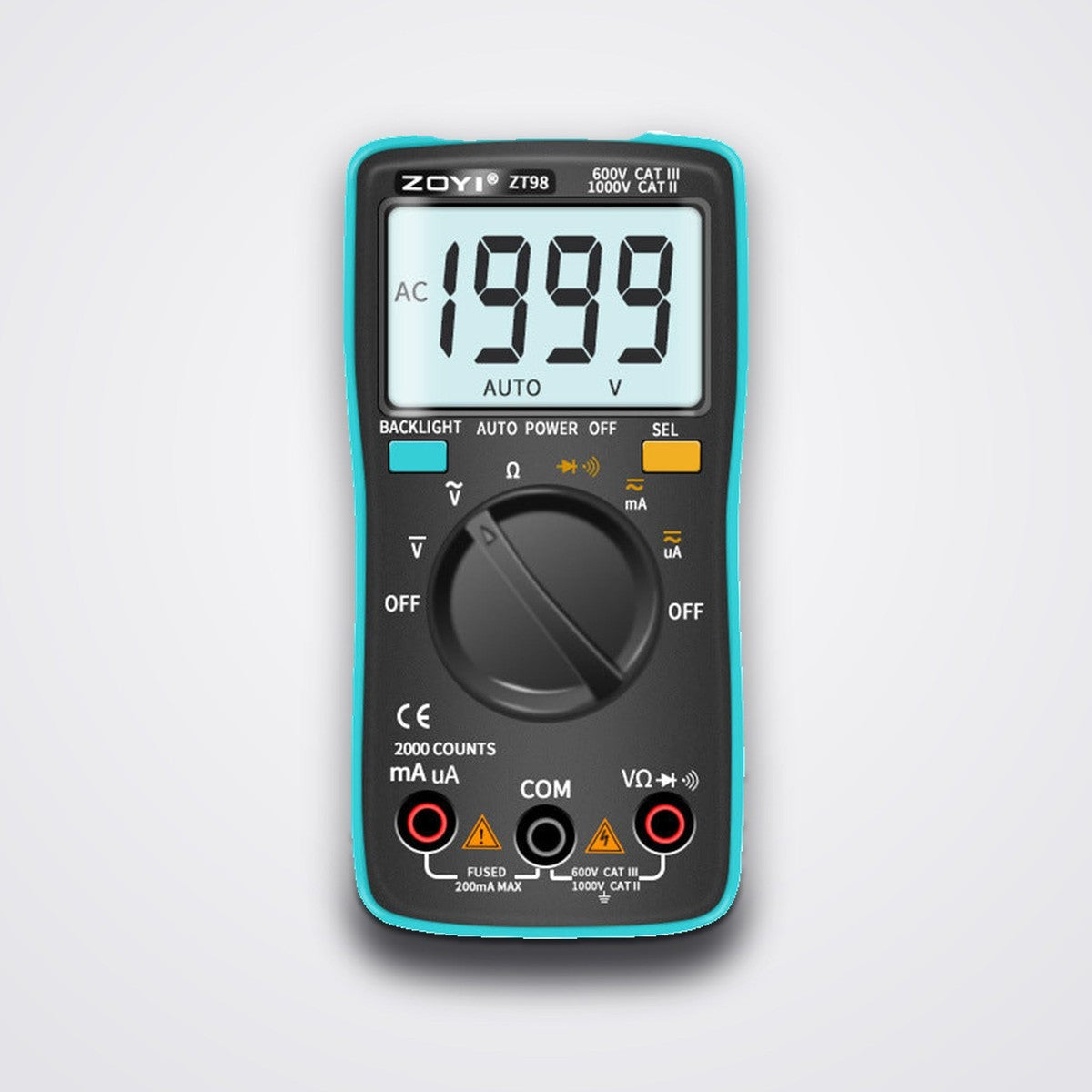
When a resistance measurement is small, the probes and their contact points can become a noticeable part of the result. The ZOYI ZT98 is listed with resistance measurement and a 1999-count display, making it worth understanding what a basic two-lead observation includes before using it to judge a wire or connection.
The useful first question is whether the setup can resolve the difference you care about. A small displayed value does not automatically belong entirely to the component under test.

The measuring path includes more than the component
A two-lead resistance measurement includes the test leads and the contacts made at the probe tips. Dirty surfaces, light pressure, movement or a poor connection can change the displayed result.
Check the meter's instructions and range first, then inspect the leads. On an unpowered task, an appropriate probe-to-probe check can help reveal the setup's basic behaviour. It is a check of the measuring arrangement, not a universal calibration or proof that the leads are suitable for every application.
Never use resistance measurement on an energised circuit. Disconnect supplies and address stored energy by the appropriate procedure before connecting the meter.
Use a numerical example cautiously
Imagine that a consistent probe-to-probe check gives 0.3 Ω, while the same setup across an isolated piece of wire gives 0.5 Ω. Subtracting gives an indicated difference of 0.2 Ω. That arithmetic does not remove contact variability, display quantisation or measurement uncertainty.
These are illustrative values, not ZT98 test results or a claim about its range resolution. If the connection changes enough to move the last digits, the difference may not support a strong conclusion. For very low resistance, a suitable four-wire method may be required.

Make the contact repeatable
Choose defined clean contact points appropriate to the item and method. Keep the connection stable, then repeat after reconnecting. If repeated contacts produce a wide spread, investigate the setup before deciding the component has changed.
Record the range and unit as well as the number. An Ω result and a kΩ result differ by a factor of a thousand. A 1999-count display does not establish the resolution on every range, so obtain the relevant table rather than guessing from the count specification.
Resistance is more informative than a vague “beep”
In electronics discussions, people often say a connection beeps out. A continuity indication, where a meter provides it, is based on a threshold and response behaviour. It does not directly establish the resistance or load-carrying condition of a connection.
The reviewed ZT98 listing confirms resistance measurement but does not provide a complete continuity specification. Use the documented resistance function for this discussion, and confirm any other function on the actual model before relying on it.
Decide what the result can support
A basic two-lead reading may help distinguish a clearly open path from a finite resistance, or compare suitable unpowered components when the differences are large enough. It may be inadequate for deciding whether a very low-resistance joint meets a tight requirement.
Keep the component's identity, contact points, range and repeated observations together. If the result sits near the method's practical resolution, write that limitation instead of adding decimal places to the conclusion.
The ZT98 is most useful when the measurement question matches its documented capability. Learning the contribution of leads and contacts is a valuable part of learning how to use a multimeter on small resistance values.

See the ZOYI ZT98 product page for the current version and kit, or read the ZOYI ZT98 overview before choosing.