
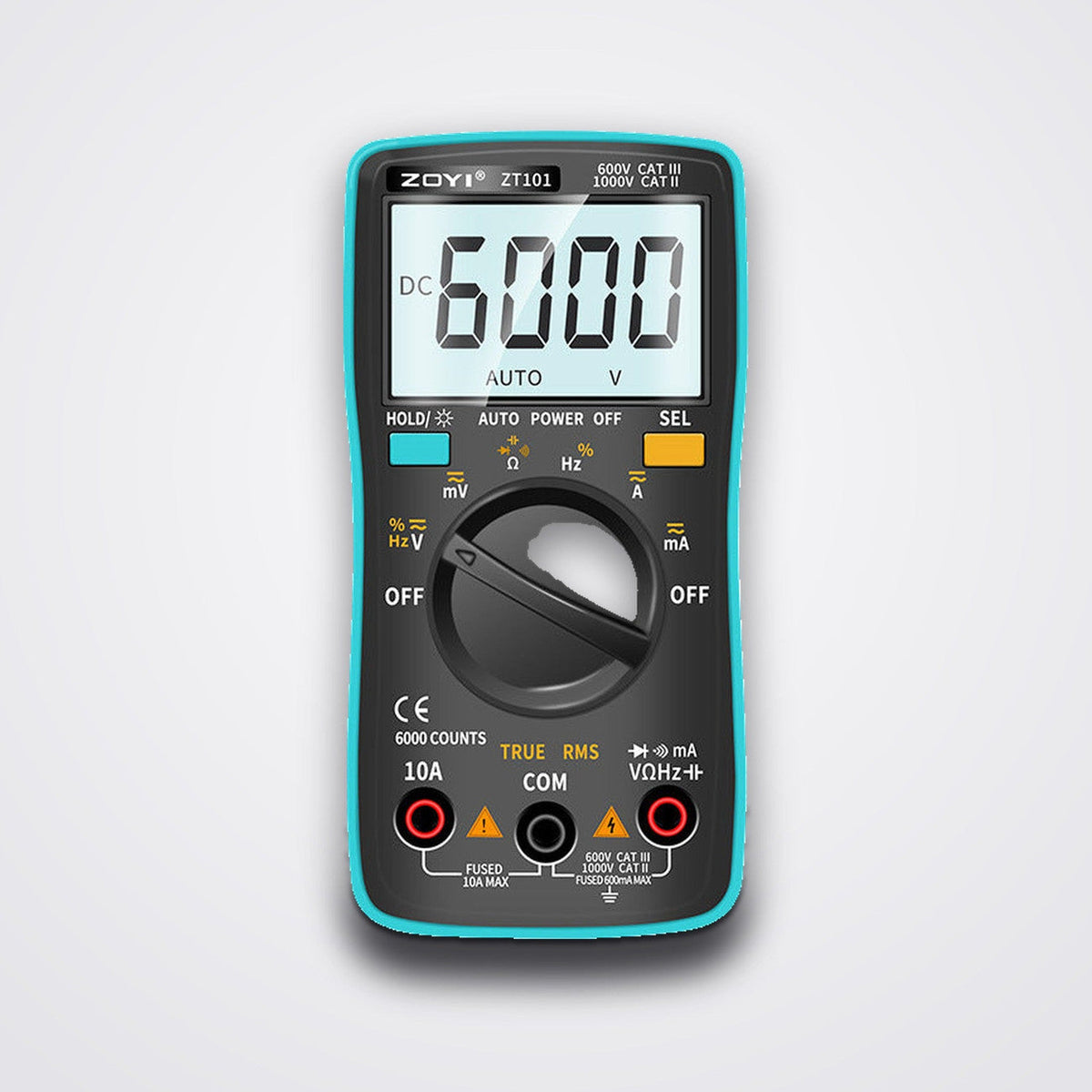
The ZOYI ZT101 can measure a capacitor within its listed range of up to 9999 µF, but the connection can change what the reading represents. A capacitor measured in circuit may still be connected to other capacitors, resistors or semiconductor paths. The display can therefore answer a different question from “what is the value of this one part?”
That is a useful starting point when a repair-bench reading looks unexpectedly high, unstable or absent. Check the test arrangement before deciding the component has failed.

ZOYI ZT101 supplier product photograph. Displayed values are illustrative.
Identify the component and its unit
Read the marking and write the expected value with its unit. Nanofarads and microfarads are easily confused: 1000 nF equals 1 µF. A printed voltage rating is a separate property; it is not the capacitance setting you should expect on the meter.
The ZT101 combines a 6000-count display with listed resistance, frequency, voltage and capacitance functions. The 9999 µF figure is the capacitance endpoint. It is not a guarantee of identical resolution or accuracy across the whole span, nor a statement about how long a large capacitor takes to settle.
Move from an uncertain reading to a useful one
For a disconnected-component check, use the equipment procedure to remove power and make stored charge safe. Verify discharge before attaching a capacitance tester. Separate the part from surrounding paths as the repair procedure requires, select the proper function and make secure contact without touching both conductive points with your fingers.
Record the result only once the display has settled. If it does not settle, inspect the connection, confirm the selected function and check that the component falls within the documented range. Do not repeatedly switch modes while the component remains charged or connected to a powered board.

A capacitance reading is not a complete capacitor-health test
Consider a hypothetical board with two capacitors connected in parallel. A measurement across those shared nodes may include both parts. Removing one appropriately can change the reading even though neither component has changed. This explains why an in-circuit number and a component-only number need different labels in a repair note.
A value check is one part of the diagnosis
A capacitor can have a plausible capacitance yet perform poorly in service. ESR and leakage are different properties. If the fault points towards either, use the appropriate test equipment and component procedure. The ZT101 specification used here does not establish ESR measurement.
Likewise, a larger capacitance range does not turn a DMM into a full component-identification instrument. An LCR or component checker may answer other questions, but its own capabilities must be verified separately.
Keep the bench setup repeatable
Use suitable test leads for multimeter component work, check contact cleanliness and keep a note of whether the part was isolated. A compact 130 × 65 × 32 mm meter is easier to store when its leads have their own place and the operating instructions stay with the kit.
Choose the ZT101 for its documented compact-meter functions and wider capacitance endpoint. If contact temperature is also part of your routine, compare the ZT102 explicitly; do not assume that function comes with every 6000-count model.
For the current specification and supplied version, see the ZOYI ZT101 product page.
Explore the ZOYI ZT101
See its functions, suitable tasks and key limits before choosing.