
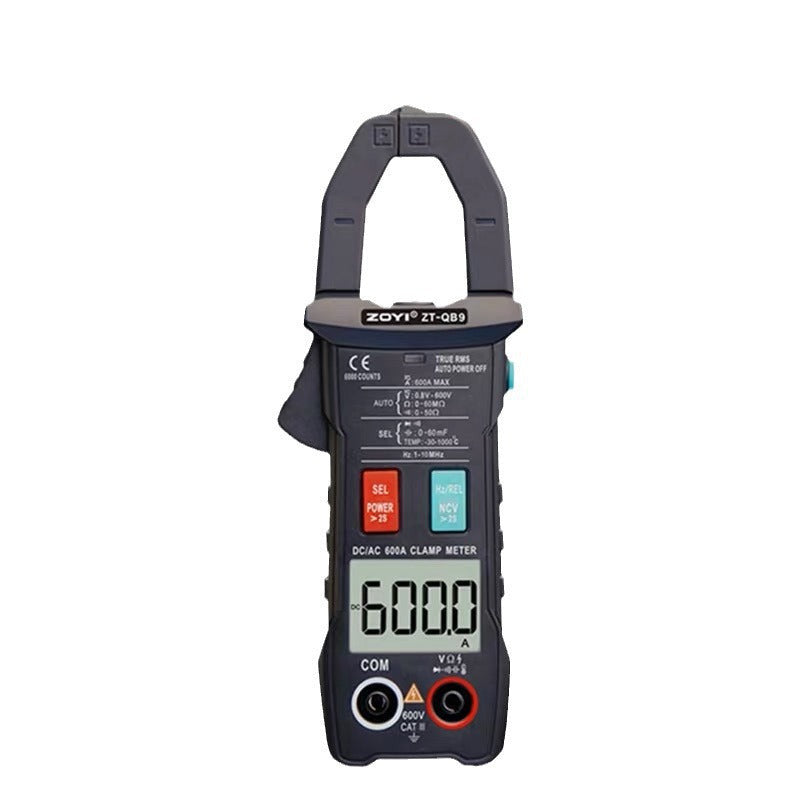
The ZOYI ZT-QB9 leakage clamp listing includes AC/DC clamp current up to 600 A, True RMS and a 6000-count display. Those figures describe important load-current capabilities. They do not, on their own, establish the resolution and accuracy needed to measure a small leakage current.
If leakage is the reason you are buying, begin with the expected milliamp range and ask for its detailed specification. The word “leakage” in a product name cannot replace that check.

ZOYI ZT-QB9 supplier product photograph. Displayed values are illustrative.
Convert the question into units
One amp is 1000 milliamps. A measuring range designed to accommodate hundreds of amps may or may not resolve the few milliamps relevant to a particular investigation. Display counts describe how many steps a range can show; the range scale and error specification determine what those steps mean.
Ask for the lowest usable current range, its resolution, accuracy and specified frequency conditions. Also establish any zeroing requirements and the effect of nearby conductors. Without those details, a small displayed number cannot be treated as a trustworthy small leakage measurement.
For example, 0.01 A equals 10 mA. That is a unit-conversion example, not a claim that the ZT-QB9 resolves 10 mA or measures it to a particular accuracy. Keeping the example separate from the instrument specification prevents a convenient decimal from becoming an invented feature.

Unit examples only • no ZT-QB9 milliamp-resolution claim
Define what goes inside the jaw
A load-current measurement around one conductor and a residual-current measurement around the relevant live conductors answer different questions. In the latter arrangement, opposing currents largely cancel and the remaining signal is the quantity of interest. The complete method depends on the circuit and must be undertaken by a competent person.
Nearby magnetic fields, jaw closure and conductor position can become significant when the signal being investigated is small. Repeat the setup and follow the exact model instructions. Do not compare a single-conductor load reading with a residual reading as if one were simply a lower version of the other.
What the confirmed ZT-QB9 functions contribute
The listed model supports AC/DC clamp current to 600 A, a backlit 6000-count screen, data hold and True RMS. Its additional voltage and component functions may be useful in a wider electrical kit. Verify their individual ranges and accessories for the intended job.
True RMS helps describe AC response within specified limits. It does not establish milliamp sensitivity. Likewise, NCV is not proof that a circuit is safe to touch, and a clamp reading is not an RCD trip-time or trip-current test.
Decide before commissioning the job
If your main requirement is general AC/DC load-current work, compare the confirmed current function and physical jaw access with that task. If you need a leakage investigation, obtain the missing low-range specification before choosing the instrument for it.
A useful purchase note states “required leakage range and accuracy: confirmed” alongside the exact model and document revision. That is a stronger basis for buying than assuming a 600 A headline covers every smaller current beneath it.
For the current specification and supplied version, see the ZOYI ZT-QB9 product page.
Explore the ZOYI ZT-QB9
See its functions, suitable tasks and key limits before choosing.