
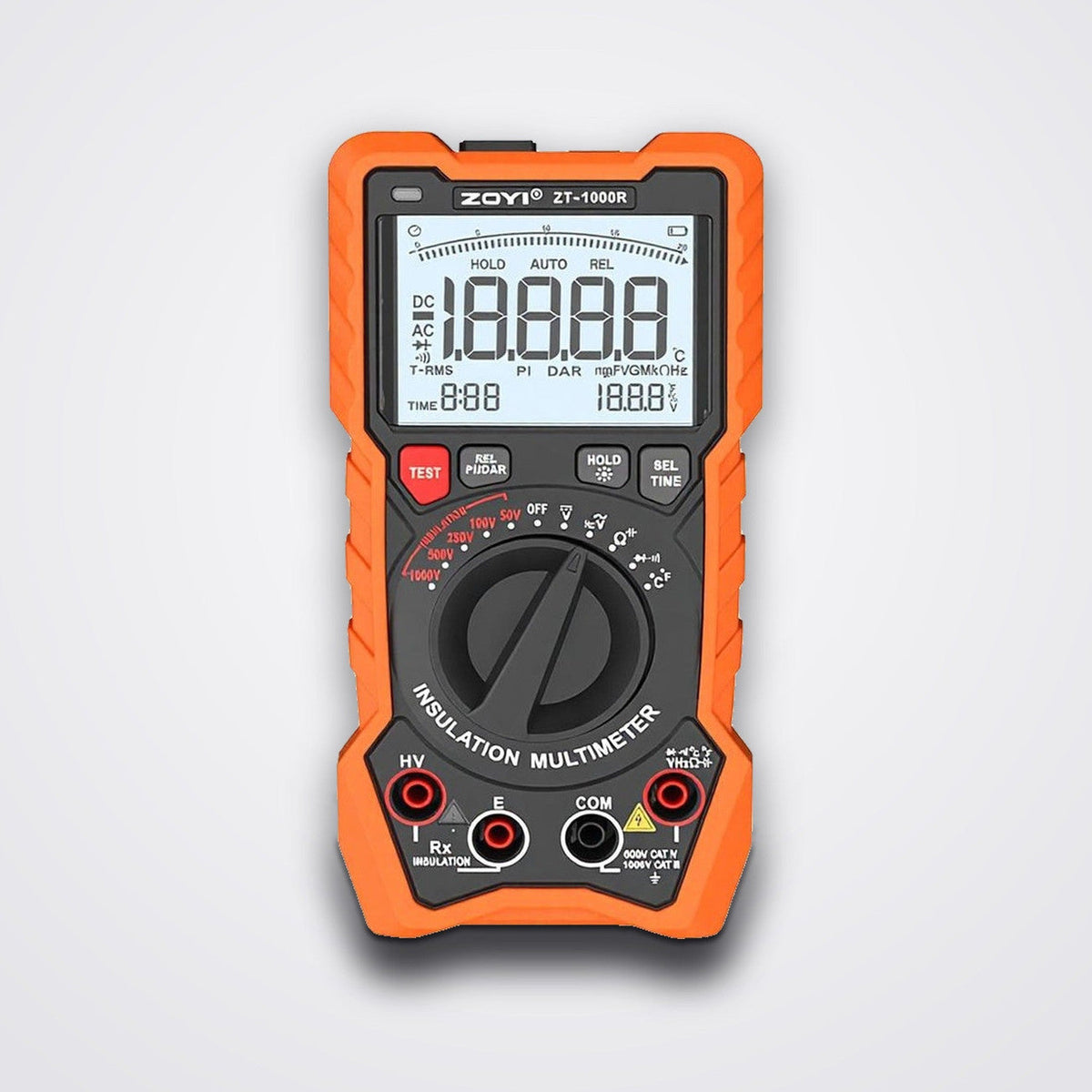
The ZOYI ZT-1000R offers five insulation test voltages: 50, 100, 250, 500 and 1000 V. Choosing between them starts with the equipment and its prescribed test procedure. The highest setting is not a general-purpose “more thorough” option.
An insulation test applies a test voltage and evaluates the resulting resistance. Equipment that tolerates one test condition may contain electronics or connected accessories that cannot tolerate another. Establish the correct configuration before connecting the tester.

ZOYI ZT-1000R supplier product photograph. Displayed values are illustrative.
Build the test from the asset instructions
Identify the asset, its rated use and the purpose of the test. A maintenance comparison, a cable investigation and a formal installation test can have different procedures and acceptance criteria. Obtain the applicable test voltage, connection arrangement and duration from the relevant instructions or standard.
Next identify everything connected to the circuit. Sensitive electronics, surge-protection components and other parallel paths may need a specific treatment or disconnection under that procedure. A low resistance can reflect a connected path rather than damaged insulation in the part you intended to examine.
Isolation, proving the equipment dead and controlling stored energy are part of preparation. The insulation tester then introduces its own test voltage. Keep the test area controlled and use the prescribed discharge and verification process afterwards, including where the asset can retain charge.

The highest voltage is not a default • isolate, test and discharge by procedure
Record more than the resistance number
A useful result includes the selected voltage, test points, asset configuration, test duration and relevant environmental conditions. Record the resistance unit carefully: MΩ and GΩ differ by a factor of 1000.
The ZT-1000R lists an insulation range up to 20 GΩ. A high endpoint helps define the instrument's measuring scope; it does not provide a universal pass mark. An over-range indication also needs its own interpretation rather than being copied as an exact resistance.
For a later maintenance comparison, reproduce the setup. Changing the voltage or connected equipment can make the new reading unsuitable for direct comparison with the previous record. Temperature and moisture can also influence insulation behaviour, so retain that context where the procedure calls for it.
Do not infer specialist modes from the product category
The model combines insulation testing with a listed 19999-count True RMS multimeter. That combination can reduce the instruments carried for some tasks, but its ordinary meter functions and insulation-output functions remain separate modes.
The reviewed information does not establish automatic polarisation-index or dielectric-absorption-ratio modes. If a PI or DAR workflow is required, verify that the exact model and procedure support the necessary timing and measurements. A marketing reference to insulation testing cannot settle that requirement.
A practical buying decision
Make a short requirement sheet containing the authorised test voltages, expected resistance range, required recording method and any mandatory certification or reporting requirements. Match the ZT-1000R to that sheet.
For qualified users following an equipment-specific procedure, the five selectable voltages provide options. Their usefulness comes from selecting the appropriate test and preserving its conditions, rather than working upwards until a reading looks impressive.
For the current specification and supplied version, see the ZOYI ZT-1000R product page.
Explore the ZOYI ZT-1000R
See its functions, suitable tasks and key limits before choosing.