
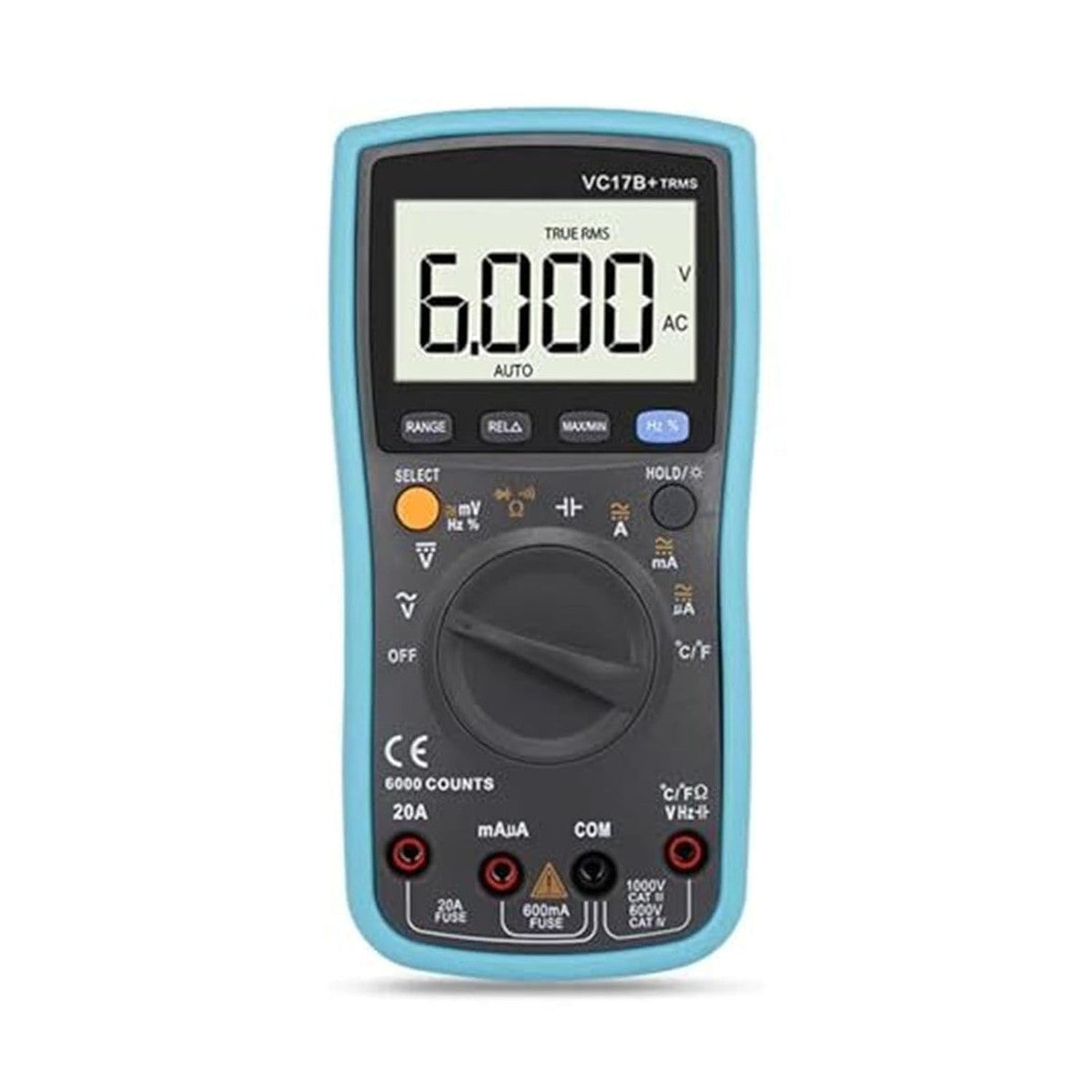
The ZOYI VC17B+ has REL and MAX MIN controls alongside its 6000-count True RMS meter functions. These controls can help compare readings, but only if you keep the baseline and capture period clear. A relative value, a maximum and the live absolute reading describe different things.
On an electronics bench, label the result before interpreting it: “absolute voltage”, “change from reference”, or “highest captured value during this observation”. That small habit prevents an apparently precise number from losing its meaning.

ZOYI VC17B+ supplier product photograph. Displayed values are illustrative.
Establish the absolute reading first
Select the appropriate function and inputs, inspect the test leads and confirm the expected range. On an accessible low-voltage setup, allow the reading to settle under a stated operating condition. Record the starting value before enabling an additional display mode.
The VC17B+ lists automatic ranging, voltage, current, resistance, capacitance, frequency, diode checks and temperature. These functions are not interchangeable. Current measurement uses a different circuit arrangement from voltage; resistance and component checks require the appropriate isolated conditions.
Treat REL as a reference, not a correction certificate
Relative mode is useful when the question concerns a change from a deliberately chosen baseline. Follow the supplied manual for its operation and permitted functions. Once a reference has been set, a near-zero display can mean “little difference from the reference”, not “no electrical quantity present”.
For a purely illustrative example, a baseline of 5.00 V followed by 5.04 V represents a change of +0.04 V. These figures demonstrate subtraction; they are not VC17B+ test results or an accuracy claim. Save the baseline as well as the difference so another person can reconstruct the observation.

Illustrative arithmetic • 5.04 − 5.00 = +0.04 V • not a VC17B+ test
Give MAX MIN a defined observation window
Note when capture starts, what load changes during the window and when you reset it. A maximum retained from an earlier setup can otherwise be mistaken for an event in the present one.
MAX MIN is also not a promise to catch every brief transient. The reviewed listing does not establish the capture timing or bandwidth. If a short event matters to the diagnosis, check those specifications and choose a suitable oscilloscope or recorder when required.

Supplier grip photograph of the VC17B+; the display is not a test result.
Keep temperature accessories and True RMS in context
The VC17B+ includes a listed temperature function, but the probe is sold separately or depends on the selected kit. Confirm compatibility and operating limits. Do not infer a numerical temperature range from the control label alone.
True RMS describes the supported AC measurement method. It remains subject to waveform, frequency and range limits in the operating specification. Display counts describe available digits; neither feature supplies a calibration certificate.
When choosing multimeter accessories, prioritise sound contacts, appropriate lead ratings and practical access. A better connection can make a comparison more repeatable, but it cannot fix a reference that was set under the wrong conditions. Return to the absolute reading at the end and leave a note of any captured or relative mode still active.
For the current specification and supplied version, see the ZOYI VC17B+ product page.
Explore the ZOYI VC17B+
See its functions, suitable tasks and key limits before choosing.