
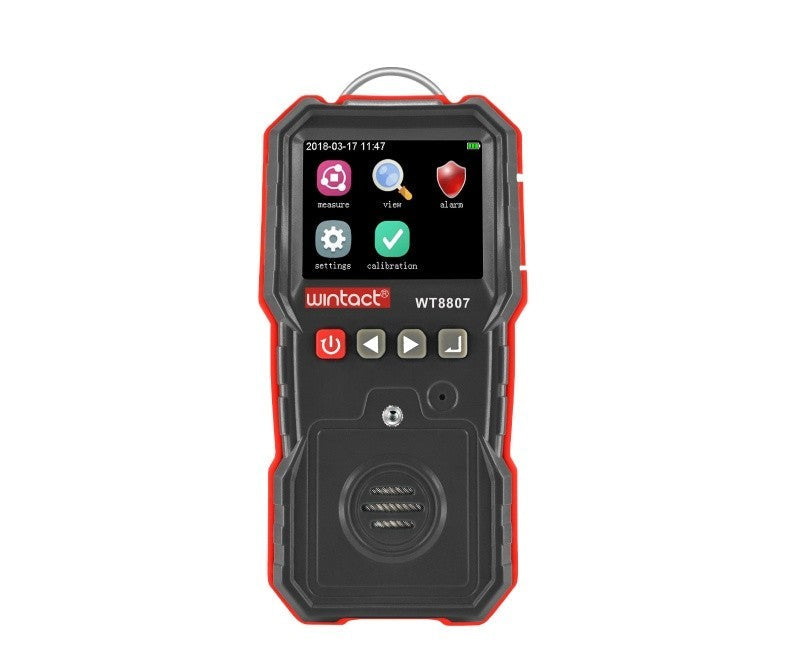
A quick walk from the kitchen to a home office can produce a neat list of CO₂ numbers and a misleading comparison. The Wintact WT8807 is a portable CO₂ monitor with a listed response to 90% of a change of about two minutes. An immediate reading after moving it may still reflect the previous room.
The useful approach is to slow the survey down, choose representative positions and record occupancy alongside the numbers. Portability makes it convenient to move the instrument; it does not remove its response time.

Why the first number can belong partly to the previous room
Sensors respond over time. The WT8807's stated T90 describes reaching approximately 90% of a step change under the specified conditions. It is not a promise that every real room observation becomes fully settled at exactly two minutes.
After moving the unit, allow the manufacturer-directed settling period and watch whether the value remains in motion. Do not use the largest or smallest number encountered during the walk as a room's representative value. Breathing directly over the inlet is another easy way to create a short local rise.
Choose a repeatable position
HSE's CO₂ monitor guidance recommends representative head-height positions away from doors, windows and supply openings, and more than 50 cm from people. Larger rooms may need more than one position.
For a home-office comparison, note where the instrument sits relative to the occupied desk. Keep it away from the user's immediate breath and repeat the same location. A photograph of the placement makes a later comparison easier.

Compare a room's story, not just its peak
Record the number of occupants, the approximate activity period and whether doors, windows or mechanical ventilation are operating. Then take observations through a representative occupied period. A room that feels stuffy after a meeting is a useful prompt to investigate ventilation, but the feeling is not a calibration reference.
For example, compare similar occupied periods with the usual ventilation arrangement and with an appropriate ventilation improvement. Keep other conditions as comparable as practical. Label the change explicitly so that a drop after everyone leaves is not credited entirely to an opened window.
HSE warns that snapshots can be misleading and that CO₂ is a broad guide to ventilation, not a demonstration of safe air. It also does not measure particles, carbon monoxide or every airborne contaminant.
Understand the units and stored record
The WT8807 listing gives a 0–10000 µmol/mol span. For this gas concentration expression, µmol/mol is numerically equivalent to ppm. Preserve the unit displayed in the original record and make any conversion label clear.
The listing describes up to 7,605 recorded points with review on the device. That is useful for looking back, but it does not establish PC export, a particular sampling interval or a cloud dashboard. Before planning a report, check how the actual unit timestamps, retains and displays its records. Copy or photograph the relevant screens if that is the supported route.
When a different instrument is needed
A portable CO₂ monitor chosen for ordinary occupied-room ventilation checks is not automatically suitable for hazardous CO₂ processes or oxygen-deficiency assessment. It is also unrelated to a domestic carbon monoxide alarm despite the similar abbreviation.
For everyday ventilation observations, the WT8807's value comes from a complete, well-positioned record. Allowing for its response time can improve that record more than collecting twice as many hurried readings.

See the Wintact WT8807 product page for the current version and kit, or read the Wintact WT8807 overview before choosing.