
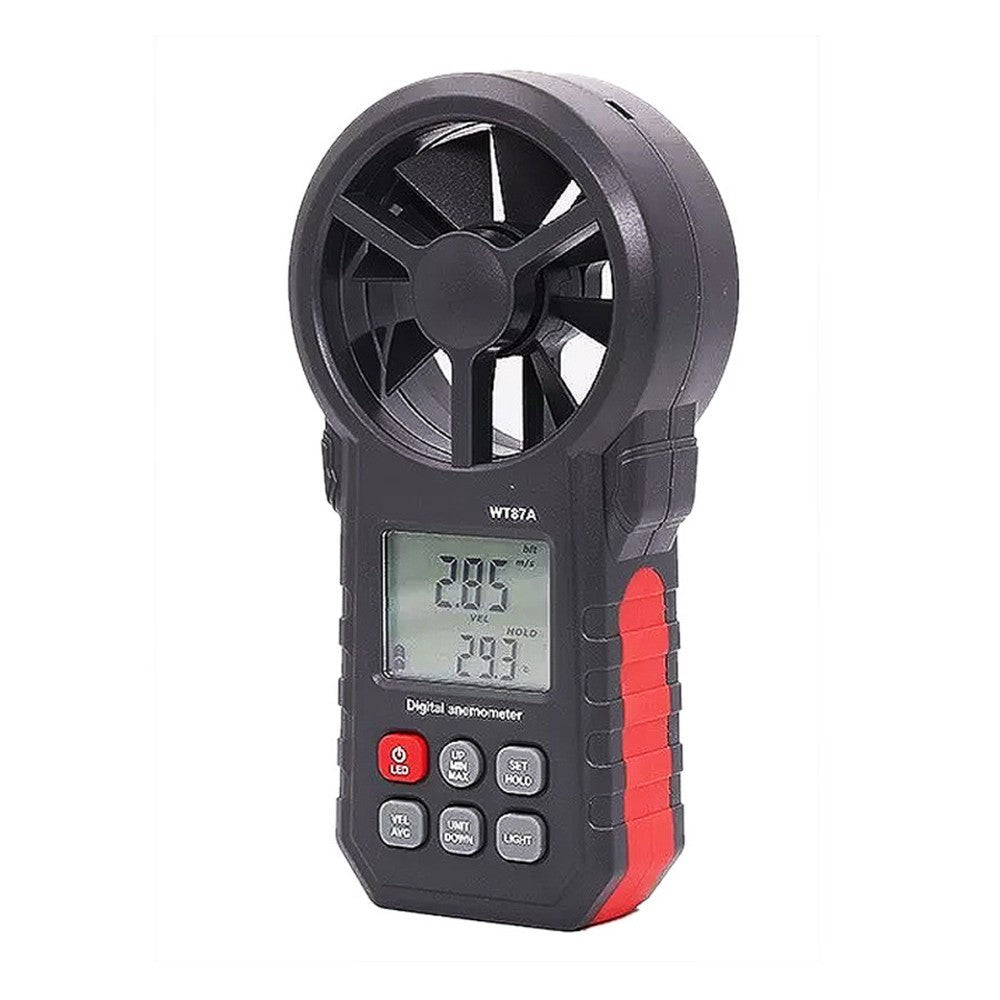
A sheltered garden corner and an open patch can feel very different in the same weather. The Wintact WT87A handheld anemometer can help compare those local conditions, provided the vane position, height and observation period are recorded. A short handheld reading is not directly interchangeable with the sustained wind or gust figure in a weather report.
The WT87A lists a 0–30 m/s air-speed range, current/MAX/MIN/AVG displays, air temperature, wind chill and Beaufort indications. Use those functions to describe the session you actually observed.

Keep the vane clear and record height, orientation and surroundings for a local comparison.
Decide what “wind here” means
Choose a purpose: comparing two seating areas, observing the effect of a fence or checking how exposed a particular accessible position is. Mark the location and height above ground. Keep the same height when comparing places, and note nearby walls, vegetation and buildings.
Weather discussions use terms such as sustained, gusting and AGL—above ground level. Those terms are useful reminders that wind readings have a time and exposure definition. A number held briefly at chest height beside a wall does not share the same method as a formally exposed weather-station observation.
Do not go onto a roof, ladder or hazardous location to imitate a weather station. Select safe positions that answer the local comparison you need.
Keep the vane and your body out of each other's way
Face the vane into the airflow and keep it clear. Your body, clothing and the meter's angle can disturb the air reaching the sensor. Use a consistent holding or suitable tripod arrangement and follow the manual's orientation guidance.
Near a wall or fence, turbulence can cause rapid changes in both direction and speed. Record that variability rather than repeatedly turning the vane until a preferred maximum appears. If the direction is changing too much for a comparable observation, describe the limitation and repeat under more suitable conditions.
The reviewed information does not establish rainproof operation. Protect the instrument from unsuitable weather and follow its environmental limits. A lanyard or carry case is not a waterproof rating.

Location map only. No wind values are invented, and a handheld session is not a formally exposed weather-station record.
Give MAX and AVG a defined session
Before each comparison, reset or initialise the summary functions as instructed. Use the same observation duration and identify its start and end. Check the manual for how the WT87A calculates AVG; do not assume that the label reproduces an official meteorological averaging interval.
| Session field | Record |
|---|---|
| Position | Location, height and nearby obstructions |
| Orientation | How the vane faced the airflow |
| Duration | Actual start/end or elapsed period |
| Readings | Current variation, MAX and AVG as supported |
| Conditions | Weather changes and any interrupted observation |
A retained MAX is the highest value captured under the instrument's response and sampling behaviour. It is not proof of the strongest gust that occurred anywhere nearby. A brief event may be represented differently by another instrument or method.
Compare locations without confusing time changes
If you measure the open patch first and the sheltered corner ten minutes later, changing weather can explain some of the difference. Return to the first position for another observation. If the reference position also changed substantially, be cautious about assigning the entire difference to the shelter.
Use m/s consistently in the record. The source's alternative unit endpoints are not internally equivalent, so this guide uses the primary 0–30 m/s span rather than repeating an unreliable conversion table. Check the actual unit shown before comparing values.
Match anemometer accuracy to the decision
The WT87A listing gives ±5% speed accuracy, but the conditions and basis require the current manual. Anemometer accuracy is only one contributor; poor exposure and inconsistent placement can dominate a local comparison.
Wind chill is a derived indication, not a measured object temperature. The WT87A also does not provide a direct volume-flow function. For ventilation balancing, formal weather records or safety-critical flight decisions, use the appropriate instruments, methods and external information.
See the Wintact WT87A product page for the current kit and the related environmental-instrument guide for broader selection context. A good garden comparison explains where, when and how the air was measured.
Explore the Wintact WT87A
See its functions, suitable tasks and key limits before choosing.