
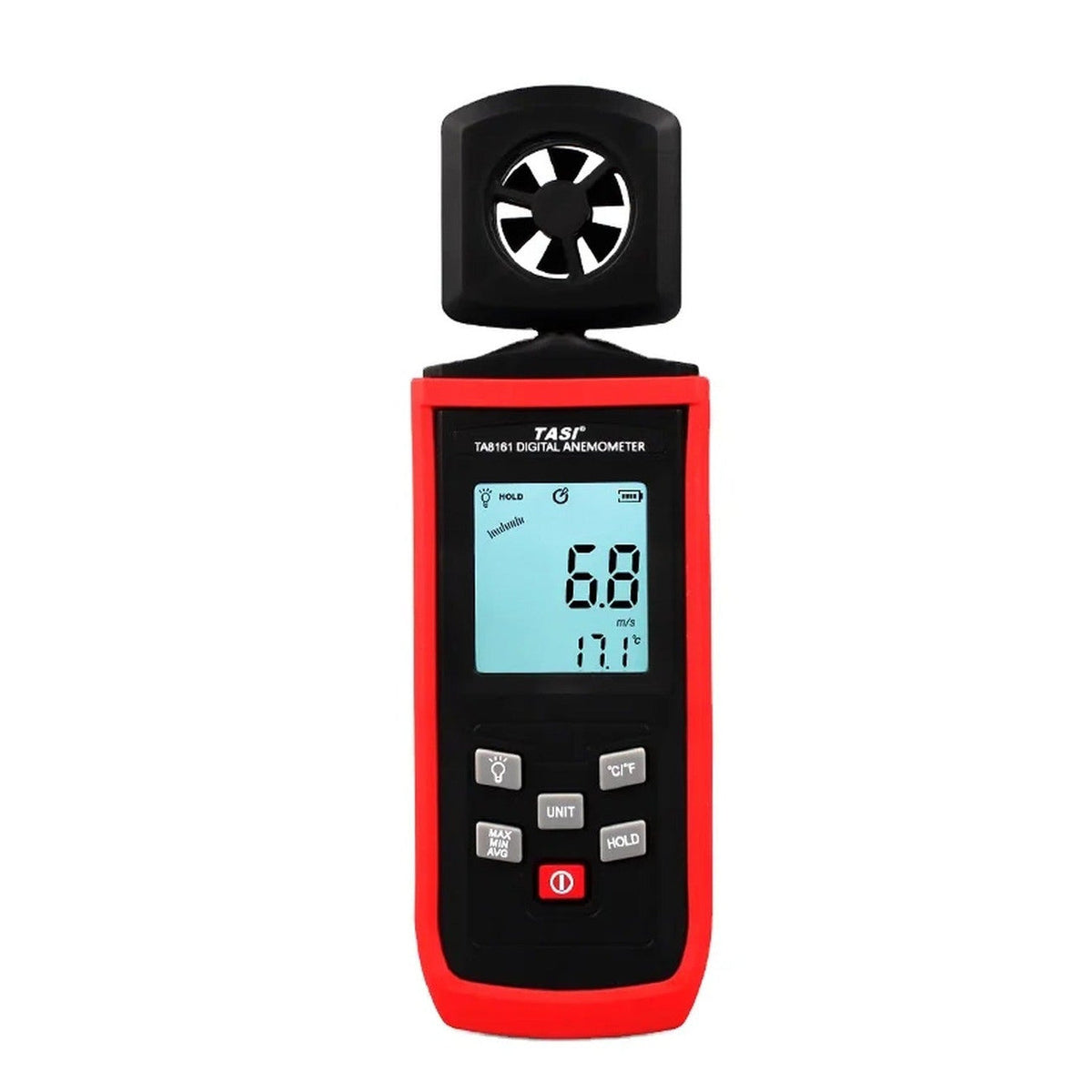
TASI TA8161 vane positioning starts with the space around the vent. Its vane sits above the display in the same body, so the sensor, your grip and the screen must all fit the measurement position. Check that arrangement before planning a comparison between outlets.
The TA8161 is an integrated-vane anemometer with wind-speed, temperature and air-volume readouts. Confirm the exact function settings and numerical specification for your task; the available description does not establish every range or calculation detail.

TASI TA8161 supplier product photograph. Displayed values are illustrative.
Check the access with the equipment safe
Plan a position that leaves the vane correctly oriented, your hand clear of the air path and the display readable. A deep recess or an angled grille can make those requirements difficult to satisfy together. Do not tilt the vane merely to see the number and then treat that reading as equivalent to a correctly aligned one.
A separate cabled probe can be more practical where the sensor and display need different positions. The TA8161 uses an integrated vane, so choose the format around the access you actually have. Use suitable access equipment and keep clear of moving fan parts; a compact meter does not make an unsafe reach appropriate.
Preserve one system state for the comparison
Identify the fan setting, damper positions and normal door or window arrangement. Record whether other outlets are open. Changing one part of a duct system can affect the rest, so keep the arrangement stable while comparing vents.
Let the system reach the operating condition relevant to the check. If it cycles, choose comparable parts of the cycle or document the cycle explicitly. A warm-up reading at one outlet and a steady-state reading at another are not equivalent observations.
Mark a repeatable measurement position at each vent. Record the vane's distance, orientation and height. Keep your body from blocking the approach or disturbing the flow as far as practical.

Supplier grip photograph, showing the vane above the main display.
Compare a small pattern, not only the fastest point
Flow can vary across a grille. Use a suitable sampling pattern for the application and record the individual observations. A central jet at one outlet should not be compared with an edge reading at another.
If you calculate a mean manually, use the same method and number of positions for both outlets. Do not assume that a stored maximum or held spot reading is a time average. Check the exact TA8161 instructions for any averaging functions you intend to use.
Repeat an outlet if the observations vary widely. A consistent spread may reflect real flow structure, while an unstable grip or changing fan state can create avoidable variation. Preserve that distinction in the notes.

Different grille areas can pass different flow at the same mean velocity
Different outlet sizes change the question
Velocity in m/s describes local speed. CFM or m³/h describes volume flow. Two differently sized vents can have the same representative velocity yet pass different volumes of air.
Before using an air-volume readout, confirm the area entry, area units and the appropriate effective area for the opening. The outer grille dimensions may not be the area required by the method. Do not infer a formal balancing result from a convenient display mode.
Temperature is another separate observation. A difference can describe the supplied air or the local mixing conditions, but it does not by itself establish the delivered heating or cooling power.
Use the result to choose the next check
A reproducible difference between outlets can justify investigating a grille, damper, duct restriction or system setting. It does not identify the cause automatically. Record what changed when you make a controlled adjustment, then repeat the original sampling pattern.
For a required ventilation assessment, establish the prescribed method and anemometer calibration evidence before starting. For a practical comparison, the TA8161 can help build a clear record when its verified specification fits the job. The strength of that record comes from keeping the two tests comparable.
For the current specification and supplied version, see the TASI TA8161 product page.
Explore the TASI TA8161
See its functions, suitable tasks and key limits before choosing.