
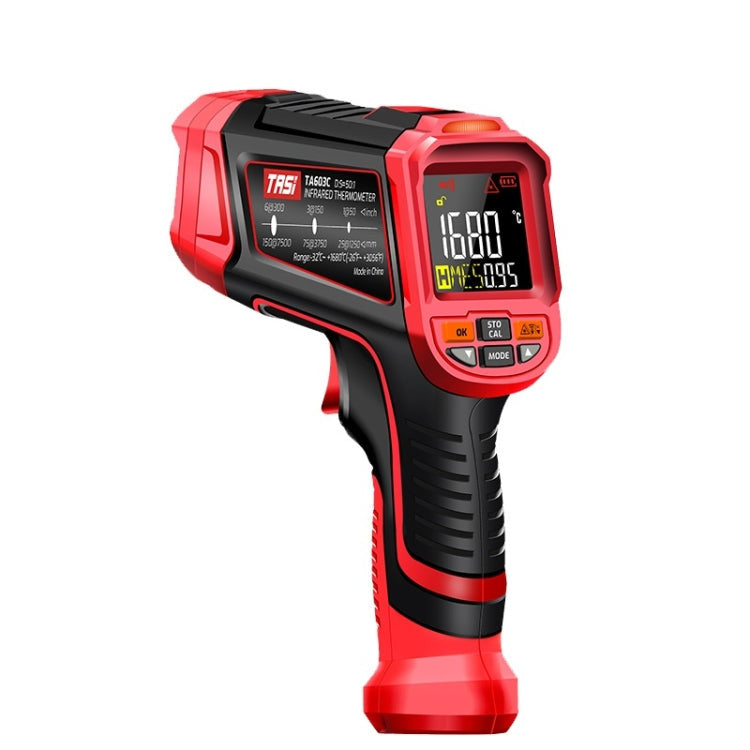
TASI TA603C stored temperature readings need a location key if they are to help on the next inspection. The instrument lists 255 groups of data storage, with STO/DATA controls. Decide which point belongs to each saved observation before walking a route of similar-looking surfaces.
A memory slot preserves a number under the instrument's storage method. It does not establish which bearing housing, pipe or process surface you measured, nor whether the next visit reproduced the conditions.

TASI TA603C supplier product photograph. Displayed values are illustrative.
Give the route a fixed sequence
Identify appropriate accessible surfaces and name the points on a sketch or photograph. Record the operating state relevant to the inspection. Follow a repeatable route and keep additional investigative readings separate from the planned sequence.
Run a short storage-and-recall trial first. Confirm how the exact TA603C saves, recalls and clears records. Do not assume automatic timestamps, computer export or unlimited history from the stated storage capacity. Keep an external record of date, point identity and settings where the instrument does not supply them.
Review each important saved value while you can still identify the location. A shifted sequence can otherwise attach every later temperature to the wrong asset.
Make the target reproducible too
The TA603C lists 50:1 distance-to-spot optics. At a nominal distance of 1000 mm, that ratio suggests a spot about 20 mm across; at 2500 mm, about 50 mm. These are geometry examples, not measured spot sizes or guarantees at every focusing distance.
The ratio is described at 90% energy, so allow sensible margin around the nominal spot and consult the optical diagram. A small hot target against a cooler background can give a mixed reading when the target does not fill the field. The laser point is not the complete measuring area.
Record distance and angle for each point, or establish a repeatable position. Safe access and the asset procedure still govern where you can stand.

D ÷ 50 = nominal spot diameter • geometry examples, not optical test results
Keep surface and emissivity information with the value
The TA603C offers adjustable emissivity from 0.10 to 1.00. Use a defensible surface method and retain the setting. Do not adjust emissivity simply until the display matches a preferred temperature.
Shiny metal can reflect surrounding infrared radiation. Different paint, contamination or surface finish can also complicate a comparison. If an observation is unexpected, repeat it and investigate the surface conditions before recording a fault conclusion.
An infrared thermometer measures the surface presented to its optics. It does not automatically measure through glass or establish an object's internal temperature.
Close the route with a readable record
Check the point sequence, save the necessary notes and retain any relevant reference-check information. On the next visit, reproduce the operating state and optical arrangement before comparing values. A changed distance or different target surface can create an apparent trend.
This is the TA603C, listed for −32 to 1680 °C. Similar-looking TA603A/B/D/E variants have different specifications. Choose the C model for its verified temperature, optics and storage requirements, then make the memory useful with a route record that another person can follow.
For the current specification and supplied version, see the TASI TA603C product page.
Explore the TASI TA603C
See its functions, suitable tasks and key limits before choosing.