
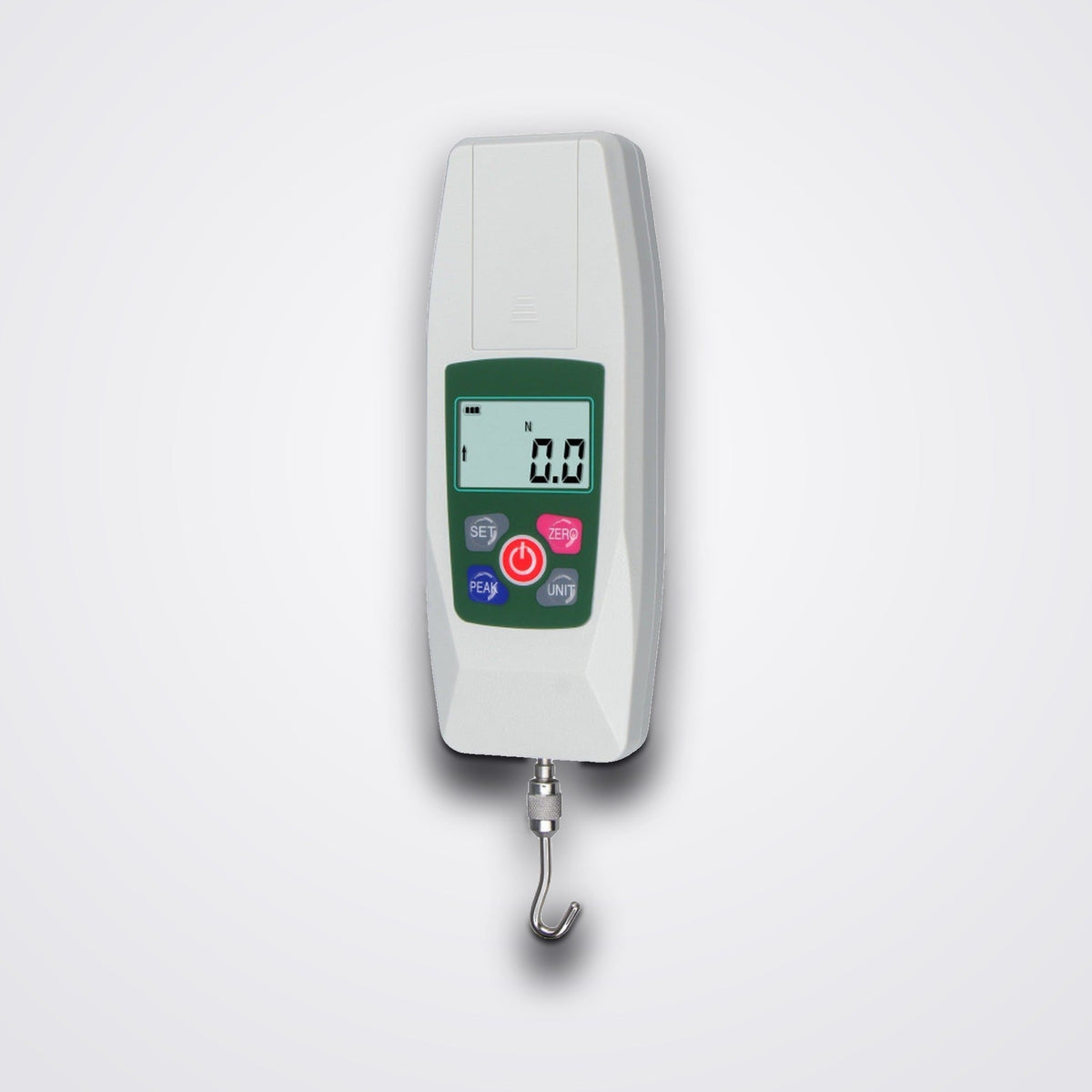
The KF-50 is a compact handheld push-pull force gauge with a green backlit LCD. A small pull test becomes useful when the load path, endpoint and repeat count are fixed. The product listing establishes the model and form, while the URL does not establish a complete 50 N specification.

KF-50 Force Gauge — supplier product view.

A second supplier view used to confirm the exact model and interface.
Describe the load before you pull
Reddit engineering searches use ‘max pull force gauge’, ‘pull force’ and the deliberately plain comparison ‘fish scale’; another answer calls the expensive version a load cell. Those phrases describe the reader’s problem, not this model’s capacity. State whether the test is a spring, latch, cable or printed part, and where the force should act.

Original workflow diagram: the record keeps setup, observation and boundary together.
Keep the load path straight
Mount or hold the gauge so the force is axial. Align the hook or adapter, remove side loading and define the point at which the reading is captured: breakaway, peak, working load or a steady pull. The white housing and display are visible in the store images, but no universal fixture or calibration certificate is established.
Repeat the same test
Run three or more pulls with the same starting position and speed as far as your fixture allows. Record direction, peak, unit, sample ID and any visible slip. If the first pull changes the part, treat that as part of the result and do not average it away.
Interpret a bounded observation
A force gauge can make a relative comparison legible. It does not turn a hand-held test into a certified tensile test. Confirm the supplied instructions, capacity and calibration needs for the exact KF-50 before relying on a limit.
Keep a record someone else can use
Write the fixture drawing before collecting a number. It should show force direction, attachment point, travel limit and endpoint. Record peak and settled force separately when both matter. If the part slips, tears or bends, keep that row and describe the failure.
A practical handover
Write down the exact model, the setup, the observation and the limit that still needs checking. For current version and buying information, use the KF-50 Force Gauge product page.
For the related product overview, see the KF-50 Force Gauge Learn More page.