
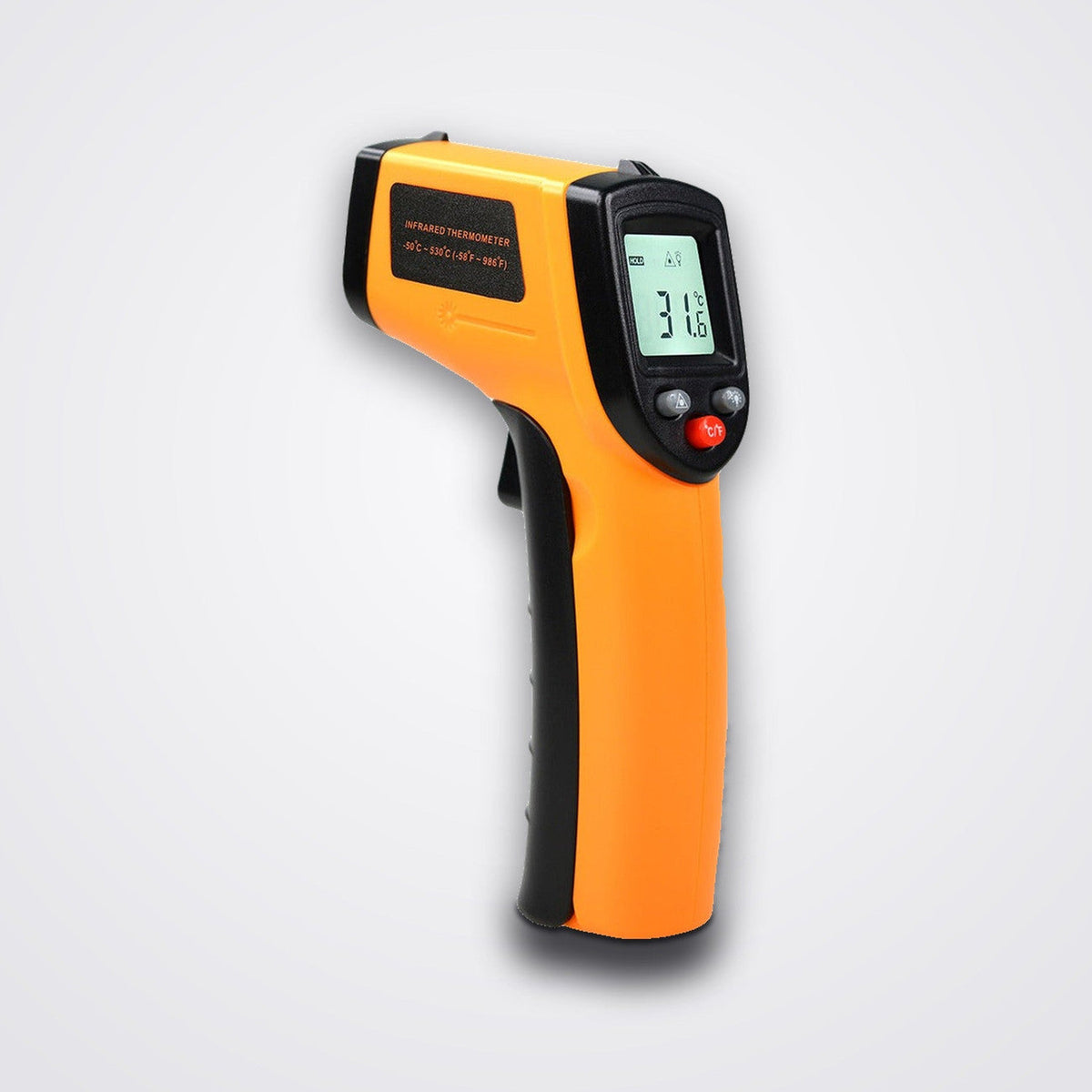
The BENETECH GM530 lists a surface-temperature range of −50 to 530°C and a response of about 0.5 seconds. That quick response is useful, but it does not define a complete scanning method. Sweeping past several different surfaces can make it unclear which target produced the number you recorded.
Give each observation a definite surface and a deliberate pause rather than treating the trigger as a continuous inspection record.

BENETECH GM530 supplier product image. Screen values and accessory layouts are illustrative; confirm the selected version.
Make a short route of named targets
Choose accessible surfaces relevant to the actual question. Identify the target boundary, finish and operating condition. A broad painted surface may be easier to assess consistently than a narrow reflective feature beside it.
Confirm the GM530's exact optical guidance, emissivity treatment and operating instructions before deciding how far away to stand. The response-time figure does not tell you the spot size or whether the target fills it. A laser aiming point does not outline the complete measurement footprint.
Pause long enough for an interpretable observation
Follow the manual's measurement sequence and allow the indication to respond to the chosen target. Watch whether the surface or operating condition itself is changing. The approximate 0.5-second statement is not a guarantee that every rapidly changing or poorly covered target will be represented accurately after exactly half a second.
Record the reading while the target remains identified. If you move between two surfaces, establish which value is retained and how the display updates before putting it in the notebook. Learn the behaviour on suitable stable targets before using a fast route on equipment.

GM530 surface checks do not establish internal temperature.
Separate surface checks from internal temperature
A temperature gun reports an infrared surface indication under its measurement conditions. It does not automatically measure the centre of food, the inside of a bearing or a component concealed behind a cover. Do not use the GM530's stated temperature range to extend it into a different measurement method.
For food-related work, a suitable contact or penetration method may be needed for the actual safety or cooking question. For equipment, a warmer surface can guide another investigation without proving a particular fault. Keep the follow-up appropriate to the task.
Informal temperature discussions use the convenient phrase “surface temp”. Keep that distinction in your own record: surface, location, conditions and method. The GM530's quick response then helps you move efficiently between defined observations, instead of producing a fast sequence of numbers whose targets have been lost.
For the current specification and supplied version, see the BENETECH GM530 product page.
For the related product overview, see the BENETECH GM530 Learn More page.