
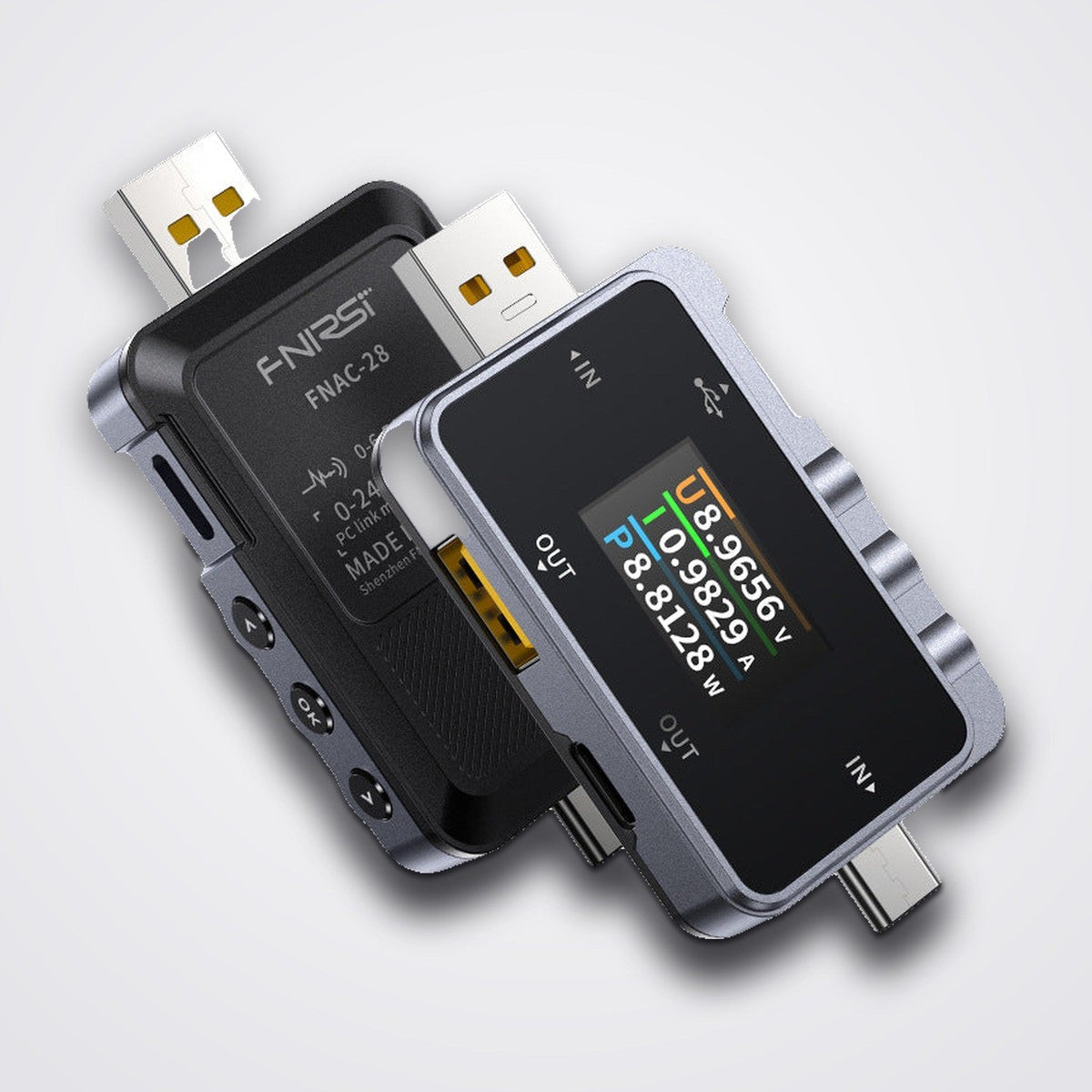
The FNIRSI FNAC-28 combines USB-A and USB-C connections with voltage, current, power, cable-resistance and battery-capacity functions. It lists 4–24 V, up to 6.5 A and up to 156 W, plus several fast-charge protocols. Those numbers describe the tester's stated operating envelope; they do not promise that every charger, cable and device will negotiate every listed protocol.
The useful first test is a controlled observation of one complete USB power path, with the protocol and direction kept visible.

Voltage, current and power answer different questions
Power is the product of voltage and current at the point and time measured. A charger can change voltage as a device negotiates a different profile, while current changes with the load. One screenshot of a final value cannot describe that sequence.
Record the connector route, active protocol if shown, voltage, current, power and observation time. If the tester displays a curve, retain the curve's units and interval rather than copying only the highest point.
The listed maximum of 156 W follows 24 V × 6.5 A as an arithmetic envelope. It is not a claim that every USB-C arrangement or cable can carry 156 W, nor that the tester is suitable for a higher-voltage EPR test.
Keep direction and connector roles clear
The FNAC-28 is described as bidirectional and includes USB-A and Type-C male/female connections. Check the actual direction, port and adapter arrangement before connecting. A plug that fits mechanically does not establish the data or power path you intend.
Use the tester within its voltage and current limits. Stop if a connector or cable warms unexpectedly. Do not use a 4–24 V, 6.5 A tester in a higher-voltage system because the Type-C connector looks similar.

Protocol detection is not a compatibility guarantee
QC2.0, QC3.0, FCP, SCP, AFC, VOOC/WARP and SVOOC are listed detection targets. The actual charger, device, cable and tester arrangement must support the negotiation. A protocol name appearing on a menu does not mean the attached phone or power bank will select it.
For a troubleshooting session, compare the same charger and cable with a known device, then change one item at a time. Record whether the negotiation occurred and what voltage resulted. A failure to reach a headline profile can be a device, cable, load or negotiation issue rather than a tester fault.
Use cable resistance as a separate observation
The FNAC-28 lists cable-resistance testing. Make sure the method and port arrangement are correct before interpreting the result. Connector contact, cable length and current path all affect what is observed. A resistance value does not prove the cable supports every protocol or wattage.
Likewise, a battery-capacity test in mAh needs its voltage and discharge conditions. For power banks, Wh can be a clearer comparison because mAh depends on the voltage at which it is quoted. Retain the original units and the test boundaries.
Build a safe, repeatable USB test
Start below the tester's limits with a known charger, cable and load. Confirm the display unit, direction and active path, then record the result. Avoid changing connectors while powered unless the equipment instructions explicitly support it.
When choosing a USB tester tool or USB voltage tester, look beyond the headline current and screen. A useful decision needs the complete path and protocol context. The FNAC-28 is most valuable when it helps reveal that context without asking the tester to carry a load outside its specification.

See the FNIRSI FNAC-28 product page for the current version and kit, or read the FNIRSI FNAC-28 overview before choosing.