
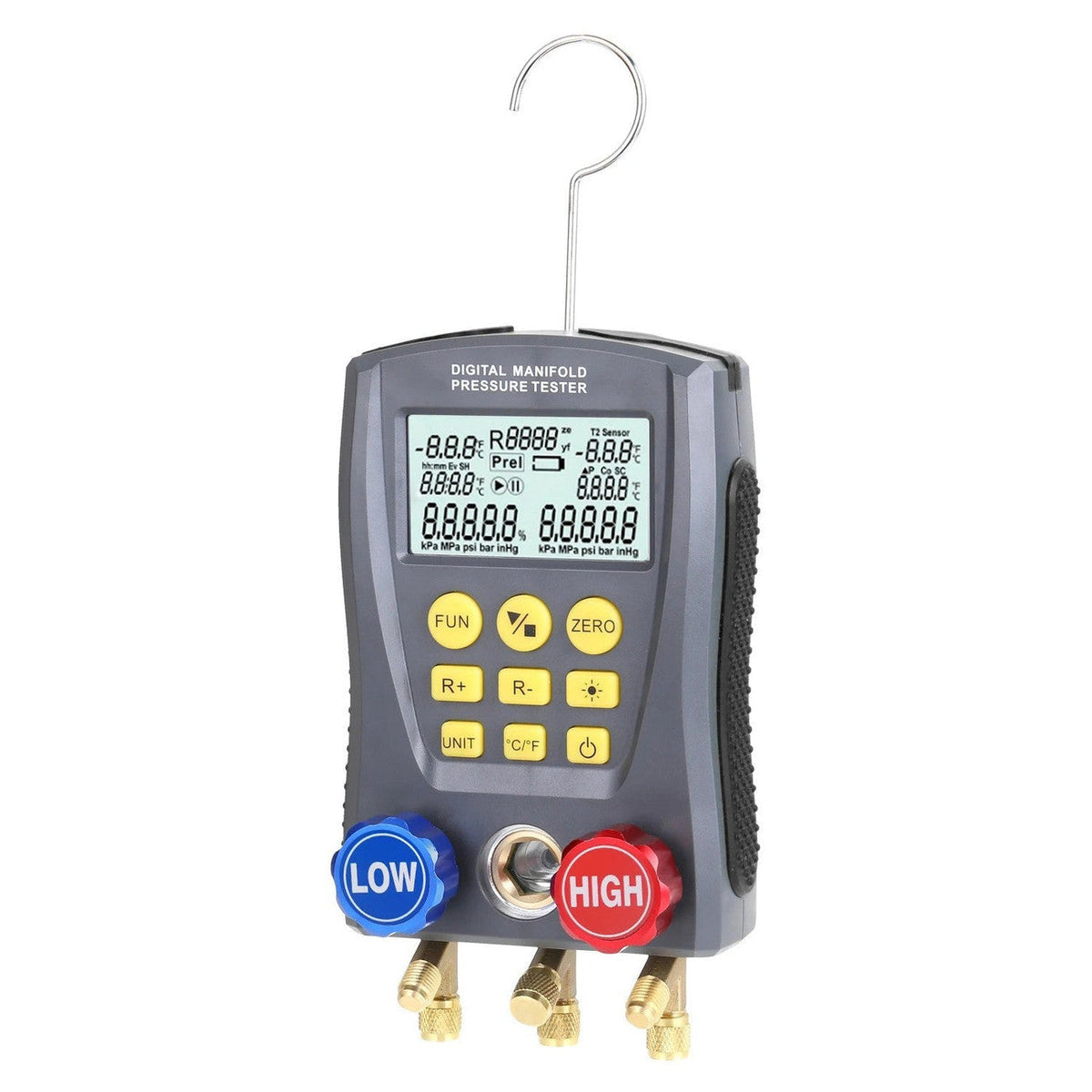
A digital pressure reading and a refrigerant-derived temperature are different pieces of information. The DY517 manifold has 89 built-in refrigerant profiles, English controls and 1/4-inch connections. Keep the selected profile in the same record as every pressure observation.
Selecting the wrong profile can make a plausible display difficult to interpret, even when the pressure transducer itself has responded normally.

DY517 supplier product image. Screen values and accessory layouts are illustrative; confirm the selected version.
Confirm the system and the instrument together
Refrigeration work needs appropriate competence, procedures and legal authorisation where applicable. Identify the actual refrigerant from reliable system records before connecting equipment. A profile menu is not a method of identifying an unknown gas.
Verify that the exact refrigerant, working pressure, hoses, seals and connection arrangement are supported. The count of 89 profiles does not establish compatibility with every refrigerant, blend or application. A 1/4-inch connection size alone does not settle pressure rating or refrigerant suitability.
Prepare and connect the equipment under the relevant procedure, including controls on release and exposure. This article explains the record, not a charging, recovery or commissioning sequence.

Supplier industry-context collage. The technicians are not verified as using the DY517; it is not a model-specific test photograph.
Record the selected profile explicitly
Write down the system identifier, refrigerant designation, low/high connection assignment, pressure units and operating state. Preserve the raw displayed pressure values alongside any derived temperatures so the original observations remain available.
For blends with temperature glide, the dew and bubble references require particular care. Refrigeration discussions use those words because the appropriate saturation reference depends on the calculation. Do not assume that an unlabelled temperature on a digital display is the one required by the service procedure.

A saturation temperature is not independently measured pipe temperature.
Check what the calculation actually needs
When assessing superheat or subcooling, use the appropriate refrigerant data, reference and independently measured line temperature under the system's procedure. A pressure-derived saturation temperature is not itself a measurement of the pipe surface.
Confirm the DY517's current instructions and display behaviour before relying on a specific automatic calculation. The shop description establishes the profile library and connection size; it does not provide a verified list of every supported gas or every software calculation.
If a result looks implausible, check the selected profile, units, connection assignment and system state before changing the charge. Preserve the original entry and any correction, rather than silently replacing a number that may explain the error.
The DY517's digital profile selection can help organise suitable refrigeration observations. Its most useful output is a pressure record tied to an identified refrigerant and defined method. That remains interpretable when a colleague reviews the job later, without having to guess which menu choice was active at the time.
For the current specification and supplied version, see the DY517 product page.
For the related product overview, see the DY517 Refrigerant Manifold Learn More page.