
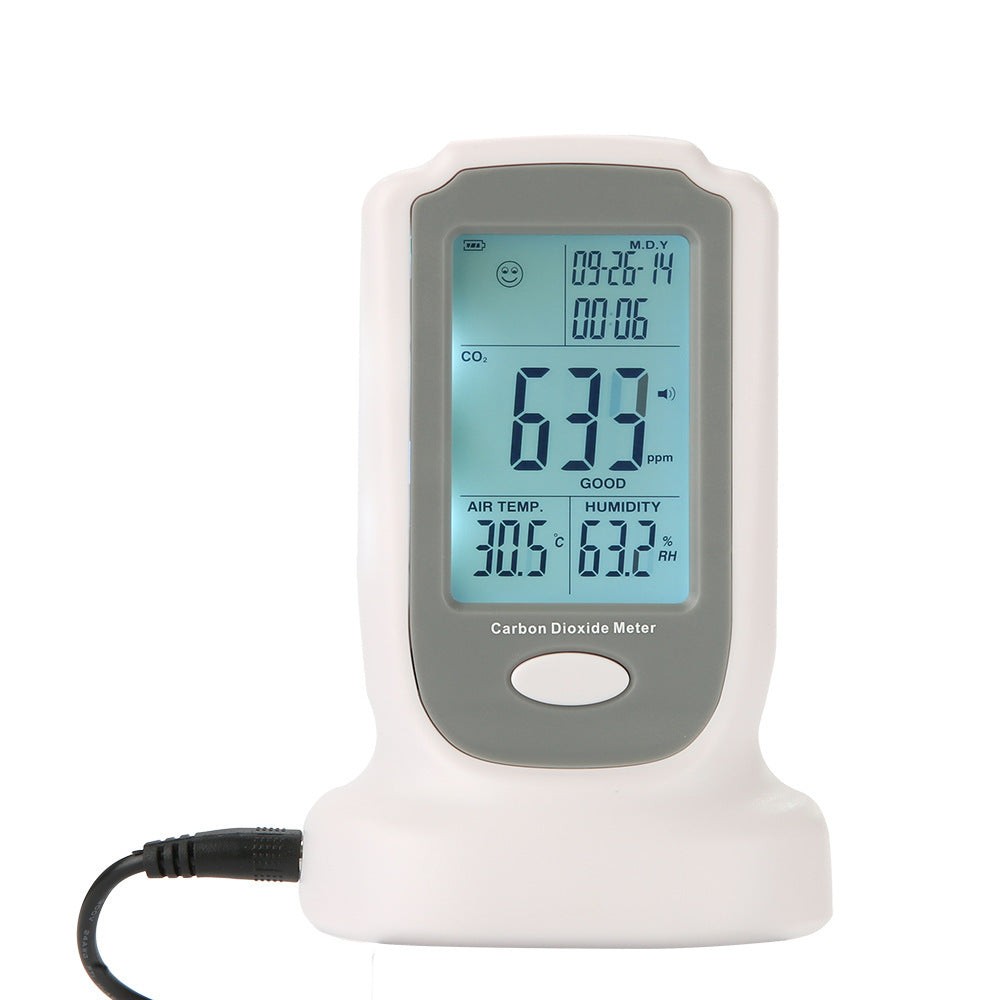
If a room feels stuffy, turning on a desk fan may make it feel better without bringing in more outdoor air. The BENETECH GM8802 CO₂ meter can help investigate that distinction in an appropriate occupied-room setting: air movement, particle filtration and ventilation are separate processes.
The GM8802 is listed as an NDIR carbon dioxide meter. It measures a specific gas, so its display should not be presented as a complete air-quality score.

Start with what each intervention changes
A recirculating fan moves the room's air and can improve comfort. A typical particle-filtering air purifier removes some airborne particles. Ventilation exchanges air with an outdoor or suitably supplied air source. The first two do not, by themselves, establish additional fresh-air supply or CO₂ removal.
This is why the community phrases CO₂ buildup, stuffy room and fresh air need a little explanation. They describe a useful concern, but not interchangeable measurements. A room can have moving air and still have inadequate ventilation for its occupancy.
Choose an observation that can answer the question
For a small occupied office, record the number of people and the ventilation state over a representative period. Place the meter where it can sample a representative part of the space, away from someone's immediate breath and direct supply or window airflow.
HSE's CO₂ monitoring guidance recommends head-height placement more than 50 cm from people, and warns that single snapshots can mislead. It also explains limitations in spaces with changing occupancy, process-generated CO₂ or air cleaning systems. CO₂ cannot be used to assess everything those systems may change.

Compare like with like
Suppose a room's reading falls after a window opens and everyone leaves. The change does not isolate the effect of the window, because occupancy changed too. Record both events rather than crediting the entire result to one intervention.
A more useful comparison keeps the occupied period and activity as similar as practical, then documents the ventilation change. Natural ventilation still varies with weather, so repeat observations may be needed. Label this as a practical observation, not a controlled experiment establishing an exact ventilation rate.
Understand what NDIR does not promise
NDIR identifies the listed CO₂ sensing method. It does not establish the calibration algorithm, automatic baseline behaviour or every accuracy condition of the specific meter. Follow the actual GM8802 instructions for calibration and settling.
The reviewed listing describes 0–2000 ppm as typical for the series, so that figure should not be treated as a confirmed maximum for every delivered GM8802 variant. If your intended observations may approach a limit, obtain the exact model's specification before purchase. Do not interpret a clipped or over-range reading as a stable real concentration.
Decide what needs a separate measurement
CO₂ does not measure fine particles, carbon monoxide or volatile compounds. An improvement on its screen cannot prove those other hazards have improved. Equally, a particle purifier may do its intended job without producing a CO₂ reduction.
For UK buyers comparing a CO₂ monitor, this distinction is more useful than a vague promise of “healthy air”. The GM8802 has a defined role in suitable ventilation observations, with placement, occupancy and the current model's limits kept visible.

See the BENETECH GM8802 product page for the current version and kit, or read the BENETECH GM8802 overview before choosing.